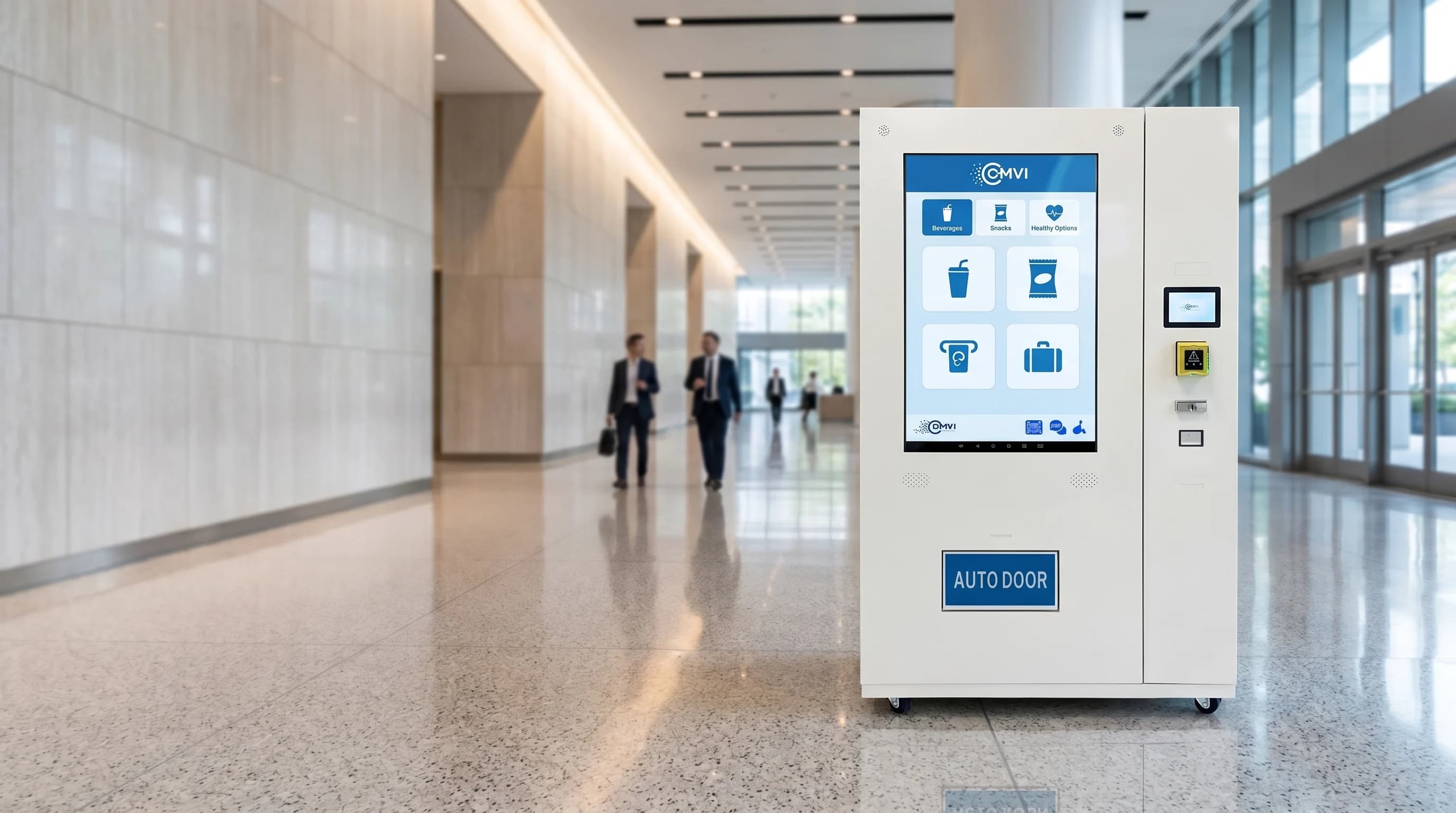
How to Scale a Vending Machine Business: Route Planning, Reinvestment, and When to Hire
Machine one is the test. Machine five is the business.
Current DMVI vending machine financing: DMVI no longer offers all-inclusive leases. Standard machine financing is subject to approval, with a 25%–50% machine deposit depending on stock status and the remaining machine balance paid in 12 monthly payments starting 30 days after shipment at 8%–15% interest, based on repayment ability and other approval conditions. The quote confirms the deposit percentage. All applicable upfront costs are due at signing, including the wrap, optional topper, payment terminal, annual software license, shipping, and sales tax. Financing is not guaranteed; DMVI reserves the right to deny financing. A UCC filing applies, and a personal guarantee may be required. See the vending machine financing terms for details.
Most operators who start with a single vending machine have the same experience: they spend the first three to six months learning how the machine actually operates, what the data tells them, which products are selling, and whether the location they chose is performing the way they expected. Some discover they chose wrong on one or more variables and adjust. Others find that the machine is producing exactly what the data suggested it would and start asking the same question: what happens when I do this again?
Scaling a vending machine business is not complicated, but it is sequential. Each stage depends on the evidence from the prior stage. Operators who skip the validation steps and scale prematurely end up with a multi-machine portfolio of problems rather than a portfolio of revenue. Operators who scale from evidence, at the right pace, with the right operational infrastructure in place, build businesses that compound.
This guide covers the growth path from one machine to a multi-machine route: when the data says you are ready, how to plan the geography of a growing route, how to fund the next machine from the revenue of the current one, how inventory management changes at scale, and when hiring a route employee becomes the right economic decision.
When the Data Says You Are Ready to Scale
The decision to add a second machine should come from the first machine's VendingTracker data, not from enthusiasm about the category or impatience with the pace of growth. The signals that indicate readiness to scale are specific.
Consistent revenue over at least 90 days. A machine that has produced consistent revenue for three to four months has demonstrated that the location, product mix, and pricing are working together. A machine that is three weeks into operation and showing promising numbers has not yet proven that the performance is durable. Scaling too early compounds any unresolved problems in the first machine into the second.
VendingTracker data showing the location is at capacity. If VendingTracker shows that top-selling slots are depleting faster than restocking can keep up, the machine is at or near its revenue capacity for the current format. This is a strong signal that either upgrading the current machine format (adding a larger-format machine at the same location) or adding a second machine at a new location will produce incremental revenue.
A validated second location. The second machine needs a location that has been evaluated with the same rigor as the first: verified foot traffic data, a written placement agreement with defined commission terms, and demographic alignment with the product. DMVI's vending machine prime location guide covers location validation in detail. A second machine without a validated location is capital committed to an unproven asset.
Financial readiness for the second machine. Scaling should be funded from the first machine's revenue or from retained capital, not from personal savings or debt that would not be recovered if the second location underperforms. The reinvestment model described below addresses how to structure the growth funding.
For operators in the Pokémon and TCG category specifically, DMVI's detailed guide to scaling from one to ten Pokémon vending machines provides a category-specific roadmap for the growth path. The underlying financial and operational principles apply across product categories.
The Reinvestment Model: How One Machine Funds the Next
The fundamental scaling mechanic in a vending machine business is reinvestment of machine revenue into the next machine purchase. This model works because the machine's revenue is recurring and predictable once the location and product mix are validated, making it a reliable source of capital for the next expansion stage.
The reinvestment calculation is straightforward: take the monthly net contribution from the operating machine, set a target number of months for accumulating the next machine's capital requirement, and determine whether the timeline is acceptable or whether additional external financing accelerates the path.
Example: To estimate how quickly one machine can fund another, subtract product costs, venue commission, restocking, overhead, and the actual approved monthly financing payment from sales. Divide the next machine's required deposit and signing costs by the cash you can realistically retain each month. This avoids using obsolete monthly-payment figures or assuming a fixed expansion timeline.
The multi-machine scaling path typically follows this pattern:
-
Machine 1: validate location and product at a conservative format (Wall-Mounted or Option 4)
-
Machine 2: add at a validated second location, funded from machine 1 revenue or DMVI financing
-
Machine 3: by this stage, two machines are generating combined revenue that funds the third while covering both existing machines' operating costs
-
Machines 4 and beyond: the compounding effect of multiple revenue-generating machines creates capital for faster subsequent additions
Route Geography: Driving Time and the Economics of Distance
The vending machine business is a physical business. Every machine requires a restocking visit. The distance between machines determines how much of the operator's time and cost goes into restocking logistics rather than into operations, marketing, or expansion.
The route radius principle. Experienced vending machine route operators typically keep their machines within a defined geographic radius, commonly 30 to 60 minutes of driving time from the operator's base. Machines within that radius can be visited and restocked efficiently as part of a single route day. Machines outside that radius require dedicated travel that produces disproportionate time cost relative to the revenue they generate.
Dense versus sparse routes. A route with 8 machines all within 20 minutes of each other is far more operationally efficient than a route with 8 machines spread across a 90-minute radius. The dense route allows the operator to visit multiple machines in a single restocking trip, share inventory in transit, and respond quickly to machine health alerts without significant travel cost. The sparse route treats each machine as a separate expedition.
Geographic expansion from an anchor. A practical scaling strategy is to establish a strong anchor placement, typically the highest-revenue machine in the portfolio, and then expand geographically outward from that anchor, adding machines within a compact radius before expanding further. This approach keeps the early-stage route dense, manageable, and efficient before geographic complexity increases.
VendingTracker route optimization. VendingTracker's real-time inventory data allows operators to plan restocking trips based on which machines actually need attention, rather than visiting all machines on a fixed schedule. For a growing route, this data enables trip planning that groups geographically proximate machines needing restocking while skipping machines that are still adequately stocked. The operational efficiency advantage of data-driven restocking compounds as the route grows.
See DMVI's why vending machines fail guide for a detailed breakdown of restocking mistakes, specifically the cost of schedule-based versus data-based restocking, that become more expensive as the route grows.
Inventory Management at Scale
A single-machine operator can manage inventory with relatively informal systems. At three or more machines, inventory management complexity increases in ways that require more structure.
Centralized inventory storage. As the route grows, maintaining a central inventory stock, a storage space or room where product is purchased in bulk and held for restocking runs, becomes more efficient than purchasing product per-machine, per-visit. Bulk purchasing from wholesale distributors typically produces better per-unit costs, and centralized storage enables efficient packing for each restocking run.
SKU standardization across machines. Wherever possible, standardizing the core product mix across machines in the same product category reduces inventory management complexity. A portfolio of gaming venue machines all carrying a consistent set of core TCG SKUs requires managing one replenishment cycle rather than tracking different mixes across each machine independently. VendingTracker's multi-machine dashboard shows inventory across all machines simultaneously, making standardized management practical.
Differentiated assortment by venue type. Standardization works for core SKUs, but venue-specific assortment differences require tracking. A gaming venue machine and a hotel lobby machine in the same operator's portfolio serve different demographics and carry different product mixes. VendingTracker's planogram management by machine enables the operator to track the differentiated assortments without conflating inventory across incompatible venue types.
Spoilage and expiration management. As inventory volume grows, the risk of product approaching expiration without being sold increases. Regular VendingTracker sales reports by SKU make slow movers visible before they become expiration problems. Building a monthly inventory rotation check into the operational routine, identifying slow-moving SKUs and either discounting them via VendingTracker's remote pricing or removing them from the planogram, reduces spoilage losses across a larger portfolio.
Multi-Format Scaling: When Different Venue Types Require Different Machines
Scaling a vending machine business does not always mean adding more of the same machine. As the route grows, different venue types may enter the portfolio, each requiring a different machine format to perform optimally.
An operator who starts with a Wall-Mounted machine at a gaming store may expand to an Option 4 (21,995) to maximize the revenue potential of that higher-footprint location.
Managing a portfolio with multiple machine formats. Wall-Mounted units in space-constrained venues, Option 4 at mid-tier entertainment venues, and M1 at premium placements, is one of the advantages of the DMVI lineup. All formats run on VendingTracker, so the operator sees all machines in one dashboard regardless of format. The revenue, inventory, and health data for a wall-mounted gaming store machine and an M1 mall deployment are both visible in the same interface.
DMVI's revenue share versus flat rent decision guide is relevant at this stage, as different venue types have different standard deal structures. Understanding when each structure is more favorable becomes increasingly important as the portfolio includes venues with different characteristics.
When to Hire: The Restocking Employee Decision
Most vending machine operators start as solo operators, handling all restocking personally. At some point in the scaling process, the route becomes large enough that the operator's personal restocking time is the binding constraint on further growth. This is the point at which hiring a part-time or full-time route employee becomes economically justified.
The break-even calculation for route hiring. The decision to hire comes down to whether the labor cost of the hire is covered by the additional revenue that the freed operator time enables. If the operator is spending 20 hours per week on restocking that a hired employee could handle at 400 per week), and that freed time enables the operator to add one additional machine generating $2,000 per month in net contribution, the hire pays for itself within the first week of additional machine revenue.
The hire makes economic sense when: the operator's restocking time cannot be reduced further through VendingTracker-based trip optimization; the route has grown to the point where the operator cannot also handle location prospecting, machine maintenance, supplier management, and business development; and the labor cost of a route employee is clearly covered by the incremental revenue that the freed capacity enables.
What a route employee handles. Restocking visits, basic machine maintenance and cleaning, refilling cashless payment system paper rolls or confirming hardware status, and flagging any machine health concerns for the operator's attention. Route employees do not require specialized vending knowledge, the VendingTracker dashboard and clear restocking protocols provide the information they need to complete restocking visits correctly.
The documentation requirement. A route employee cannot operate efficiently without documented procedures: what to restock in what quantities, what to check for in terms of machine condition, what to report and how, and what to do if a machine has a problem. Building this documentation before hiring is what makes the hire productive from day one rather than a training project.
Digital Media Vending International and Scaling Operators
Digital Media Vending International supports operators through the full scaling journey, from the first Wall-Mounted machine at $4,995 to a multi-format portfolio including Option 4 and M1 machines at premium placements. VendingTracker's multi-machine dashboard is specifically designed for operators managing more than one machine, providing a unified view of revenue, inventory, and machine health across all deployed units.
DMVI is a Made in California certified manufacturer, founded in 2009, with more than 2,000 deployments across 22 countries. DMVI no longer offers all-inclusive leases. Standard machine financing is subject to approval, with a 25%–50% machine deposit depending on stock status and the remaining machine balance paid in 12 monthly payments starting 30 days after shipment at 8%–15% interest, based on repayment ability and other approval conditions.
Visit digitalmediavending.com to discuss machine options and financing for the next stage of your route.
Financial Modeling for Route Growth
Growing a vending machine business without a financial model is the equivalent of driving without a map. The model does not need to be complex, but it needs to exist before capital is committed.
The scaling financial model has four components: current route contribution, cost of the next machine addition, projected contribution from the new machine, and the timeline to portfolio breakeven after the addition.
Current route contribution: total monthly net contribution from all operating machines combined, after product cost, venue commissions, machine financing, and restocking costs. This is the operating cash flow available for reinvestment.
Cost of next machine addition: Include its purchase price or required financing deposit, all signing costs, initial inventory, and any site setup costs. If financing is approved, add the exact payment from its 12-month schedule to the route budget.
Projected contribution from new machine: estimated gross revenue at the new location, minus product cost, minus venue commission, minus incremental restocking cost. This should be modeled conservatively, using the lower end of realistic ranges for the venue type and product category, not optimistic projections.
Timeline to portfolio breakeven: Model how long the expanded route takes to recover its additional upfront cash outlay. The new machine must cover its own operating costs and approved financing payment before it improves route cash flow. Use conservative sales assumptions rather than assuming the first machine's performance will repeat.
Building this model before each machine addition keeps the scaling decision grounded in financial reality rather than enthusiasm. Operators who model each addition make fewer additions they regret.
Conclusion
Scaling a vending machine business is a sequential process that rewards patience, evidence-based decision making, and operational discipline. Machine one is the proof of concept. Each subsequent machine should be funded by confirmed performance, placed at validated locations, and added to a route with geographic discipline that keeps logistics manageable.
Digital Media Vending International's machine lineup. Wall-Mounted through M-Series, and VendingTracker software are built to scale with the operator. Start the conversation at digitalmediavending.com.
Sources
-
DMVI — Building a Pokémon Vending Machine Route: From 1 to 10 Machines in 24 Months
-
DMVI — Why Vending Machines Fail: The Operational Mistakes That Cost Operators Real Revenue
-
DMVI — Revenue Share vs. Flat Rent for Pokémon Vending Machines: Which Deal Structure Wins?
-
GetBiopak — The Ultimate Guide to the Vending Machine Business in 2026
Ready to scale beyond one machine?
DMVI helps operators plan machine formats, financing, and software visibility before adding more locations.