Revenue Share vs. Flat Rent for Pokémon Vending Machines: Which Deal Structure Wins?
DMVI purchase financing: Subject to approval and not guaranteed; DMVI reserves the right to deny financing. A 25%–50% machine deposit is required depending on whether the machine is in stock, with the percentage specified in your quote. The remaining machine balance is paid in 12 monthly payments with 8% simple interest. All upfront costs are due at signing, including the wrap, optional topper, payment terminal, first-year software subscription, shipping, sales tax, and other quoted upfront charges. A UCC filing applies, and a personal guarantee may be required. See vending machine financing and your approved agreement for details.
TL;DR: Revenue share (10–20% of gross sales) lowers placement friction but costs more at high-revenue locations. Flat rent ($100–$500/month) costs more upfront but lets operators keep all the upside. For a machine generating $10,000/month: revenue share at 15% = $1,500 to the venue; flat rent at $400/month = $400. At that revenue level, flat rent wins by $1,100/month. For uncertain new locations, revenue share reduces your downside risk. Once you've proven the location, convert to flat rent at renewal.
Every time you negotiate a spot for your Pokémon vending machine, you face a choice: revenue share or flat rent? Most operators pick one structure and stick with it for every location. The best operators choose the structure that maximises their net revenue at each specific location.
This isn't a philosophical debate — it's math. The right deal structure can be worth thousands of dollars a month at a high-performing location. Get it wrong at a mall, and you could be handing over $2,000–$5,000/month in unnecessary commissions on a machine that earns $25,000+. Get it wrong at a new, unproven barbershop, and you could be paying $300/month flat rent for a machine earning $800.
This guide walks through how each structure works, the exact break-even math at every revenue level, when to propose each structure, and how to negotiate hybrid deals for high-revenue placements. If you're evaluating Pokémon vending machines for sale and want to understand what your placement costs will actually look like, start here.
Section 1: How Each Structure Works
Revenue Share
Under a revenue share agreement, the venue receives a percentage of your gross vending revenue each month. This is the most common structure for first-time placements, especially with venue owners who have never hosted a vending machine before.
- Typical range: 10–20% of gross monthly sales
- How it's calculated: Your machine's total sales for the month × the agreed percentage
- Example: Machine generates $8,000 in May → venue receives $1,200 at 15%
- Transparency: VendingTracker transaction data provides a full audit trail, so there's no dispute about what the machine earned
- Venue risk: Zero. If the machine doesn't sell, they get nothing — but they lose nothing either
- Operator risk: Low upfront, but your cost scales directly with success. The better your machine performs, the more you pay
Revenue share is the "easier yes" in negotiation. Venues that are hesitant about taking on a fixed cost are far more willing to say yes when they understand they only get paid when the machine sells. It removes their fear of backing a concept that doesn't work.
Flat Rent
Under a flat rent agreement, the venue receives a fixed monthly fee regardless of how much the machine earns. This is the structure you want to be in at every high-revenue, proven location.
- Typical range: $100–$500/month for most venue types
- Mall kiosks: $500–$1,500/month
- Barbershops and small retail: $100–$250/month
- FECs and arcades: $200–$500/month
- Venue risk: If the machine underperforms, they still get paid — which is why venues sometimes push for this at uncertain placements
- Operator risk: Higher fixed monthly cost, but unlimited upside above the rent amount
Flat rent lets you build a predictable P&L. Your location costs are fixed; your gross margin on Pokémon packs runs 59–61%; and every dollar of revenue above your break-even is yours. At a machine generating $25,000/month, the difference between 15% revenue share ($3,750) and a $400 flat rent is $3,350/month — $40,200/year you keep instead of paying out.
Section 2: The Break-Even Math
The break-even crossover point is the monthly revenue level at which flat rent and revenue share cost the same. Above that point, flat rent wins. Below it, revenue share is cheaper (and safer).
Table 1: $300/Month Flat Rent vs. Revenue Share
| Monthly Revenue | Flat Rent $300 | Rev Share 15% | Rev Share 20% | Winner (vs. $300 flat) |
|---|---|---|---|---|
| $1,000 | $300 | $150 | $200 | Revenue share |
| $2,000 | $300 | $300 | $400 | Break-even / Rev share |
| $3,000 | $300 | $450 | $600 | Flat rent |
| $5,000 | $300 | $750 | $1,000 | Flat rent |
| $10,000 | $300 | $1,500 | $2,000 | Flat rent (saves $1,200/mo) |
| $25,000 | $300 | $3,750 | $5,000 | Flat rent (saves $3,450/mo) |
| $87,000 | $300 | $13,050 | $17,400 | Flat rent (saves $12,750/mo) |
Crossover point: At a $300 flat rent, revenue share beats (or ties) flat rent only up to ~$2,000/month. Above $2,000/month, flat rent is the financially superior deal — and the gap widens dramatically as revenue scales.
That $87,000 row isn't theoretical. DMVI has documented a single operator in the San Francisco Bay Area hitting $87,000/month on one machine. At 15% revenue share, that operator would be paying $13,050/month in commissions. At a $300 flat rent, they pay $300. That's a $12,750/month difference — $153,000/year.
Table 2: $750/Month Flat Rent vs. Revenue Share (Mall-Grade Locations)
Mall placements command higher flat rents. Here's how the math shifts at that level:
| Monthly Revenue | Flat Rent $750 | Rev Share 15% | Winner |
|---|---|---|---|
| $2,000 | $750 | $300 | Revenue share |
| $5,000 | $750 | $750 | Break-even |
| $8,000 | $750 | $1,200 | Flat rent |
| $25,000 | $750 | $3,750 | Flat rent (saves $3,000/mo) |
Crossover point at $750 flat rent: Revenue share is cheaper below $5,000/month. Above $5,000/month, flat rent saves money — and a mall machine doing $8,000–$25,000+/month in Scarlet & Violet era product is entirely realistic. Strong locations with high foot traffic and the current momentum behind sets like Destined Rivals and Mega Evolution can push well past this threshold.
Stat callout: DMVI operators report monthly revenues ranging from $6,000–$7,000 (conservative) to $25,000–$30,000 (strong) to a peak of $87,000 at a single Bay Area location. At strong-performer revenues ($25,000), switching from 15% revenue share to a $750 flat rent saves $3,000/month — $36,000/year.
Section 3: When Revenue Share Is the Right Choice
Revenue share is not the "bad" deal structure. In the right context, it's exactly the right move.
New location with unproven traffic. You're negotiating a spot in a venue you haven't operated before. You don't have data on foot traffic, buyer demographics, or whether Pokémon product moves in that market. Revenue share removes your downside. If the machine earns $1,500/month, you pay $225 at 15% — not $400 in flat rent on a machine that isn't justifying its cost yet. Check our guide to best Pokémon vending machine locations to assess foot traffic quality before you commit to a deal structure.
Hesitant venue owners. The venue owner has never hosted a vending machine. They don't know what to expect. Revenue share removes the fear of making a bad bet — they can only gain, and they understand the logic immediately. It dramatically increases your placement conversion rate.
Short-term or trial agreements. Many operators structure the first 60–90 days as a trial period. Revenue share matches the trial spirit: you're both testing the concept, and both parties share in the outcome, whether strong or weak.
Seasonally variable locations. Event venues, pop-up markets, seasonal retail, and similar locations have highly variable traffic month to month. Revenue share aligns your costs with the actual business reality. A venue that draws 8,000 people for a holiday market but 400 people in February shouldn't be charging flat rent on February traffic.
Section 4: When Flat Rent Is the Right Choice
Once you know what a location can do, flat rent is almost always the move.
High-traffic, proven location. You've operated the machine for 3–6 months. You have real VendingTracker data showing $8,000+/month in consistent sales. This is exactly the moment to propose converting to flat rent at the next renewal. The venue has seen the machine work; you have leverage because removing the machine is now a loss for them too. See our post on how to negotiate a vending machine location agreement for specific language to use in this conversation.
Strong negotiating position. If you brought the concept to the venue, if you've proven demand, and if you're generating visible revenue — you have leverage. Use it to convert from percentage to fixed.
Building a predictable P&L. Operators running multiple machines prefer flat rent because it produces fixed, forecastable costs. Your machine lease, inventory cost, processing fees (~5%), and location rent are all known quantities. Variable revenue share costs make financial planning harder as you scale.
Venues with multiple tenants. Retail centers, malls, and multi-tenant properties often prefer flat rent because it's administratively simpler — no need to audit your VendingTracker reports or verify monthly sales figures. A flat monthly invoice is frictionless for their accounting team.
Rule of thumb: Once your machine exceeds $4,000–$5,000/month consistently for two consecutive months, use the renewal conversation to propose a flat rent conversion. If the venue resists, offer a hybrid structure (see Section 5).
Section 5: Hybrid Structures
A hybrid deal is increasingly common at high-revenue placements where the venue isn't willing to accept a flat rent outright but the revenue share exposure has grown uncomfortably large.
Structure: Flat base + over-threshold revenue share
- "We pay $400/month flat, plus 10% of revenue above $5,000"
- The venue gets guaranteed base income regardless of performance
- The operator caps their cost at the flat rate until a defined threshold
- Above that threshold, the venue participates in the upside
Example: Machine generates $15,000/month
- Pure 15% revenue share: $2,250 to venue
- Hybrid ($400 flat + 10% above $5,000): $400 + 10% × $10,000 = $400 + $1,000 = $1,400 to venue
- Operator saves $850/month compared to pure revenue share
When to use it: Venues that have seen strong machine performance and won't accept flat rent — they know the machine earns well and want to participate in the upside. The hybrid structure gives them a floor and lets them share in exceptional months without costing you as much as a straight percentage at scale.
This is also a useful bridge structure when transitioning from pure revenue share at an established location. Propose the hybrid as a middle step if the venue is resistant to going fully flat.
Section 6: Norms by Venue Type
Deal structures vary by venue category. Here's what operators are typically seeing in the market:
| Venue Type | Common Structure | Typical Range |
|---|---|---|
| Shopping mall | Flat rent or % of sales | $500–$1,500/mo or 10–15% |
| Barbershop | Flat rent | $100–$300/mo |
| FEC / arcade | Revenue share | 15–20% |
| Card shop | Flat rent or informal | $100–$300/mo |
| Airport | % of revenue (negotiated with authority) | 15–20% |
| University | Flat rent or % | $200–$500/mo |
Notes by venue type:
- Malls have professional property management with formal lease processes. DMVI provides direct mall introductions and placement strategy support — a significant advantage over going in cold. Expect formal licensing agreements rather than handshake deals.
- Barbershops and card shops are often informal. The owner is easy to reach, the deal is simple, and flat rent at $150–$250/month is usually accepted without much negotiation. These are great starter locations.
- FECs and arcades already understand the revenue share model from their redemption machine operators — it's familiar to them, which makes it an easy conversation. Getting to flat rent here takes more convincing.
- Airports and universities typically have procurement or licensing offices with set rate cards. Expect 15–20% with little room to negotiate structure.
For a deeper look at which locations produce the strongest returns, see our Pokémon vending machine best locations guide.
Ready to Structure Your First Deal?
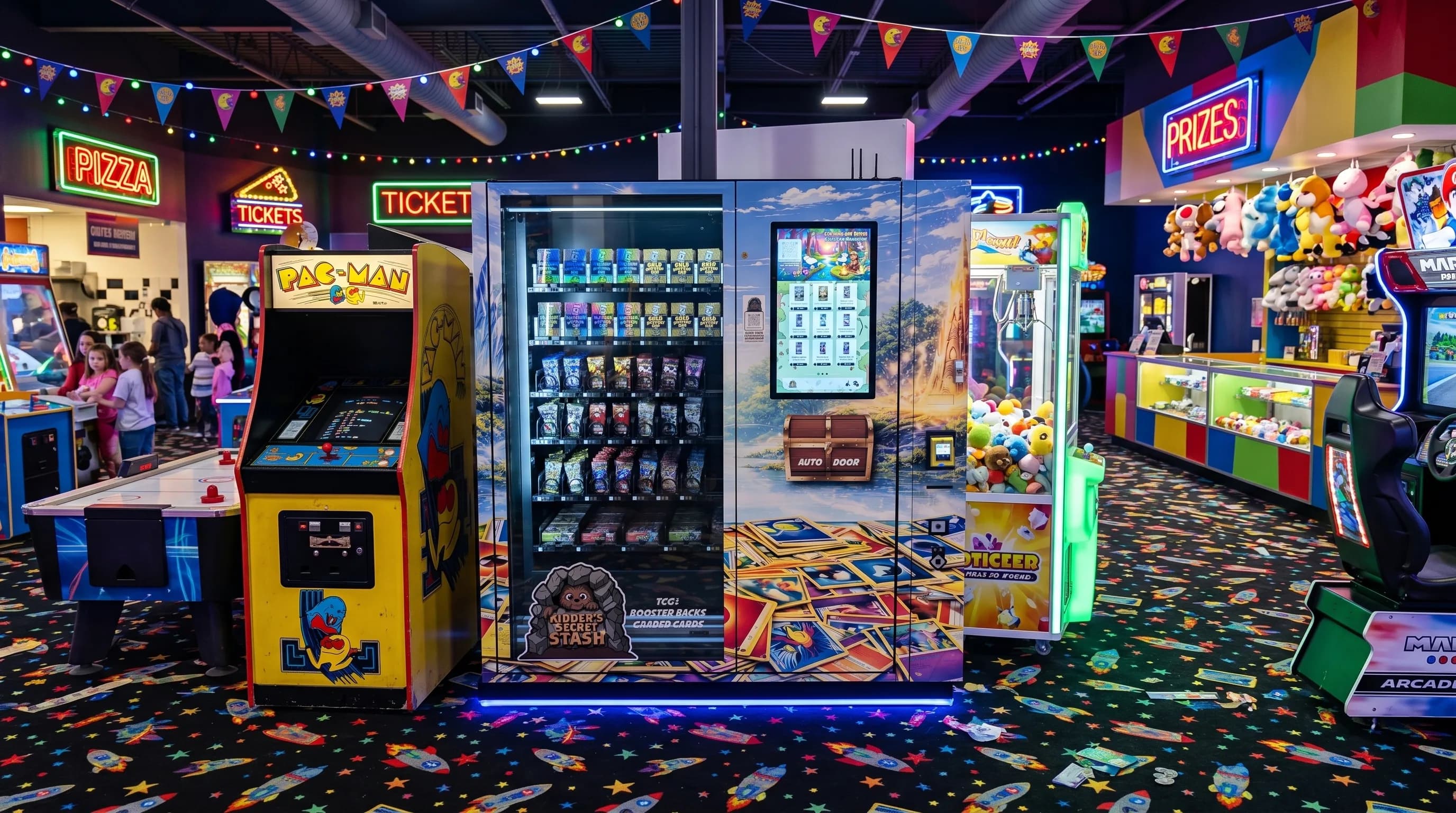
The location fee structure is one lever. The machine you put in that location is the other. DMVI's M1 cabinet — the workhorse of serious operators — supports up to 140 SKUs, runs on VendingTracker cloud management (which makes your revenue share reporting fully transparent and auditable), and is available from $625/month all-inclusive on a lease. That means your break-even math at any location starts with a known, predictable cost.
Browse DMVI's Pokémon card vending machines to see machine formats and request current pricing or a financing review.
If you're working through the broader business model before committing to a deal structure, our Pokémon vending machine ROI and profit calculator post runs the full P&L math from machine cost through net margin at every revenue level.
Want pricing, format guidance, or a launch plan?
DMVI can help you compare Pokemon vending machine formats, rollout strategy, financing, and location fit based on your route goals.