
How to Start a Pokémon Vending Machine Business: The Complete 2026 Operator Guide
DMVI purchase financing: Subject to approval and not guaranteed; DMVI reserves the right to deny financing. A 25%–50% machine deposit is required depending on whether the machine is in stock, with the percentage specified in your quote. The remaining machine balance is paid in 12 monthly payments with 8% simple interest. All upfront costs are due at signing, including the wrap, optional topper, payment terminal, first-year software subscription, shipping, sales tax, and other quoted upfront charges. A UCC filing applies, and a personal guarantee may be required. See vending machine financing and your approved agreement for details.
TL;DR: To start a Pokémon vending machine business, form an LLC, purchase or lease a smart vending machine designed for collectibles (starting at $4,995 for a wall-mounted unit), secure a high-traffic location such as a mall or arcade, open accounts with authorized distributors, and stock core SKUs like booster packs and Elite Trainer Boxes. Total startup costs range from $8,000 to $30,000 depending on machine size and inventory level. Conservative operators generate $6,000–$7,000/month; top performers exceed $87,000/month.
Introduction
The global trading card market has crossed $15 billion and shows no signs of slowing. Unlike most retail categories, this one comes with a built-in repeat-buyer cycle: collectors do not buy once and walk away. They return every week — for new sets, new pulls, and the next chase card.
Most entrepreneurs who want a piece of this market face the same problem: they know the opportunity is real, but they do not know where to start. How do you get access to authentic Pokémon inventory? What machine do you need? How do you land a mall placement?
This guide answers every one of those questions in sequence. Whether you are starting from zero or you already own a card shop and want to expand, here is the complete playbook for launching a Pokémon vending machine business in 2026.
Section 1: Is This a Real Business?
The short answer: yes — and the revenue data backs it up.
Based on field deployments tracked by Digital Media Vending International (DMVI), operators running a single M1 machine report the following monthly revenue ranges:
- Conservative scenario: $6,000–$7,000/month (net ~$4,300–$5,300 after machine lease, rent, and processing fees)
- Strong scenario: $25,000–$30,000/month (net ~$23,250–$28,250)
- Peak (proven): $87,000 in a single month — achieved by one operator in the San Francisco Bay Area with a single M1 deployment
Those are not projections. They are operator-reported figures from active machines in the field.
What makes this business model structurally sound is the buyer behavior. A collector who pulls a rare card from your machine comes back next week. New Pokémon sets release multiple times per year, and each release creates a demand spike. The customer acquisition cost is effectively zero — the product itself drives repeat visits.
The machine operates 24 hours a day, seven days a week, with no staff. You check inventory remotely, restock on your schedule, and collect revenue.
For TCG store owners, DMVI offers a partnership model built specifically for expansion — putting your branded machine in malls with your existing inventory, no additional staff required.
Section 2: The Two Paths Into This Business
Before choosing a machine, you need to choose your business model. There are two distinct paths.
Path A — Independent Operator
You buy or lease a machine, find your own locations, open accounts with authorized distributors, and keep 100% of the revenue. This is the standard route for entrepreneurs entering the category without an existing retail presence.
The upside: full control, full margin. The trade-off: you are building from scratch — location relationships, distributor accounts, and operational systems all need to be set up.
Path B — TCG Store Expansion
If you already own a card shop, you have a significant head start. You have existing distributor relationships, established inventory systems, and brand recognition in your local market.
DMVI's M1 machine is purpose-built for this scenario. The pitch is simple: "Your Store. Every Mall. No Extra Staff." Your branded machine goes into a high-traffic mall location, stocked with your existing inventory, generating automated revenue around the clock without touching your current store's operations.
One important clarification: the Pokémon vending machines you see in Kroger and Albertsons are owned and operated by The Pokémon Company International (TPCi) and are not available for purchase. They are a proprietary retail program. Independent operators source their machines from manufacturers like DMVI — purpose-built smart vending hardware designed specifically for cards and collectibles. You can view DMVI's machine formats here.
Section 3: Step-by-Step Launch Checklist
| Launch Step | What You Need to Lock In | You're Ready to Move On When |
|---|---|---|
| Business setup | LLC, bank account, tax setup, insurance plan | The entity exists and you can accept revenue cleanly |
| Machine format | Wall-mounted, Option 4, or M1 based on venue and budget | The cabinet matches your target location type |
| Placement pipeline | 10-20 target venues, pitch materials, follow-up process | You have active conversations instead of a vague wish list |
| Inventory sourcing | Distributor applications, opening order, storage plan | You can restock without relying on retail markups |
| Pricing and telemetry | Nayax, VendingTracker, initial price ladder | You can monitor sales and adjust from day one |
| Operating rhythm | Restock cadence, route day, reorder triggers | The machine can run without constant firefighting |
Follow these steps in order. Skipping steps — especially the legal and sourcing steps — creates problems that are difficult and expensive to fix later.
1. Form your LLC
Before you spend a dollar on a machine, set up your business entity. File an LLC in your state (typically $50–$500 depending on the state), obtain your EIN from the IRS (free, done online), open a dedicated business bank account, and apply for a resale certificate in your state. The resale certificate is what allows you to purchase inventory at wholesale without paying sales tax — it is essential for your distributor accounts.
2. Choose your machine format
DMVI's line-up covers three primary entry points for Pokémon operators:
- Wall-Mounted unit at $4,995 — compact, ideal for barbershops, card shops, or lower-traffic secondary placements
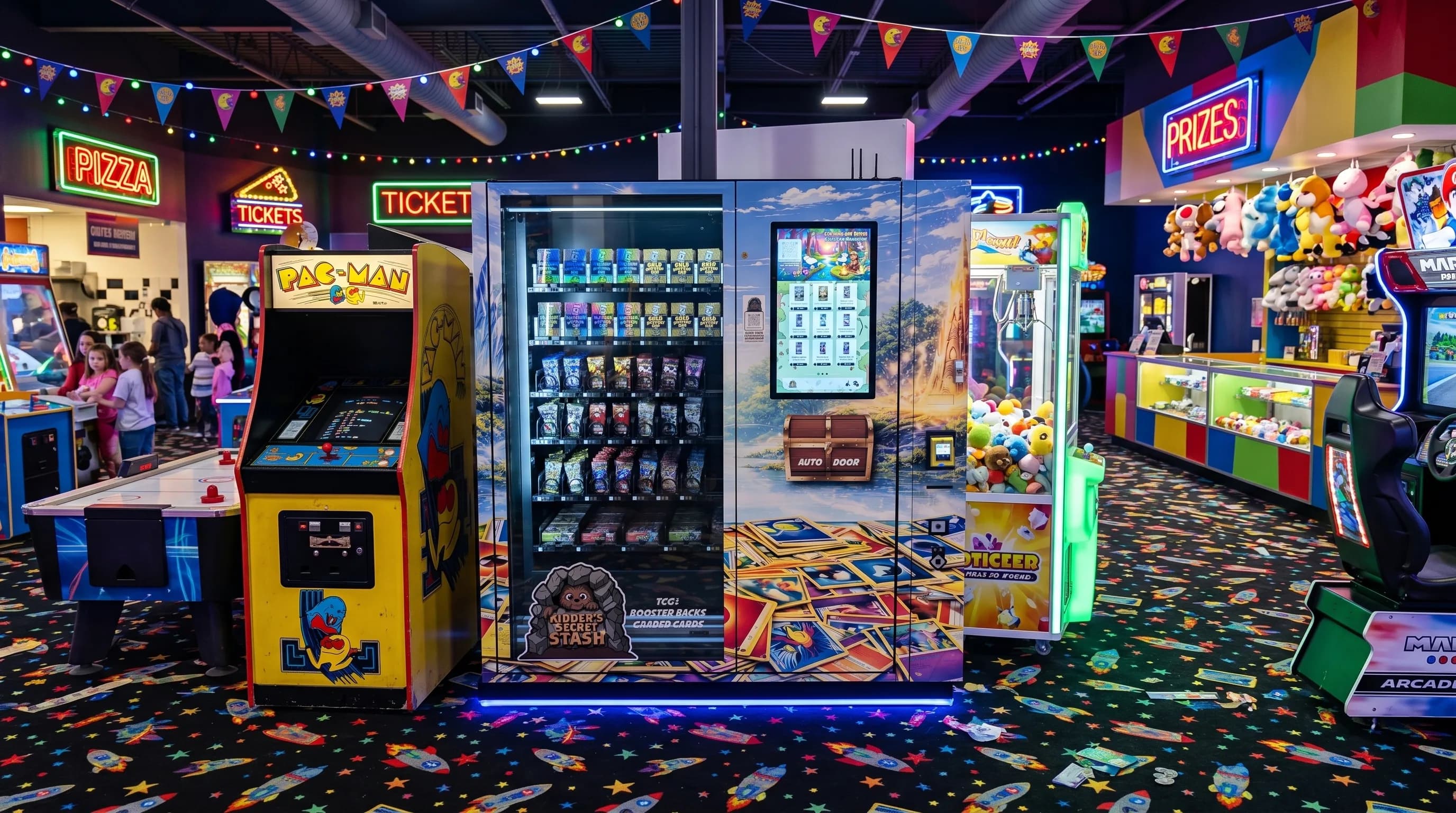
- M1 at $21,995 — the workhorse for mall deployments; holds up to 140 SKUs, full touchscreen, custom branded wrap, cloud management
- M3 at $39,995 — maximum capacity for flagship or multi-category deployments
Review the full comparison at the Pokémon vending machine format guide before committing. The right machine depends on your target location's foot traffic and your available capital.
3. Decide how to acquire your machine
You have three options:
- Buy outright: Pay the full purchase price upfront
- Finance: Approved buyers can finance the remaining machine balance after a stock-dependent 25%–50% deposit. Budget separately for all signing costs and use the payment schedule in your approved quote.
- Lease (M1): $625/month all-inclusive — covers the machine, custom full-body graphic wrap, cloud management via VendingTracker.com, branded touchscreen UI, California-based tech support, and remote diagnostics. A backlit illuminated logo topper is available for an additional $40/month.
Purchase, lease, and financing have different cash requirements. Compare the actual quote, total cost, operating reserves, and ownership goals before choosing.
4. Secure a location
High-traffic locations are the single biggest variable in this business. The best-performing placements for Pokémon vending machines include regional malls, entertainment centers, arcades, family entertainment centers (FECs), card shops, barbershops, and airports.
Rent structures vary: some locations take a percentage of revenue (typically 10–20%), others charge a flat monthly fee ($300–$1,000+). Avoid the temptation to choose a low-cost location to save money — a low-traffic location will cost you far more in lost revenue than the rent savings justify.
Read the full breakdown in the best locations guide. DMVI also provides direct mall management introductions for qualifying operators.
5. Get approved by authorized distributors
Pokémon product must come from authorized channels. The four main distributors for US operators are:
- GTS Distribution
- Southern Hobby Supply
- Alliance Game Distributors
- ACD Distribution
You will need your LLC documentation, EIN, and resale certificate to open wholesale accounts. Distributor pricing typically runs approximately 50% off MSRP on Pokémon product — a standard booster pack that retails for $4.49 costs roughly $2.20–$2.50 wholesale. See the Pokémon card wholesale sourcing guide for the full account-opening process.
6. Stock your machine
Start with the core SKUs that drive consistent volume: booster packs, Elite Trainer Boxes (ETBs), and mystery boxes. Price booster packs at $8–$12 each (your wholesale cost is ~$2.20–$2.50, giving you a gross margin of 59–61%).
The biggest single revenue driver is booster packs sold by the case. Collectors who are chasing specific sets will clear your machine during a new release window. Make sure you are restocked before major set launches.
7. Set up cashless payments
Cash-only vending loses revenue. DMVI machines come with a built-in Nayax terminal supporting tap, swipe, and chip card payments. No additional setup is required — the payment infrastructure is part of the machine.
8. Launch and monitor remotely
DMVI machines are cloud-managed via VendingTracker.com, which gives you real-time sales data, inventory alerts, and remote diagnostics from any device. You do not need to visit the machine to know what is selling and what needs restocking.
Section 4: Startup Capital Required
Here is a full breakdown of what it actually costs to get operational.
| Cost Item | Low End | High End | Notes |
|---|---|---|---|
| Machine hardware | $4,995 | $39,995 | Wall-Mounted to M3; or lease M1 at $625/mo |
| Initial inventory | $1,500 | $5,000 | First stocking of booster packs, ETBs, mystery boxes |
| LLC formation + permits | $50 | $500 | State filing fee + registered agent if used |
| Business insurance | $300 | $700 | General liability; required by most locations |
| Payment processor setup | $0 | $0 | Included with DMVI machines (Nayax) |
| Freight & installation | $300 | $1,200 | Varies by location and machine size |
| Location deposit | $0 | $1,000 | Many locations require first + last month |
| Total — Lean build | ~$8,000 | ~$12,000 | Wall-Mounted machine + modest inventory |
| Total — Standard build | ~$25,000 | ~$30,000 | M1 + full initial inventory stocking |
Monthly operating costs (M1, standard scenario):
- Machine lease: $625/month in this lease example; purchase-financing payments depend on the approved quote.
- Location rent: $300–$1,000/month (varies significantly)
- Payment processing fees: ~5% of gross revenue
- Restocking travel + labour: Variable (most operators restock weekly or bi-weekly)
On financing: A financed purchase has different upfront and monthly cash requirements from the lease example above. Use your deposit, all signing costs, and the approved 12-payment schedule to assess affordability; gross sales alone do not establish payment coverage. See the startup cost breakdown and profit calculator.
Section 5: Realistic Revenue Trajectory — Month 1 to Month 12
No machine hits peak revenue in week one. Here is what a typical operator trajectory looks like.
Months 1–2: The ramp period
Your first 60 days are about dialling in two variables: location and SKU mix. Expect $2,000–$4,000/month during this period. You are learning which products sell fastest at your specific location, adjusting pricing, and building awareness with the local collector base. This is normal — do not judge the business by month-one numbers.
Months 3–6: optimized operation
Once you have the right location confirmed and your top-selling SKUs identified, a solid mall placement should be generating $6,000–$10,000/month. Your restocking cadence is set, your margins are understood, and the machine is largely self-managing.
Months 6–12: Set release spikes
This is where the Pokémon calendar becomes a strategic asset. Major set releases — Prismatic Evolutions, Journey Together, Destined Rivals, Mega Evolution — drive 2–4× normal weekly revenue in the days following launch. Operators who plan inventory ahead of release dates capture the biggest revenue windows. Cases clear fast. The biggest individual revenue events in this business are set launch weeks where booster packs move by the case.
Stat callout: One DMVI operator in the San Francisco Bay Area generated $87,000 in a single month from a single M1 deployment. That figure represents a single machine, a single location, and the right inventory mix at peak demand.
Month 12+: Route expansion
Operators with one successful machine almost universally move to machine two or three within 12 months. The operational knowledge is already built. The distributor relationships are live. The incremental overhead of adding a second machine is minimal compared to the revenue upside.
Section 6: Common Mistakes First-Time Operators Make
Most early failures in this business are avoidable. Here are the ones that come up repeatedly:
- Choosing a low-traffic location to save on rent. A $300/month rent saving is irrelevant if foot traffic is 10% of what you need. Location quality drives everything.
- Understocking. Running out of popular SKUs between visits means lost sales and frustrated repeat customers. Set inventory alerts and restock before you are empty.
- Ignoring set release dates. Missing a major Pokémon launch is the most expensive mistake an operator can make. Keep a calendar and pre-order inventory well in advance.
- Using coil-style snack vending machines for cards. Standard vending machines damage product, jam on irregular packaging, and have no mechanism for handling the varying sizes of TCG products. Use a machine purpose-built for collectibles.
- Sourcing outside authorized channels. Counterfeit Pokémon product is a real and growing problem. Sourcing from unofficial channels risks your reputation, your distributor relationships, and potentially your legal standing. Stick to the four authorized distributors listed in Section 3. See the legal compliance guide for more detail.
- Treating it as passive income from day one. The business becomes largely passive after 60–90 days of active management. In the first two months, it needs your attention — restocking, location adjustments, pricing tweaks.
- Not forming an LLC before operating. Operating as a sole proprietor exposes your personal assets. Form the LLC first, before the machine is live.
Section 7: When to Add Machine #2
The signal to scale is straightforward: if your first machine has generated $1,500 or more per month consistently for four or more months, you are ready.
Before adding machine two, confirm that available cash covers its deposit, all signing costs, initial inventory, and operating reserves. If financing is approved, stress-test the 12 monthly payments against net cash flow after every operating expense; machine revenue does not guarantee payment coverage.
The operational overhead of machine two is a fraction of machine one. You already have distributor accounts, a location strategy, and a restocking system. Adding a second machine mostly means doubling the revenue line.
Operators who reach 5–10 machines are running a genuine business — one that scales revenue without proportionally scaling overhead. The distribution, remote management, and supplier relationships all stay the same; only the number of revenue-generating assets increases.
Ready to Get Started?
The Pokémon vending machine business is one of the few retail formats where the product creates its own repeat demand, the machine operates without staff, and the infrastructure is purpose-built for the category.
DMVI's philosophy is direct: "If you are successful, then we are successful." That alignment is built into the partnership — machine introductions, mall placement support, operator community, and California-based technical support are all part of the relationship.
To review machine specifications, see financing details, and request a quote, visit the Pokémon vending machines for sale page. If you want to compare formats side by side before committing, the format guide walks through every model in the line-up.
For a broader overview of the TCG vending category — including Magic: The Gathering, Yu-Gi-Oh!, and sports cards — see the TCG vending machines overview.
Want pricing, format guidance, or a launch plan?
DMVI can help you compare Pokemon vending machine formats, rollout strategy, financing, and location fit based on your route goals.