
Pokémon Card Wholesale Sourcing: The Operator's Distributor Playbook
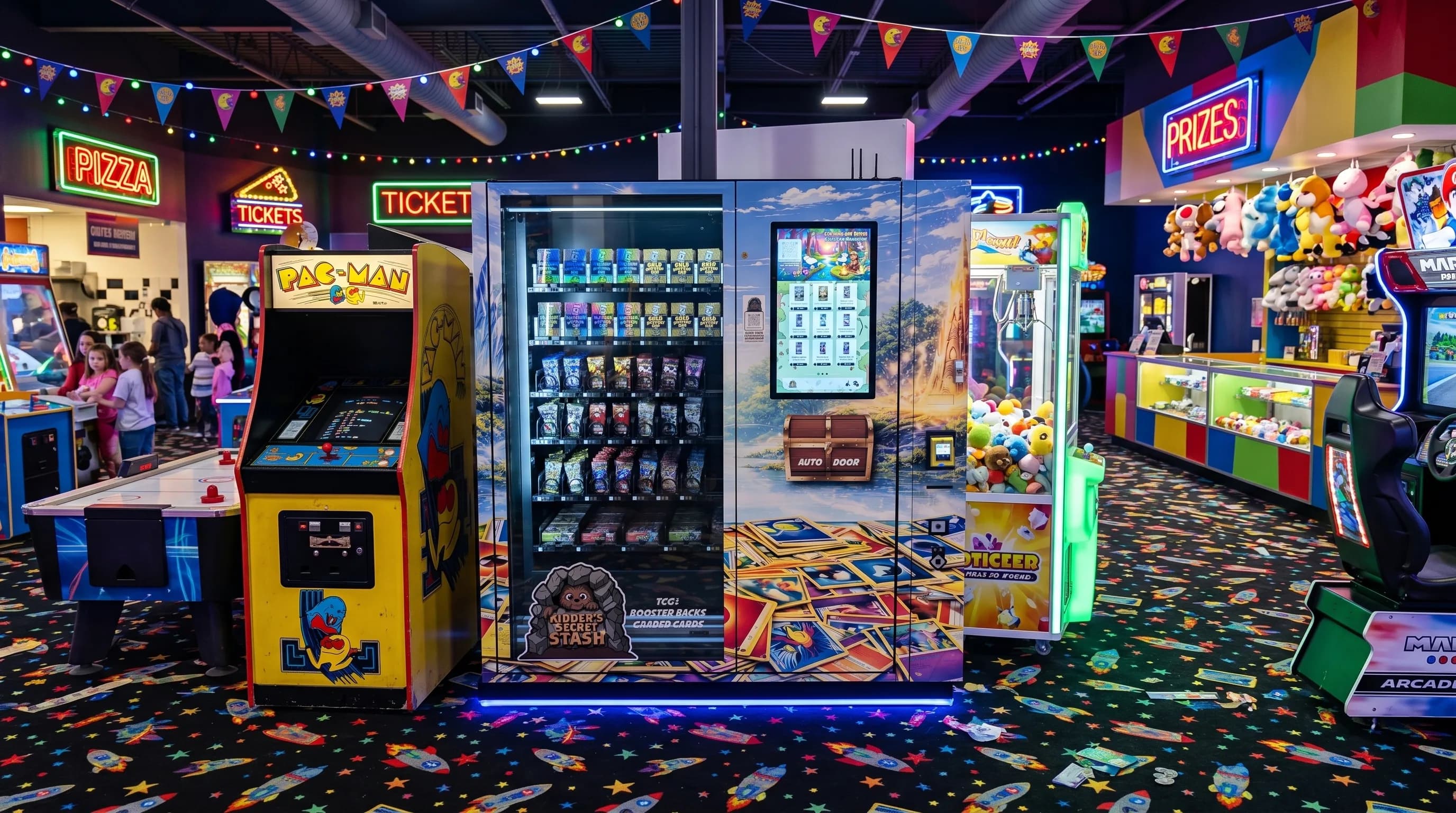
TL;DR Authorized Pokémon TCG distributors in the US — GTS Distribution, Southern Hobby Supply, Alliance Game Distributors, and ACD Distribution — offer roughly 50% off MSRP. Wholesale cost on a single booster pack runs ~$2.20–$2.50 versus a $4.49 MSRP; booster boxes land at ~$80–$90 wholesale versus ~$144 MSRP. Vend prices of $8–$12 per pack produce gross margins of 59–76%. Sourcing exclusively from authorized channels is also the legal and IP-compliance requirement under the First Sale Doctrine (17 U.S.C. § 109).
Introduction
Your machine is only as profitable as your inventory margin. And your margin is only as good as your sourcing.
Many new operators overpay for Pokémon cards — buying from retail, eBay resellers, or unapproved secondary markets — and unknowingly destroy their own margins in the process. Worse, some unknowingly take on legal exposure by sourcing product they can't verify as authentic.
This guide covers the four authorized Pokémon TCG distributors in the US, how to get approved, what to realistically expect on pricing, how to build a restock cadence, and how to protect your allocation access when a new high-demand set drops. Whether you're setting up your first machine or scaling to a multi-unit fleet, these are the sourcing fundamentals that separate operators who run sustainable, high-margin businesses from those who plateau or fail.
If you haven't yet decided on your machine format, start with DMVI's Pokémon vending machines for sale — format and capacity directly affect how you purchase and rotate inventory.
Section 1: Why Authorized Distributors Are Non-Negotiable
There are two reasons every serious operator sources exclusively through authorized Pokémon TCG distributors: margins and legality. Neither is optional.
The Legal Requirement
The First Sale Doctrine (17 U.S.C. § 109) gives you the legal right to resell Pokémon cards without a license from The Pokémon Company International. This is why vending machines can legally dispense sealed product. But the protection only applies to authentic, legitimately manufactured goods that entered the market through authorized channels.
If you source from a gray-market supplier or overseas bulk seller and unknowingly sell counterfeit cards, the First Sale Doctrine does not protect you. You face potential trademark infringement liability — not because you manufactured fakes, but because you distributed them. This is a real legal risk, not a theoretical one.
The full legal breakdown is covered in the Pokémon vending machine legal compliance guide and Is a Pokémon vending machine business legal? — both worth reading before you place your first wholesale order.
The Margin Requirement
Authorized distributors buy directly from TPCi's US distribution arm. That unbroken supply chain is how you get authenticated product at 40–55% below MSRP, depending on volume and product category. Here's what that pricing looks like at the product level:
| Product | MSRP | Typical Wholesale | Gross Margin at $10 Vend | Gross Margin at $12 Vend |
|---|---|---|---|---|
| Booster Pack (single) | $4.49 | ~$2.35 | 76.5% | 80.4% |
| Booster Box (36 packs) | ~$144 | ~$85 | — | — |
| Elite Trainer Box | $49.99 | ~$35 | — | — |
| Build & Battle Box | $14.99 | ~$9 | — | — |
| Scarlet & Violet Tin | $24.99 | ~$15 | — | — |
These margins are only available through the authorized channel. Retail sourcing from a big-box store gives you zero margin. Buying from a secondary reseller typically means paying $3.50–$4.00 per pack — which at a $10 vend price produces a margin of 60–65% before any other costs. The difference compounds fast at volume.
Stat Callout An operator vending 500 packs per month at $10 each generates $5,000 in revenue. At authorized wholesale ($2.35/pack), COGS is $1,175 — leaving $3,825 in gross profit. At retail sourcing ($4.49/pack), that same volume produces $2,255 in gross profit — a $1,570/month difference that comes directly out of your bottom line.
Section 2: The Four Authorized Pokémon TCG Distributors
| Distributor | Why Operators Use It | What Helps Approval | Watch-Out |
|---|---|---|---|
| GTS Distribution | Broad game and hobby coverage with strong industry relevance | Clean resale documents and a credible operating plan | Hot-set allocations reward established buyers |
| Southern Hobby Supply | Familiar to many trading-card operators and hobby stores | Business entity, resale cert, and category focus | Relationships matter once demand tightens |
| Alliance Game Distributors | Useful for operators stocking beyond Pokémon into adjacent TCGs | A real wholesale profile, not a casual retail buyer signal | Product mix may reward broader category buying |
| ACD Distribution | Helpful for operators building a diversified hobby supply stack | Clear business intent and organized purchasing | Allocation discipline matters on sought-after releases |
You do not have to pick one and commit. Most experienced operators work with two or three of these distributors to maintain sourcing flexibility, manage allocation across hot set releases, and compare pricing tiers as their volume grows.
GTS Distribution
GTS is one of the largest hobby and game distributors in North America, with a catalog that spans the full Pokémon TCG line, Magic: The Gathering, Yu-Gi-Oh!, sports cards, and accessories.
How to apply: Online retailer application. You'll need your EIN, state resale certificate, and proof of a legitimate retail operation — a photo of your vending machine or a business address works. GTS verifies that you're a real commercial buyer, not a reseller flipping to consumer markets.
MOQ: Generally no strict minimum order on standard sets. Allocation on high-demand releases is limited and distributed proportionally based on account history and volume.
Strengths: Widest SKU range in the hobby distributor space, reliable fulfilment infrastructure, and strong availability on standard product between major set launches.
Southern Hobby Supply
Southern Hobby is a specialist hobby distributor with deep TCG roots and strong institutional knowledge of the Pokémon product line. They carry Pokémon TCG alongside board games, RPGs, and accessories.
How to apply: Standard retailer application with business verification. Similar requirements to GTS — EIN, resale certificate, business documentation.
Regional strength: Particularly strong in the Southeast US, though they ship nationwide.
Strengths: Known for strong customer support and better-than-average allocation access on new Pokémon sets, partly because of their long-standing relationships within the hobby distribution channel. If you're going to prioritize one distributor to build a relationship with ahead of a major set launch, Southern Hobby is frequently cited by operators for allocation responsiveness.
Alliance Game Distributors
Alliance is a major distributor across the game and hobby category, carrying TCGs including Pokémon, board games, RPGs, miniatures, and accessories.
How to apply: Standard retailer/operator application with business verification.
Strengths: Broad catalogue that makes Alliance useful for operators who want to manage multiple SKU categories — Pokémon, MTG, Yu-Gi-Oh!, and accessories — through a single account. Competitive pricing tiers scale meaningfully with volume, which benefits operators running multiple machines.
ACD Distribution
ACD is a full-service game and hobby distributor with a comprehensive Pokémon TCG line, strong reorder reliability, and consistent availability on both new and legacy product.
How to apply: Business verification required. Standard process: EIN, resale certificate, business documentation.
Strengths: ACD is frequently noted for reorder consistency — when you need to replenish a specific SKU mid-cycle, ACD's fill rates on standard product tend to be reliable. For operators who run tight inventory rotations and can't afford stockouts on core SKUs, this matters.
Section 3: How to Get Approved
The approval process is straightforward for any legitimately registered business. Here's the step-by-step:
Step 1 — Form your LLC and obtain your EIN. Every distributor verifies that you're a real business entity. A sole proprietor using a personal SSN may be approved, but an LLC with an EIN is the cleaner path and the standard setup for vending operators.
Step 2 — Obtain a state resale certificate (also called a reseller's permit or seller's permit). This document, issued by your state's tax authority, proves you collect sales tax at the point of sale — which means you don't owe sales tax on wholesale purchases. Without it, distributors are required to charge you sales tax on every order. Apply through your state's department of revenue or franchise tax board. Turnaround is typically 1–5 business days.
Step 3 — Complete each distributor's online application. All four distributors have online retailer/operator application portals. Complete each one in parallel — don't wait for approval from one before applying to another.
Step 4 — Provide your documentation. Standard requirements across all four distributors:
- EIN confirmation letter (CP 575 from the IRS, or any official EIN document)
- State resale certificate
- Business address
- Some distributors request a photo of your retail location or vending machine
Step 5 — Wait for approval. Typical timeline is 3–10 business days. If you haven't heard back within 10 days, follow up directly — applications sometimes stall in a queue.
Step 6 — Place your first order. Some distributors require a minimum first order, typically in the $250–$500 range. Subsequent orders are generally flexible. Budget for a meaningful initial order — buying a single case of booster packs establishes you as an active account, which matters for future allocation.
Pro tip: Apply to all four distributors simultaneously. It costs nothing and gives you maximum sourcing flexibility from day one. Having multiple active accounts also strengthens your position when allocation is restricted on a hot set.
Section 4: Pricing Structure and What to Expect
Distributor pricing is not fixed — it varies along several dimensions:
Volume tiers: The more you buy, the better your pricing. Most distributors have 2–4 volume tiers, typically broken at monthly spend thresholds of $500, $1,000, and $5,000+. As your fleet grows, revisit your tier status with each distributor every quarter.
Product category: TCG pricing is typically at higher discount rates than accessories. Accessories (sleeves, binders, deck boxes) often have higher MSRP margins available, but the volume is lower. Booster packs and booster boxes are the core of your business.
Allocation status: On hot set launches — Prismatic Evolutions, Mega Evolution, Journey Together — distributors receive a fixed allotment from TPCi and ration it among accounts. During these windows, pricing may shift slightly toward full wholesale with strict quantity caps. This is normal, not a negotiating failure.
Payment terms: New accounts typically pay upfront via credit card or ACH. Net-30 terms become available as you establish payment history. Net-30 meaningfully improves cash flow once you're restocking regularly.
As a reference point, a fully loaded M1 machine running 140 SKUs across packs, ETBs, and tins represents roughly $1,500–$2,500 in wholesale inventory. At a 70%+ gross margin on packs, a single sell-through cycle covers restocking costs and then some.
For full machine specifications and capacity options, view DMVI's TCG cabinet line-up.
Section 5: Allocation Challenges on Hot Sets
Every major Pokémon TCG release creates an allocation crunch. This is the single biggest sourcing challenge for operators, and it's entirely manageable if you plan ahead.
Why allocation exists: TPCi controls production quantities and releases product in controlled waves. Distributors receive a fixed quantity — often far less than market demand, especially for high-profile sets like Prismatic Evolutions or Mega Evolution. They distribute that inventory among their accounts, typically weighted by account volume and history.
What this means for new operators: If you open your distributor accounts the week a hot set launches, you will receive little or no allocation. Established, high-volume accounts get priority. This is not punitive — it's how every major commodity distribution system works.
The strategy: Build your distributor relationships before the hot set launches. Place consistent orders on standard product — even modest orders of core Scarlet & Violet sets or evergreen reprints — so you're an active account when allocation is distributed. Pre-orders on announced sets typically open 6–10 weeks ahead of street date; place them as early as possible.
Secondary market supplements: Some operators fill allocation shortfalls by purchasing from secondary sources — eBay, direct from other retailers, local card shop overstock. This is legal if the product is authentic, but the margins are meaningfully thinner (often $3.00–$4.00 per pack versus $2.35 wholesale). Use secondary sourcing as a bridge strategy, not a primary channel.
For a full breakdown of how to maximize revenue on new set launches, see the dedicated Pokémon TCG new set release vending strategy guide.
Section 6: Restock Cadence by Set Lifecycle
Understanding where a set sits in its lifecycle tells you how to manage inventory and pricing at each stage.
Launch week (Days 1–7): Maximum demand, maximum pricing power. Customers are actively seeking new product. Vend at the top of your price range ($10–$12 per pack). Stock as deep as your machine allows. This is the week that drives your velocity numbers for the month.
Weeks 2–4: Velocity normalises as initial demand is met. The most price-sensitive buyers have already purchased. Steady sales continue but at a lower pace. Hold pricing — discounting during this window is rarely necessary and compresses margins without meaningfully accelerating sell-through.
Month 2–3 (Steady State): The set is established. Collectors who didn't buy at launch are now buying to chase specific cards. Velocity is slower but predictable. This is the right window to reorder a moderate quantity and maintain SKU presence.
Month 3+ (Wind-Down): Attention shifts toward the next announced set. Begin drawing down inventory on the ageing set without heavy restocking. Use remaining sell-through to free up capital for the next launch.
The dual-set principle: Always carry inventory of at least two sets simultaneously — the current hot set and a reliable evergreen product (base set reprints, classic Scarlet & Violet sets, or a proven high-velocity SKU). This protects you against allocation gaps and provides consistent sell-through during the weeks between major launches.
The Pokémon vending machine SKU strategy guide covers the full product mix framework, including how to balance booster packs, ETBs, tins, and accessories across your machine's capacity.
Section 7: Avoiding Counterfeit Product
Counterfeit Pokémon cards are a genuine problem, particularly product originating from overseas manufacturing. As an operator, your reputation depends on every pack dispensing authentic product. One counterfeit card discovered by a customer — and reported publicly — can cause lasting damage to your business.
Visual indicators of counterfeit product:
- Misaligned or inconsistent holo pattern on foil cards
- Wrong font weight on card text (slightly bolder or thinner than authentic)
- Inconsistent card finish — authentic cards have a specific texture; fakes are often glossier or matte in the wrong places
- Color saturation that looks slightly off compared to a known authentic reference card
- Packs that feel slightly lighter or have inconsistent seal quality
Never source from:
- AliExpress or Temu (primary counterfeit sourcing channels for TCG product)
- Unverified Amazon third-party sellers (Amazon Marketplace has known counterfeit product in TCG categories)
- Bulk eBay lots without a verified seller history and explicit authenticity guarantees
- Any supplier offering pricing that seems too good to be true (wholesale significantly below $2.20/pack is a red flag)
The rule is simple: If you can't trace the product back to one of the four authorized distributors above, don't buy it. The authenticity chain from TPCi to your machine must be documented and unbroken.
For a full treatment of the legal framework around authentic sourcing, read the Pokémon vending machine legal compliance guide.
Ready to Build a Sourcing-Optimized Operation?
Getting your distributor accounts approved is the foundation — but it's only one piece of a profitable vending operation. The operators who consistently outperform are the ones who combine the right machine format with an optimized product mix and a tight restock cadence.
DMVI operators get hands-on guidance on all of it: sourcing strategy, SKU selection, placement, and scaling. That's the partnership model — when you succeed, DMVI succeeds, and vice versa.
Explore DMVI's Pokémon card vending machines by DMVI and see which format fits your target location and volume goals. Or call +1-800-490-1108 to talk through your setup with the team directly.
For a comprehensive overview of the full business model, start with the complete guide to starting a Pokémon vending machine business.
Want pricing, format guidance, or a launch plan?
DMVI can help you compare Pokemon vending machine formats, rollout strategy, financing, and location fit based on your route goals.