
New Pokémon TCG Set Release Strategy for Vending Machine Operators (2026 Guide)
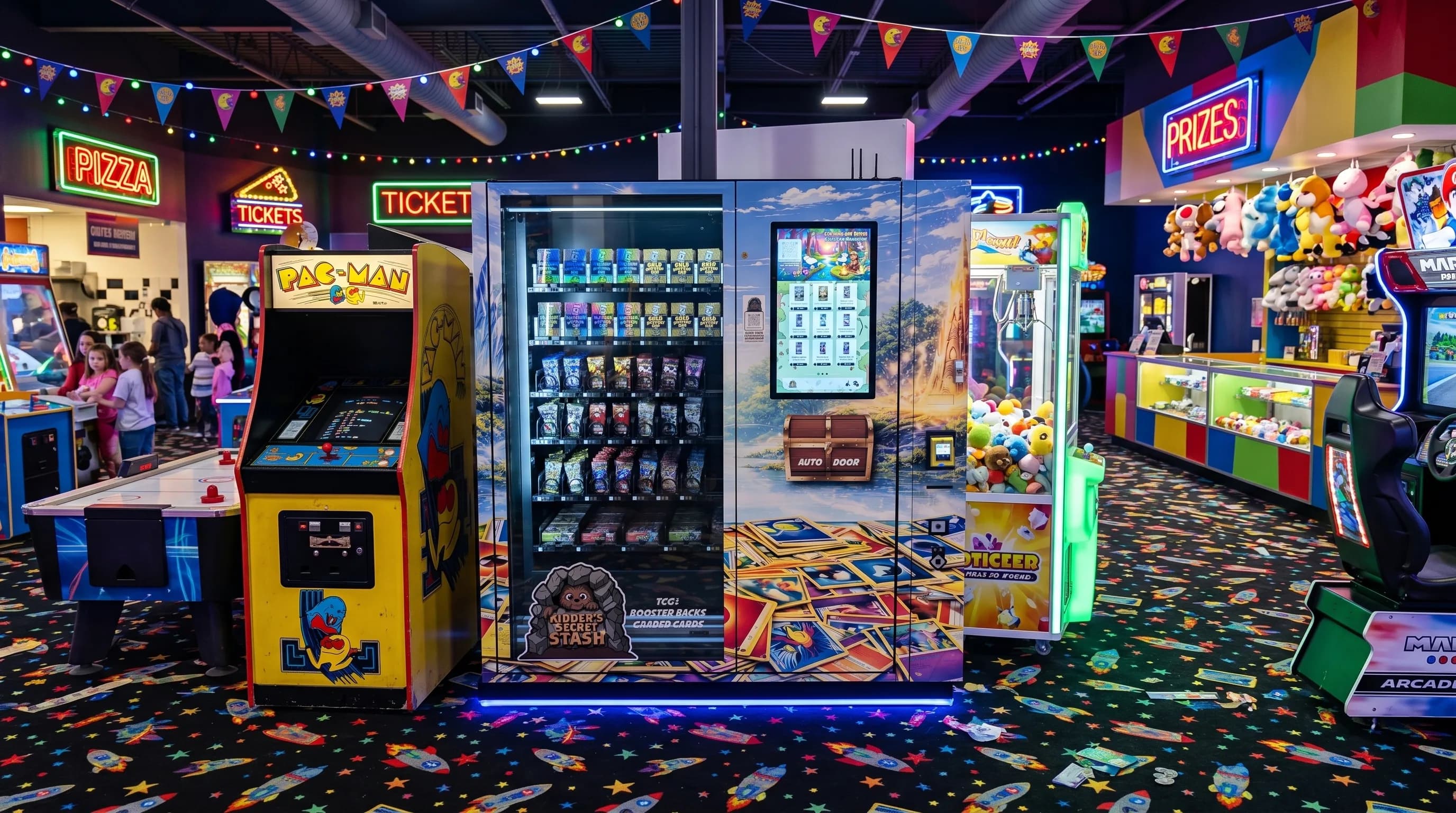
TL;DR: New Pokémon TCG set launches are the highest-revenue events in a vending operator's calendar. Release weeks can generate 3–5× normal daily revenue. Smart operators pre-order allocation 6–8 weeks in advance, raise prices remotely on street date, swap planograms to prime slots, and market the launch via their machine's on-screen advertising. The 2026 Scarlet & Violet era sets — including Mega Evolution and beyond — are the current revenue cycle to plan around.
Introduction
If you're operating a Pokémon vending machine and not planning around set releases, you're leaving significant money on the table. The Pokémon TCG release calendar is the most predictable revenue accelerator in the business — four to six major set launches per year, each creating a 72–96-hour demand spike that rewards operators who are prepared.
Unlike seasonal retail, this isn't a vague "holiday bump." A new Pokémon TCG set is a hard date: distributors ship out the week before, YouTube channels and Reddit light up in the 48 hours prior, and your machine will see a measurable surge within hours of street date if you're stocked and priced correctly. The operators who treat release day like a revenue event — not just a restock — are the ones consistently sitting at the top end of the revenue range.
This guide covers exactly how to capitalise on every release: which sets to plan around, how to secure allocation, when to move prices, how to rearrange your machine's real estate, and how to manage the inevitable cooldown before the next cycle begins. Whether you're running one machine or ten, this is the playbook.
Section 1: 2026 Pokémon TCG Release Calendar
The Pokémon Company follows a consistent schedule: major sets release roughly every three months, with smaller supplemental products (tins, premium collections, promo sets) filling the gaps. As of May 2026, the active Scarlet & Violet era is delivering some of the strongest consumer demand the TCG has seen in years.
Here is the current planning calendar for operators:
| Set Name | Expected Release | Key Products | Demand Level |
|---|---|---|---|
| Prismatic Evolutions | Jan 2026 (released) | ETB, booster packs, special sets | Extreme — highest demand in years |
| Journey Together | Mar 2026 (released) | Booster packs, ETBs, tins | High |
| Destined Rivals | May 2026 (released) | Booster packs, ETBs | High |
| Mega Evolution (SV10) | Expected Q3 2026 | Booster packs, ETBs, premium collections | Very High (highly anticipated) |
| Black Bolt / White Flare | Expected late 2026 | Booster packs, ETBs, premium sets | TBC |
Note: As of May 2026, confirm the current release schedule with official sources at pokemon.com/us/pokemon-tcg/trading-card-expansions. This table reflects confirmed and anticipated releases — update this section each quarter alongside your pre-order planning.
What the calendar tells you as an operator: The Pokémon Company typically announces new sets 8–12 weeks before street date. That announcement is your trigger to contact your distributor and lock in a pre-order. By the time a set is trending on social media, allocation at most distributors is already spoken for. Operators who wait until hype peaks to place their order consistently come up short.
The Mega Evolution opportunity: SV10 (Mega Evolution) is expected to be the breakout commercial set of Q3 2026. Mega Pokémon have enormous nostalgia value for the 25–35 demographic — exactly the impulse buyer in your mall aisle. Early pre-orders on this set are strongly recommended for any operator with established distributor accounts.
Section 2: Pre-Order Strategy — When to Commit Capital
The single biggest operational mistake Pokémon vending operators make is treating inventory purchasing reactively. You cannot walk into a distributor order system two weeks before a major set launch and expect meaningful allocation. Here is the timeline and logic:
The Pre-Order Timeline
- 8–12 weeks before street date: Pokémon Company announces the set. Start monitoring distributor pre-order portals.
- 6–8 weeks before street date: Place your pre-order. This is the target window for guaranteed allocation.
- 2–3 weeks before street date: Allocation confirmations come through. If you're short, pursue secondary sourcing (see below).
- 1 week before street date: Distributors ship. Confirm your delivery is on track.
- Street date (or day before): Machine restocked, planogram updated, pricing adjusted, attract screen updated.
Why Pre-Orders Matter More Than You Think
Hot sets face strict allocation limits — distributors receive a fixed quantity from their regional Pokémon Company representative, and that quantity is divided among accounts based on purchase history. Prismatic Evolutions in early 2026 illustrated this clearly: operators who had consistent order histories received adequate allocation; new or irregular accounts received far less, or nothing.
Building your distributor relationship before the hot set arrives is one of the highest-ROI activities you can do as an operator. Place regular monthly orders — even small ones — with two or three distributors (GTS Distribution, Southern Hobby Supply, Alliance Game Distributors, and ACD Distribution are the four primary authorized channels). When Mega Evolution arrives, you want to be a known account, not a new name.
Pre-orders at most distributors are non-refundable once confirmed. Only commit quantities you're confident you can sell through. A booster pack unsold after 90 days is capital you can't deploy elsewhere.
How Much to Order
| Commitment Level | Quantity | Use Case |
|---|---|---|
| Conservative | 1–2 display boxes (72–144 packs) | Single machine, first release, testing demand |
| Strong | 3–6 display boxes | Established machine in high-traffic location |
| Aggressive | Full case allocation (6 boxes) + secondary sourcing | Multiple machines or proven high-velocity location |
A single display box at wholesale (~$80–$90) yields 36 booster packs. At a street-date price of $13 per pack, one display box generates ~$468 gross revenue — roughly 5× the cost. Six display boxes at aggressive pricing during a peak release week can generate $2,800+ from a single machine before costs.
For operators running DMVI's TCG cabinet line-up, this margin math is the core of the business case. The machine is the infrastructure; the release calendar is the revenue engine.
Section 3: Release Week Pricing Playbook
This is where VendingTracker's remote pricing feature pays for itself. Instead of driving to each machine to manually adjust prices — which takes hours you don't have on street date — you update pricing from a browser or app and every machine reflects the change within minutes.
The pricing strategy differs based on set demand tier:
Standard Set (Moderate Demand)
| Period | Vend Price per Booster Pack |
|---|---|
| Normal (pre-release) | $9.00 |
| Release day – Week 1 | $11–$12 |
| Week 2–3 | $10.00 |
| Week 4+ | Normalise to $9.00 |
High-Demand Set (Mega Evolution Tier)
| Period | Vend Price per Booster Pack |
|---|---|
| Normal (pre-release) | $9.00 |
| Announcement day (related stock) | $11.00 |
| Street date | $13–$15 |
| Release weekend | $13–$15 (peak foot traffic) |
| Week 2 | $12.00 |
| Week 3–4 | $10–$11 (normalising) |
Extreme Demand (Prismatic Evolutions Level)
At the Prismatic Evolutions launch, operators with stocked machines reported selling booster packs at $18–$25 per unit. Secondary market prices on eBay hit $8–$15 per pack for singles from the booster pool. At those margins — wholesale cost of ~$2.20–$2.50 per pack — gross margin exceeded 85%.
The risk at extreme pricing is velocity: some customers will choose to wait. The right balance is typically $15–$18 during the first week for an extreme-demand release, dropping to $13–$15 for week two. Monitor your machine's hourly sales data to find where velocity drops and adjust accordingly.
Revenue Impact: Flat Pricing vs. Dynamic Pricing Over 4 Weeks
The following table models a single machine selling an average of 15 packs per day at a high-demand release:
| Week | Dynamic Price | Daily Revenue | Flat Price ($9) | Daily Revenue (Flat) |
|---|---|---|---|---|
| Week 1 | $14 | $210 | $9 | $135 |
| Week 2 | $12 | $180 | $9 | $135 |
| Week 3 | $10 | $150 | $9 | $135 |
| Week 4 | $9 | $135 | $9 | $135 |
| 4-Week Total | $4,725 | $3,780 |
That's $945 in additional revenue from a single machine over one release cycle — purely from pricing strategy. Across a fleet of five machines, dynamic release pricing is worth approximately $4,700 per major set launch. This is why remote price management is not a nice-to-have feature for serious operators.
Section 4: Planogram Swaps for Set Launches
Your machine's physical real estate is not all equal. Eye-level slots sell. Peripheral slots don't. A planogram swap — reassigning which product occupies which slot — is as important as pricing on launch day.
Before street date (ideally 24–48 hours prior):
Use VendingTracker's planogram editor to reassign your highest-traffic, most visible slots to the new set. On DMVI's M1 machine, which supports up to 140 SKUs, you have significant flexibility. Reserve 40–60% of total capacity for the new set during launch week.
Slot prioritisation:
- Prime slots: Eye-level, first visible on the touchscreen carousel, historically highest sell-through
- Secondary slots: Above/below eye-level, less prominent in the browsing UI
- Tertiary slots: Deep inventory positions used for evergreen SKUs that don't need prominent placement to sell
Keep evergreen SKUs in secondary slots during launch. Classic reprints, multi-set bundle packs, and always-in-demand product (Scarlet & Violet base sets, 151 reprints) still generate revenue during a launch week — customers who don't want the new set will still buy if alternatives are visible and accessible.
Physical restock protocol: Arrive at the machine on street date, or the morning before, with new inventory pre-packed by slot number. Label each unit with its target slot before you leave your car. Efficient operators can complete a full planogram swap in under 20 minutes when inventory is pre-organized. On-site decision-making is the enemy of fast restocking.
For a detailed breakdown of SKU selection across different machine configurations, see our Pokémon vending machine SKU strategy guide.
Section 5: On-Screen Marketing via Touchscreen
DMVI machines include a branded touchscreen interface with attract-mode advertising capability. Most operators underuse this feature — treating it as a static display rather than an active marketing channel. New set releases are the highest-value opportunity to change that.
One week before street date: Update the attract-mode screen to promote the upcoming launch. Content to include:
- Official set artwork (available from Pokémon's press kit and licensed product photography)
- Release date countdown ("3 days until Mega Evolution drops")
- "Coming Soon" badge on the relevant product slots
Street date: Switch to "Now Available" messaging immediately. Customers passing by the machine — even ones who weren't planning to stop — will notice the new set banner and convert at a higher rate than on a blank or outdated screen.
QR code integration: Include a QR code linking to your business's website or social profile where you're also promoting the launch. This builds your marketing audience alongside your machine revenue.
For card shop owners running DMVI machines in malls: The machine's screen is a free advertising channel for your physical store. "Join us [date] for our Mega Evolution release party" tied to a QR code drives foot traffic from the mall to your store — a compelling dual-channel effect that mall-based vending enables uniquely. Learn more about this touchscreen capability in our touchscreen Pokémon vending machine features guide.
Section 6: Managing the Cooldown Phase
No release spike lasts indefinitely. Understanding what happens after launch week — and having a playbook for it — is what separates operators who maintain margin from those who get stuck holding expensive inventory.
Week 2–4 post-release: Velocity normalises. The collectors who needed the new set on day one have purchased. You're now selling to casual buyers and late adopters. Price down gradually to maintain volume without abandoning margin — a $1–2 reduction per week is typical. Don't cut to normal price all at once; you leave money on the table for buyers who are still willing to pay a premium.
Month 2: The set transitions to standard inventory. It's now part of your baseline planogram rather than a feature slot. Adjust par levels based on your machine's actual velocity data from the first four weeks.
Dead SKU identification: If a set underperforms by Week 4 — lower-than-expected velocity even at reduced prices — treat it as an inventory management problem, not a waiting problem. Use VendingTracker velocity data to flag it. Options: reduce price to clear the machine ($7–$8/pack moves most product), transfer inventory to your physical card shop if you have one, or bundle with another SKU as a promotional pairing.
Overlapping into the next cycle: While you're managing the current set's cooldown, pre-orders for the next set should already be placed. The Pokémon TCG calendar is predictable enough that you should always have one active launch in market and one pre-order in pipeline. This is the rhythm of a mature Pokémon vending operation.
For more on how revenue spikes layer across the calendar year, see our guide on seasonal Pokémon vending machine revenue spikes.
Section 7: Multi-Set Inventory Strategy
Never go all-in on a single set. Allocation limits exist, demand can be unpredictable, and a machine that runs dry mid-week loses revenue it will never recover. Operators who maintain a multi-set inventory strategy insulate themselves from both supply-side failures and demand surprises.
The core rule: Always maintain two active sets simultaneously — the current hot set plus one evergreen or secondary set.
If allocation on the hot set runs dry, your machine continues generating revenue instead of going dark. This is not a theoretical risk: Prismatic Evolutions allocation constraints meant many operators ran out in Week 2 and had nothing to replace it with for several weeks.
Evergreen sets to keep in rotation:
- Scarlet & Violet base set reprints
- Pokémon 151 (consistently demanded; appeals to the nostalgia buyer alongside any new release)
- Classic era reprints — Base Set, Jungle, Fossil packs remain in demand regardless of the new set cycle
Cross-TCG hedging: A machine carrying Pokémon plus Lorcana or Magic: The Gathering weathers Pokémon allocation shortages without revenue impact. TCG audiences overlap significantly, and many collectors buy across games. If your machine format supports it (the DMVI M1's 140-SKU capacity makes this viable), multi-TCG inventory is a structural risk hedge, not a compromise.
A well-managed multi-set machine running during a hot Pokémon release is a strong performer. The same machine during an allocation shortage, with no fallback inventory, generates nothing. The inventory strategy is the insurance policy.
Ready to Maximise Your Release Week Revenue?
The Pokémon TCG release calendar is the most reliable revenue cycle in collectible vending — but only for operators with the right infrastructure. Remote pricing, planogram management, attract-screen advertising, and cloud-based inventory tracking aren't optional features for serious operators. They're the tools that convert a demand spike into maximum revenue capture.
DMVI's machines are built specifically for this category. If you're still operating on legacy hardware — or considering launching your first Pokémon vending machine — review the Pokémon vending machines for sale at DMVI and see which format fits your location and revenue goals.
For operators already in the field, the next step is straightforward: pull up your VendingTracker dashboard, check your current set inventory, and open your distributor portal to confirm your Mega Evolution pre-order is in place. The Q3 2026 cycle starts sooner than it feels.
Questions about machine formats, financing options, or distributor introductions? Contact Digital Media Vending International at +1-800-490-1108 or visit digitalmediavending.com.
Stat Callout: A single DMVI M1 machine at a high-traffic mall location can generate $87,000 in monthly revenue at peak — a figure achieved by a real operator in the San Francisco Bay Area. Release week planning is a core driver of reaching that ceiling.
This post is updated quarterly alongside the Pokémon TCG release calendar. Last updated: May 2026.
Want pricing, format guidance, or a launch plan?
DMVI can help you compare Pokemon vending machine formats, rollout strategy, financing, and location fit based on your route goals.