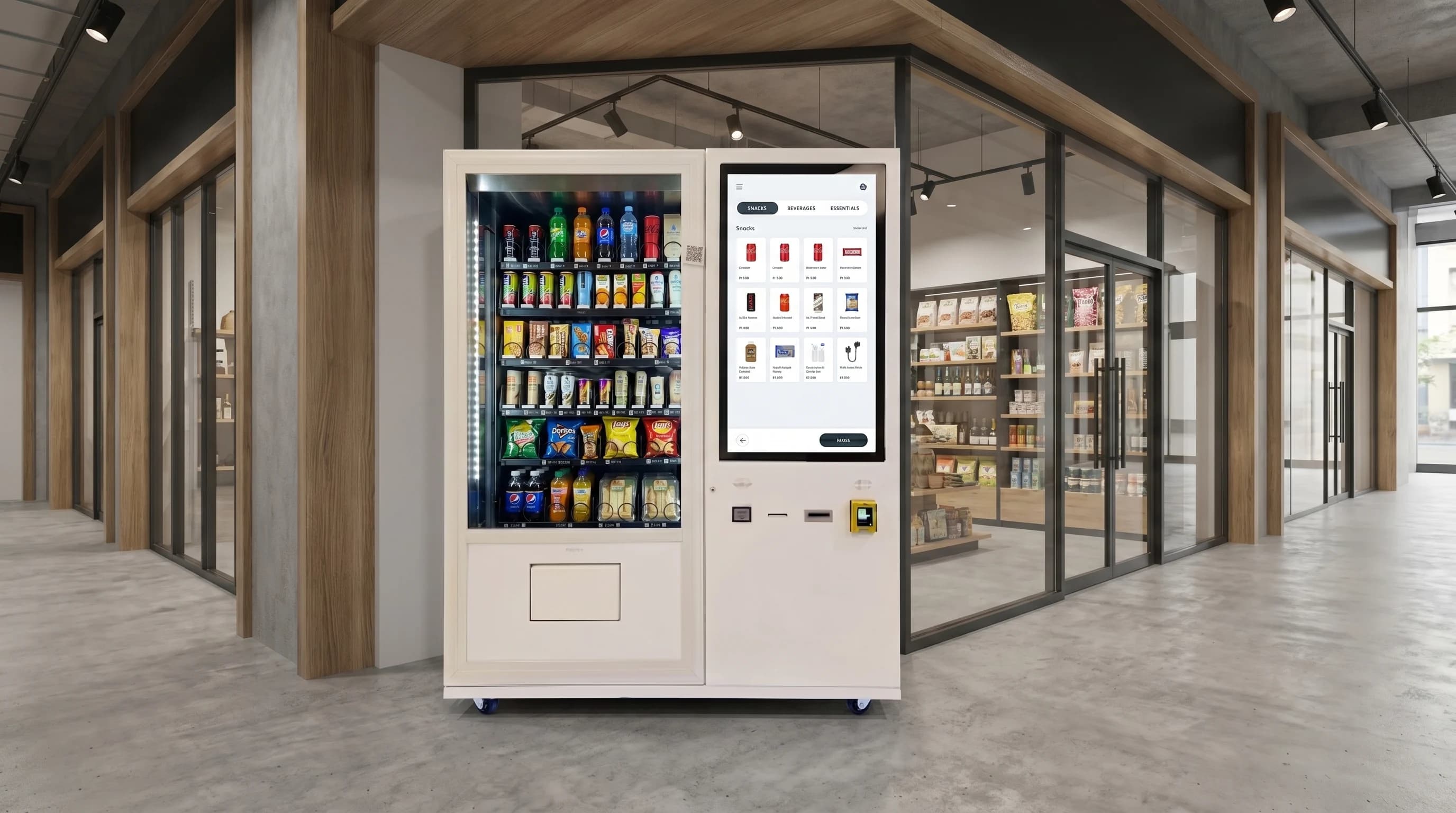
Touchscreen Pokémon Vending Machines: Features, Software & Why It Drives More Sales
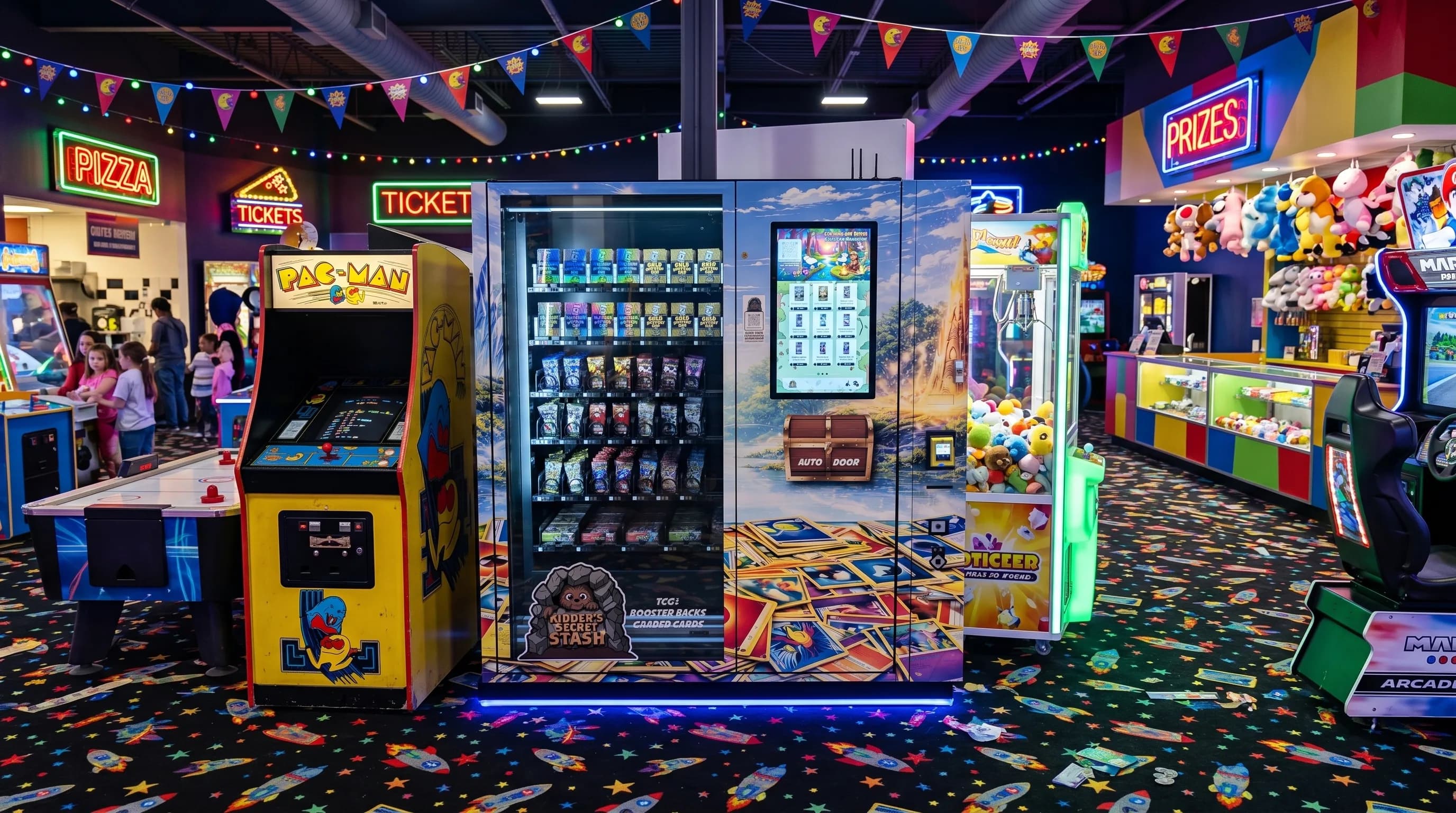
TL;DR DMVI's Pokémon vending machines feature a branded touchscreen UI, cloud-connected via VendingTracker.com, with remote pricing controls, on-screen digital advertising, real-time inventory alerts, and planogram management. Studies show touchscreen interfaces increase vending machine transaction rates by 20–30% compared to button-and-coil systems. The M1's full-colour touchscreen lets operators update pricing and swap product displays without visiting the machine.
Introduction
The difference between a $500/month vending machine and a $50,000/month vending machine often isn't location — it's interface.
A modern touchscreen Pokémon vending machine does three things a coil-and-button machine cannot: it communicates value, creates an impulse-buying experience, and lets the operator manage everything remotely. For operators in the trading card business, those three advantages translate directly into higher transaction values, better margin capture during set releases, and lower operational overhead across multiple locations.
This post covers every feature of DMVI's touchscreen platform — the hardware, the branded UI, the VendingTracker cloud dashboard, and the specific operator workflows that separate high-earning machines from average ones. If you're evaluating a touchscreen Pokémon vending machine for your first or next location, this is the complete picture.
Section 1: Why Touchscreen Beats Button-and-Coil for TCG
The traditional vending machine interaction is: press D4, wait, hope. There's no product image, no description, no pricing context, and no emotional connection between the buyer and what they're purchasing.
That model is already a poor fit for commodity products. For trading cards, it's a deal-breaker.
Pokémon cards are aspirational products. Collectors aren't buying calories or caffeine — they're buying the possibility of a rare pull, a specific set they've been chasing, or a product they've seen on social media. When a customer sees full-colour set artwork for Mega Evolution or Journey Together displayed on a large touchscreen, it triggers the same emotional response as a premium product display in a specialty retailer. The visual is doing sales work the button-and-coil machine cannot do.
Practically, here's what changes with a touchscreen:
- Full product photography for every SKU — customers see exactly what they're buying
- Set name, card descriptions, and pricing tiers are displayed clearly — no ambiguity, no hesitation
- Higher-value items become viable impulse purchases — ETBs, tins, and booster boxes are much easier to sell when clearly presented at an appropriate price point with context
- Upsell logic — the screen can guide customers toward higher-margin products at the point of decision
Research on self-service kiosk and touchscreen retail consistently shows 20–30% higher average order values compared to traditional button-based vending. In a category where a single transaction can range from $9 for a booster pack to $150+ for a booster box, that lift is commercially significant.
Stat Callout: Touchscreen self-service interfaces have been shown to increase average transaction values by 20–30% versus button-based vending — a meaningful delta when your SKUs span $9 packs to $150 booster boxes.
Section 2: Branded UI — Your Store, Your Screen
Every DMVI machine ships with a branded touchscreen UI built to the operator's identity. That means your colours, your logo, your fonts, and your store name — not a generic interface with a manufacturer's branding.
For TCG store owners using DMVI's partnership model ("Your Store. Every Mall. No Extra Staff."), this is particularly valuable. When your M1 machine sits in a regional mall, the screen carries your full brand identity to every person who walks past — not just those who stop to buy. Brand recall accumulates every day the machine runs.
What customers see on the screen:
- Your logo and store identity front and center
- Your curated product selection with custom photography or artwork
- Your marketing messages, promotional callouts, and seasonal campaigns
- Your pricing — not a manufacturer's default
The machine becomes a physical advertisement. Every customer who interacts with the touchscreen is exposed to your brand — even the ones who browse and walk away. In a high-foot-traffic mall environment, that ambient brand exposure has real value that operators frequently undercount.
DMVI configures the initial UI to your brand standards at setup. From that point forward, operators can push content updates remotely via VendingTracker without requiring a technician visit or on-site access.
See the Pokémon vending machine format guide for a full breakdown of which machine formats include the branded touchscreen UI.
Section 3: On-Screen Digital Advertising
When no transaction is in progress, the touchscreen doesn't go dark — it works.
DMVI machines use idle screen time for operator-controlled digital advertising. This is the screensaver/attract mode that runs continuously when the machine isn't processing a purchase. It's a zero-marginal-cost marketing channel that operates 24/7 at whatever locations you're running machines.
What operators use the advertising screen for:
- New arrival announcements — "Mega Evolution packs now in stock" displayed prominently on the day product arrives
- Promotional pricing callouts — "This weekend only — booster packs at $9" with a visible countdown
- QR codes linking to the operator's online store, Instagram, or loyalty program
- Event promotion — "Find us at [Convention name] this weekend" for operators who also run events or pop-ups
- Cross-location branding — "Also find us at [Mall A], [Arcade], and [Location C]" to build operator network awareness
- Set hype content — artwork and promotional imagery for upcoming Pokémon set releases to build anticipation before stock arrives
For brick-and-mortar TCG store owners, the mall machine's advertising screen actively drives foot traffic back to your physical store. A customer who discovers your brand at the mall kiosk and scans a QR code to your store's website becomes a long-term customer — a conversion value that extends far beyond that single vending transaction.
There's no additional per-impression cost to running this content. The screen time is yours to fill, and you control the creative from your VendingTracker dashboard.
Section 4: VendingTracker — The Cloud Management Dashboard
VendingTracker.com is DMVI's proprietary cloud management platform. It's included with every machine — not an add-on, not a monthly subscription on top of your lease or purchase cost.
This is the operational backbone that makes a remotely managed, multi-location vending business viable. Here's what the platform delivers:
| Feature | What It Does |
|---|---|
| Real-time sales data | See exactly which SKUs sold, at what price, at what time — updated live |
| Slot inventory levels | Know which slots are approaching empty without visiting the machine |
| Automated low-stock alerts | Push notifications when any slot hits par level |
| Remote pricing | Change vend prices from your phone or laptop in seconds |
| Planogram editor | Rearrange your virtual machine layout before your next restock visit |
| Multi-machine dashboard | Manage all machines from one screen; see combined revenue and individual performance |
| Payment alerts | Instant notification if a payment reader error occurs |
| Transaction logs | Full audit trail for tax, accounting, and performance analysis |
Real-time sales data means you're not guessing which SKUs move and which sit. You know — down to the hour — what's selling at every location. That data informs your next restock order, your pricing strategy, and your slot allocation decisions.
The planogram editor is an underrated feature. Before you drive to a location to restock, you can plan exactly what goes in every slot from your laptop. You arrive with the product pre-sorted and the layout pre-planned — restocking a machine takes 20 minutes instead of an hour.
Multi-machine management is what makes scaling viable. An operator running five M1 machines across five mall locations manages all of them from a single VendingTracker dashboard. Underperforming locations are flagged. Revenue across the portfolio is aggregated. You're running a business, not making daily site visits.
For a deeper look at the remote management workflow, see the remote management guide.
Section 5: New Set Release Pricing — The Remote Advantage
| Touchscreen / Cloud Feature | Revenue Benefit | Operating Benefit | Best Use |
|---|---|---|---|
| Branded home screen | Makes the machine feel like a store, not a box | Supports premium presentation in better venues | Mall and FEC placements |
| Remote price changes | Lets you react to set-release demand fast | No manual repricing trip required | Hot releases and promotional windows |
| On-screen promotions | Pushes bundles, upsells, and featured drops | Highlights slower SKUs without re-merchandising | Mix management and new arrivals |
| Live telemetry dashboard | Shows what is actually selling now | Improves restock planning and route efficiency | Multi-machine operators |
| Connectivity alerts | Reduces downtime and blind spots | Flags issues before the venue complains | Remote or higher-volume locations |
This is the single highest-value application of the touchscreen + VendingTracker combination, and it's one that operators with traditional machines simply cannot replicate.
A new Pokémon set — Destined Rivals, Journey Together, Mega Evolution — releases on a Friday. Demand spikes immediately. Collectors and resellers will pay 2–3× the standard vend price on release day, and the premium holds for the first weekend. By the following week, supply stabilises and pricing normalises.
The window is narrow. The upside is significant.
Here's how the workflow plays out for a DMVI operator versus a button-and-coil operator:
DMVI operator (touchscreen + VendingTracker):
- New set releases Friday morning
- Operator logs into VendingTracker at 8 AM from their phone
- Raises price on affected slots from $9 to $13 in under 60 seconds
- Machine captures premium pricing all day without the operator present
- That evening, the operator reviews real-time sales data to see exactly how many units moved at the new price
Button-and-coil operator:
- New set releases Friday morning
- Operator either doesn't raise prices (leaving $4/pack on the table across every transaction that day), or makes a physical trip to the machine to change a price sticker — a trip that costs time, fuel, and opportunity cost
At 100 packs sold on a release-day peak, the $4 premium differential is $400 in revenue that the remote operator captures and the coil-and-button operator misses. Across multiple machines at multiple locations, those release-day premiums add up to a material annual revenue difference.
Remote pricing isn't a convenience feature — it's a revenue feature.
Section 6: Connectivity — Wi-Fi + 4G Failover
VendingTracker's real-time capabilities depend on consistent connectivity. DMVI machines connect via Wi-Fi as the primary connection method. For operators in locations with reliable Wi-Fi infrastructure, this works seamlessly.
The critical addition is 4G cellular failover.
If venue Wi-Fi drops — a common occurrence in older malls, family entertainment centers, and high-traffic venues where network congestion is routine — the machine automatically switches to the 4G cellular connection. There's no manual intervention required. The machine stays online, transactions continue processing, and VendingTracker data streams without interruption.
What failover prevents:
- Lost transactions during Wi-Fi outages (each dropped sale at $9–$12 adds up quickly over a full day)
- Gaps in your sales data that complicate inventory and accounting
- Payment reader issues going undetected because the machine couldn't send an alert
For operators placing machines in venues with known Wi-Fi limitations, the 4G failover is not optional insurance — it's baseline reliability infrastructure that protects your revenue.
Stat Callout: A single day of dropped connectivity at a machine running $300/day in revenue = $300 lost. The 4G failover pays for itself on the first outage it prevents.
Touchscreen vs. Button-and-Coil: Feature Comparison
| Feature | DMVI Touchscreen | Button-and-Coil |
|---|---|---|
| Product photography on screen | ✅ Full colour | ❌ None |
| Remote pricing updates | ✅ Via VendingTracker | ❌ Manual/on-site |
| Branded UI | ✅ Operator's identity | ❌ Generic |
| On-screen advertising | ✅ Operator-controlled | ❌ None |
| Real-time sales data | ✅ Live dashboard | ❌ Manual counts |
| Low-stock alerts | ✅ Automated push | ❌ None |
| Multi-machine dashboard | ✅ Centralised | ❌ N/A |
| 4G cellular failover | ✅ Automatic | ❌ N/A |
| Planogram editor | ✅ Remote | ❌ Manual |
The gap isn't marginal. A button-and-coil machine requires more site visits, captures less revenue per transaction, misses release-day pricing windows, and provides no operational visibility between visits. For an operator running multiple locations, the accumulated time and revenue cost is substantial.
The Bottom Line
A touchscreen Pokémon vending machine isn't a premium upgrade — it's the operational baseline for running a profitable, scalable TCG vending business.
The branded UI drives brand equity and higher transaction values. The on-screen advertising turns idle machine time into a marketing channel. The remote pricing capability captures release-day revenue that button-and-coil operators leave on the table. And VendingTracker gives you the data, alerts, and controls to manage the whole operation without being physically present at every machine.
DMVI builds every machine in this model — the touchscreen UI, VendingTracker access, and 4G failover connectivity are included, not optional extras.
If you're ready to see exactly which formats are available and what the investment looks like, visit DMVI's Pokémon vending machines page for the full lineup. VendingTracker is included with every machine at no extra charge.
Want to understand how to build a profitable SKU mix once your machine is live? Read the Pokémon vending machine SKU strategy guide next.
Digital Media Vending International | +1-800-490-1108 | digitalmediavending.com
Want pricing, format guidance, or a launch plan?
DMVI can help you compare Pokemon vending machine formats, rollout strategy, financing, and location fit based on your route goals.