
The Best Pokémon SKUs to Stock in a Vending Machine: Pack, Case, ETB & Slab Mix
DMVI purchase financing: Subject to approval and not guaranteed; DMVI reserves the right to deny financing. A 25%–50% machine deposit is required depending on whether the machine is in stock, with the percentage specified in your quote. The remaining machine balance is paid in 12 monthly payments with 8% simple interest. All upfront costs are due at signing, including the wrap, optional topper, payment terminal, first-year software subscription, shipping, sales tax, and other quoted upfront charges. A UCC filing applies, and a personal guarantee may be required. See vending machine financing and your approved agreement for details.
TL;DR: The highest-revenue SKUs in a Pokémon vending machine are booster packs sold by the case (highest total margin per transaction), followed by Elite Trainer Boxes and mystery boxes. Individual booster packs at $8–$12 each deliver 59–76% gross margins but smaller per-transaction totals. Graded slabs (PSA/BGS 9–10) command the highest single-item prices ($50–$500+). Operators who mix price points — $8 packs → $25 ETBs → $150 cases — maximise both volume and average transaction value.
Choosing the right product mix for your vending machine is the second most important decision after location. The wrong mix leaves shelves stale, limits revenue per visit, and misses the customers who would spend more. This guide covers the best-performing SKU categories, how to mix them by price point, and the specific products that consistently drive the highest returns for DMVI operators. Whether you are launching your first machine or optimising an existing route, the framework below will help you stock with intention — and grow revenue faster. If you are still researching which machine format fits your needs, start with DMVI's Pokémon vending machines for sale before diving into inventory strategy.
Section 1: The Biggest Revenue Driver — Booster Packs by the Case
This is the single most important insight for any new operator: the biggest revenues come from selling booster packs by the case.
Here is the math. A standard Pokémon booster case contains 6 booster boxes. Each booster box holds 36 individual packs. That is 216 packs per case. At a standard MSRP of $4.00 per pack, the implied retail value of a case is roughly $864. Operators source cases from authorized distributors — GTS Distribution, Southern Hobby Supply, Alliance Game Distributors, or ACD Distribution — at approximately $480–$540 per case (roughly $80–$90 per box × 6).
Vend price for a case sits at $600–$900+ depending on the set's market demand, your location, and local competition. At a $720 vend price against a $510 landed cost, the gross margin is approximately 29%. That is lower than an individual pack's margin percentage — but margin percentage is not the metric that matters here.
Revenue per transaction is what matters. One case sale generates the same machine time, the same payment processing event, and the same operational footprint as a single booster pack sale — but produces 6–10× the revenue in a single transaction. An operator running 10 case transactions per week at $720 each generates $7,200 from those transactions alone. The same 10 transactions in individual packs at $10 each would produce $100.
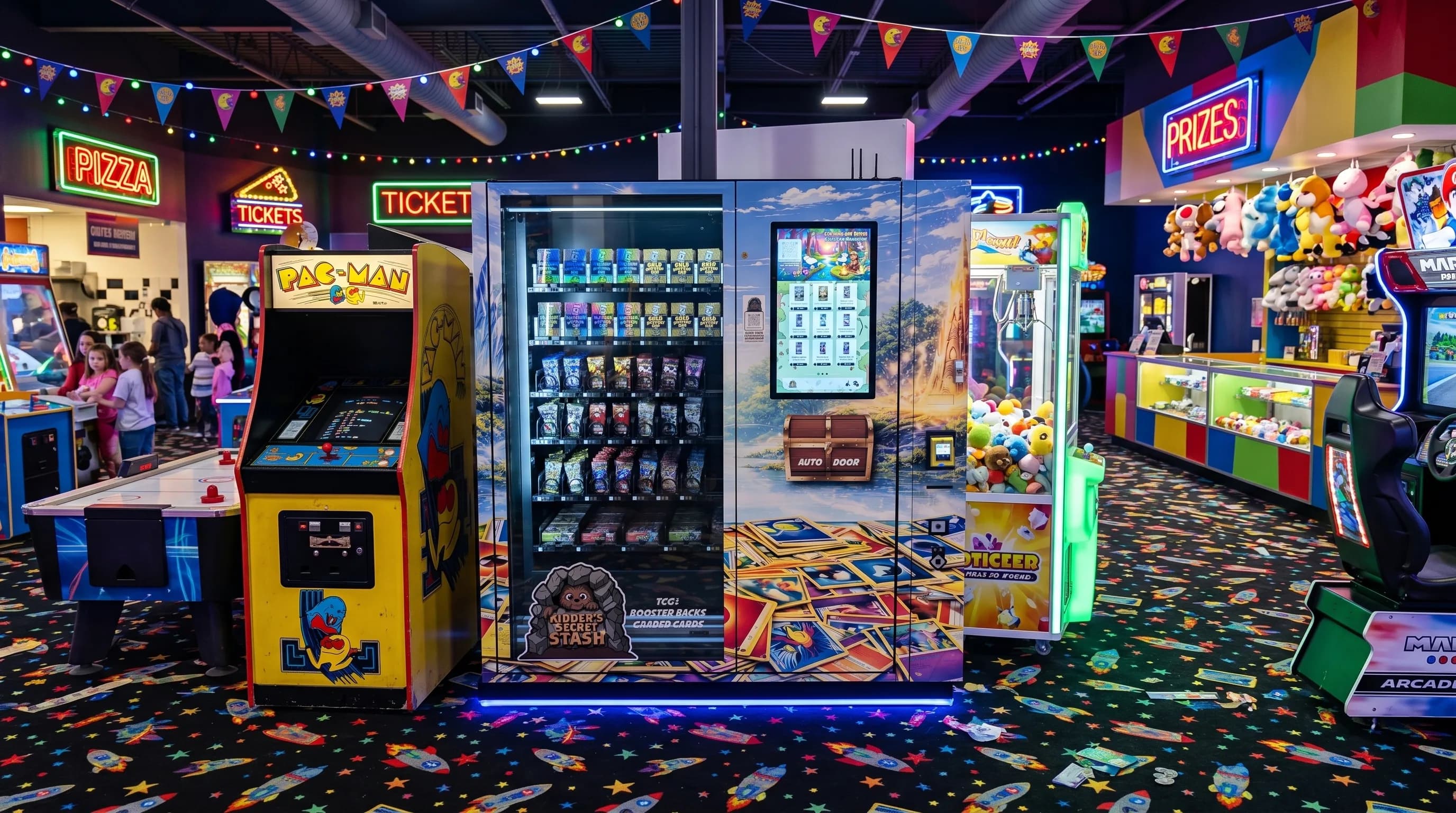
DMVI's M1 machine handles items up to 9" × 9" × 7", a specification designed precisely to accommodate booster box cases. Operators who stock cases consistently report the highest single-day revenue numbers in the DMVI network — including the operator in the San Francisco Bay Area who hit $87,000 in a single month.
The strategic takeaway: cases are your revenue anchor. Individual booster packs are still your volume driver and impulse purchase — but every machine that has the capacity should dedicate slots to cases.
Section 2: The SKU Price Ladder
| SKU Tier | Role in the Machine | Margin / Turn Profile | Best Use |
|---|---|---|---|
| Single booster packs | Volume driver and entry-price product | Fast turn, dependable repeat traffic | Every machine needs these |
| Booster boxes / bundles | Higher-ticket anchor items | Slower turn, strong dollar contribution | Stronger venues and release windows |
| ETBs and tins | Mid-tier giftable product | Good balance of visibility and basket lift | Malls, FECs, and family-heavy traffic |
| Mystery products | Engagement and novelty play | Can lift impulse sales if executed cleanly | Use sparingly and price transparently |
| Graded slabs / premium items | Destination SKU for serious collectors | Lower velocity, premium margin potential | Only in the right venue and cabinet format |
The highest-performing machines in the DMVI network share one structural feature: products at every price point. Customers who walk up to a machine stocked only with $10 packs will spend $10. Customers who see a $10 pack, a $55 ETB, a $180 booster box, and a $720 case will make a buying decision at their own budget level — and many will spend far more than they planned.
This is the price-ladder framework every operator should build into their inventory:
| Price Tier | Product Examples | Vend Price | Gross Margin | Role in Mix |
|---|---|---|---|---|
| Impulse ($5–$15) | Individual booster packs, single card packs | $8–$12 | 59–76% | Volume driver, entry point |
| Mid ($15–$30) | Blister packs, Build & Battle boxes, tins | $18–$28 | 45–55% | Upsell from impulse |
| Premium ($30–$75) | Elite Trainer Boxes, special collection boxes | $45–$70 | 40–55% | Higher margin per transaction |
| High-ticket ($75–$200) | Booster boxes (single), special collector sets | $100–$180 | 30–50% | Revenue anchor |
| Case ($150–$900+) | Full booster cases (6-box sets) | $600–$900 | 25–40% | Biggest revenue per transaction |
| Collectibles ($50–$500+) | Graded/slabbed cards (PSA 9, PSA 10) | $50–$500+ | Varies | Premium destination purchase |
Operator Insight: Customers who see only packs will spend pack money. Customers who see a PSA 10 slab next to a case of Destined Rivals will spend case-and-slab money. The presence of high-ticket items lifts the perceived value of everything else in the machine.
The price ladder also protects you against revenue concentration. If pack sales slow because a new set is between release windows, your ETBs and cases continue generating revenue. Diversification across tiers is the same risk management principle that applies to any retail business — and vending machines are no exception.
Section 3: Individual Booster Packs — The Volume Engine
Individual booster packs are the core of every Pokémon vending machine. Every collector wants them. Every casual fan understands them. The impulse to buy one more pack is hardwired into the hobby.
The economics are compelling: at a $10 vend price and a wholesale cost of approximately $2.35 per pack (sourced by the box), the gross profit per pack is $7.65 — roughly 76%. No other SKU category delivers this margin percentage at this price point.
In May 2026, the active Scarlet & Violet sets driving the most consumer demand are Destined Rivals, Mega Evolution, Journey Together, and Prismatic Evolutions. Stock the current lead set heavily — it will drive both foot traffic and repeat visits from customers chasing specific pulls. Supplement with 1–2 classic-era reprints (Base Set, Jungle, Fossil) which maintain year-round demand from older collectors and gift buyers who associate Pokémon with nostalgia.
Recommended slot allocation: 40–60% of your total slot count in a mixed-category machine should be dedicated to individual booster packs. Buy in booster box (36-pack) quantities at minimum for best per-unit wholesale pricing, then load individual packs into your coil or push-tray slots.
One operational note: rotate your set lineup with each major Pokémon TCG release (approximately every 3–4 months). Stale inventory — especially older sets with no new buzz — occupies premium slots that should be working harder.
Section 4: Elite Trainer Boxes (ETBs)
Elite Trainer Boxes are the aspirational purchase for casual and semi-serious collectors. Every player knows what an ETB is. Everyone who has been in the hobby for more than a few months wants one. At $55–$75 vend price against a wholesale cost of $30–$40, the gross margin sits at approximately 40–55% — and the absolute dollar profit per sale ($20–$35) significantly outpaces most individual pack transactions.
The ETB format — a large, premium-looking box containing 9 booster packs, 65 card sleeves, a collector's box, and accessories — photographs well on the machine's touchscreen interface and signals quality to customers scanning the selection. It is the product that turns a $10 impulse visit into a $60 purchase.
DMVI's Option 4 and M1 machines handle the ETB's physical footprint without modification. Stock the current set's ETB (Destined Rivals or Mega Evolution in May 2026) as your primary offering, and keep 1–2 high-demand classic ETBs as secondary stock — Evolving Skies and Crown Zenith ETBs, for example, maintain strong secondary market demand even after their primary release windows.
Restocking note: ETBs sell more slowly than individual packs, but their contribution to per-visit revenue is significantly higher. A single ETB sale at $65 represents the same margin dollars as 8–9 individual pack sales.
Section 5: Mystery Boxes — The Engagement Play
Mystery boxes are one of the highest-impulse SKUs in vending. The format is simple: a sealed box containing a curated assortment of packs, bonus cards, or collectible items at a fixed price. The customer does not know exactly what they will get — and that uncertainty is the product.
Wholesale cost for a mystery box runs $10–$25 depending on content; vend prices typically land at $25–$50. Operators who build their own mystery boxes — sourcing components individually and assembling sealed packages — can achieve the highest margins in this category, sometimes exceeding 60%.
Mystery boxes perform especially well in family entertainment centers, arcades, and malls where the "what's inside" experience amplifies the vending interaction. The reveal moment — even for a $25 box — drives social sharing, repeat visits, and the kind of word-of-mouth that no paid advertising can replicate.
The M1's 9" × 9" × 7" item capacity accommodates standard mystery box formats without issue. Dedicate 5–10% of your slots to this category and refresh the contents every 4–6 weeks to maintain novelty.
Section 6: Graded Slabs — The Premium Destination SKU
A graded Pokémon card in a vending machine changes what the machine is in the mind of the collector who finds it. It is no longer just convenient — it is a destination.
DMVI machines can vend PSA- and BGS-graded cards in foil-wrapped protective sleeves that preserve the slab and add perceived value. PSA 9 Pokémon cards typically vend at $30–$150 depending on the card; PSA 10 cards on desirable Scarlet & Violet, vintage, or alternate-art prints command $100–$500+. Gross margin on slabs is highly variable — it depends entirely on acquisition cost — but even at a conservative 20% margin, a $200 slab sale generates $40 profit in a single transaction.
The strategic value of graded cards extends beyond the margin math. Collectors who know a machine carries slabs will make a specific trip. They will return monthly to check for new stock. They will tell their collector community. In collector hobby circles, word-of-mouth from a well-stocked slab section is worth more than most paid marketing budgets.
Recommendation: Dedicate 5–10% of your M1 slots to graded cards. Source from reputable grading houses or re-sellers with verifiable provenance. Rotate stock monthly, and use the machine's branded touchscreen to feature any particularly desirable cards prominently.
Section 7: Cross-TCG Hedging
Pokémon is the anchor of any TCG vending machine — but smart operators use the remaining 30–40% of inventory to hedge against Pokémon's set-release cycle.
When a major Pokémon set just launched, demand spikes and allocation from distributors can tighten. When the market is in a lull between major releases, other TCGs fill the revenue gap. Here is how each category performs:
- Disney Lorcana: Strong collector pull, growing quickly, and targets the same demographic as casual Pokémon buyers. Booster packs vend well at $6–$10.
- Magic: The Gathering: The most established TCG player base. Commander precon decks sell at $15–$25 vend price and attract an older, higher-spending demographic.
- One Piece TCG: Allocation-driven with intense demand, especially in markets with strong anime fanbases. High sell-through when stock is available.
- Yu-Gi-Oh!: Steady, loyal demand with slightly lower average margins than Pokémon. Works best in machines near gaming stores or high-school-adjacent venues.
- Sports cards: PSA-graded sports slabs sit naturally alongside TCG slabs and add a cross-category appeal for the sports collector who may not be a TCG buyer — and vice versa.
The rule of thumb: keep Pokémon at 60–70% of inventory; use the remaining 30–40% to maintain revenue velocity across set cycles.
Section 8: What NOT to Stock
Equally important as knowing what to sell is knowing what to avoid. The following product types will cost you revenue, reputation, or both:
- Opened or repackaged product — Selling repackaged packs (where cards have been removed and replaced) is fraud. It is illegal, it destroys customer trust, and it is the fastest way to permanently damage a machine's reputation with the collector community.
- Counterfeit cards — Trademark infringement. Always source from authorized distributors: GTS Distribution, Southern Hobby Supply, Alliance Game Distributors, or ACD Distribution.
- Accessories only (sleeves, binders, deck boxes) — These have low impulse appeal in a vending context. Collectors visit the machine for the pull, not the storage. Accessories as a bonus element inside a mystery box work; as a standalone SKU, they occupy slots that should generate higher revenue.
- Obscure, low-demand sets — Dead inventory in a high-value slot. If a set is not moving within 30 days, rotate it out. Use VendingTracker.com cloud data to identify slow-moving SKUs quickly.
- Products that exceed machine dimensions — The M1 accommodates items up to 9" × 9" × 7". Product that exceeds these dimensions will not vend reliably and creates service calls. Know your machine's specs before ordering inventory.
Putting It Together: A Sample M1 Slot Allocation
For an M1 running 140 SKUs in a high-traffic mall location, a starting allocation might look like this:
| Category | Slot Count | % of Machine |
|---|---|---|
| Individual booster packs (current sets) | 55 | 39% |
| Individual booster packs (classic/evergreen) | 15 | 11% |
| Elite Trainer Boxes | 12 | 9% |
| Blister packs & tins | 10 | 7% |
| Mystery boxes | 8 | 6% |
| Booster boxes (single) | 8 | 6% |
| Booster cases | 6 | 4% |
| Graded slabs (PSA 9/10) | 10 | 7% |
| Cross-TCG (Lorcana, MTG, One Piece) | 16 | 11% |
Adjust proportions based on location demographics, local demand signals, and real-time sales data from VendingTracker.com.
Ready to Build Your SKU Strategy Into the Right Machine?
The SKU mix covered in this guide — packs, cases, ETBs, mystery boxes, and graded slabs — is only as powerful as the machine you deploy it in. DMVI's M1 is purpose-built for exactly this inventory range: 140-SKU capacity, 9"×9"×7" item clearance for cases and large boxes, cashless payment, branded touchscreen, and cloud management via VendingTracker.com.
To build a Pokémon vending operation around a machine that can stock this range, explore DMVI's Pokémon card vending machines and request a quote. Ask separately about purchase financing and the M1 lease option; lease inclusions do not define what is financed under a purchase agreement.
For more detail on sourcing the inventory that fills your machine, read the Pokémon Card Wholesale Sourcing & Distributor Guide. For timing your inventory around the Pokémon release calendar, see the Pokémon TCG New Set Release Vending Strategy and Seasonal Pokémon Vending Machine Revenue Spikes.
Want pricing, format guidance, or a launch plan?
DMVI can help you compare Pokemon vending machine formats, rollout strategy, financing, and location fit based on your route goals.