
Pokémon Vending Machine Legal Guide: First Sale Doctrine, IP, LLC & Insurance
TL;DR
Operating a Pokémon vending machine is fully legal in the United States. The First Sale Doctrine (17 U.S.C. § 109) permits resale of authentic Pokémon TCG products through any retail channel, including vending machines. No license from The Pokémon Company International is required. Operators need: an LLC, EIN, resale certificate, sales tax permit, and General Liability insurance. Always source from authorized distributors to maintain the authenticity chain.
Introduction
Three legal questions stop more aspiring Pokémon vending machine operators than any other factor: Is this legal? Can The Pokémon Company shut me down? Do I need a license?
The answer to all three: yes it's legal, no they can't, and no license is needed.
Yet the uncertainty is understandable. You're building a business around one of the most aggressively protected intellectual properties in the world. The Pokémon Company International (TPCi) holds hundreds of trademark registrations, actively polices counterfeits, and operates its own branded machines in major grocery chains. It's reasonable to wonder where an independent operator fits into that picture.
This guide is the definitive compliance resource for independent Pokémon vending machine operators — covering IP law, trademark, business structure, insurance, taxes, and the one thing that actually is illegal. By the end, you'll have a clear-eyed understanding of your legal position and a complete checklist of everything you need to launch.
If you're still in the research phase, start with how to start a Pokémon vending machine business for the full operational overview. When you're ready to look at hardware, explore DMVI's Pokémon vending machines for sale — the machines DMVI builds are designed from the ground up to keep operators legally protected and brand-compliant.
Section 1: The First Sale Doctrine — Full Plain-English Explainer
The legal foundation for every independent Pokémon vending machine operator in the United States is a copyright law doctrine called the First Sale Doctrine, codified in 17 U.S.C. § 109.
What the law says
The statute reads: "the owner of a particular copy or phonorecord lawfully made under this title... is entitled, without the authority of the copyright owner, to sell or otherwise dispose of the possession of that copy or phonorecord."
Strip out the legal language and you get something simple: once a copyright holder sells a copy of their work into commerce, they lose the right to control what happens to that specific copy next. The buyer can resell it, lend it, give it away, or — critically — vend it through a machine at a markup. The copyright holder gets paid once, on the first sale. Everything after that is the buyer's business.
What this means for Pokémon vending machine operators
When you purchase authentic Pokémon TCG booster packs from an authorized distributor like GTS Distribution or Alliance Game Distributors, you own those copies. You paid for them; TPCi received their payment through the distribution chain. Under 17 U.S.C. § 109, you are legally entitled to resell those packs through any retail format — a store shelf, an online listing, or a vending machine — without asking TPCi for permission, paying them a royalty, or obtaining any license.
This is not a legal gray area. It is settled law.
Historical context and how it works everywhere else
The First Sale Doctrine is why these perfectly normal things are legal without copyright holder permission:
- eBay can operate a marketplace for used media, games, and collectibles
- GameStop can buy and resell used video games
- Libraries can loan books to thousands of patrons without paying publishers per loan
- Card shop singles — every local game store that sells individual Pokémon cards out of a binder is operating under the First Sale Doctrine
- Thrift stores selling DVDs and books without film studio or publisher consent
Your Pokémon vending machine is legally no different from any of these. You are a retailer reselling lawfully purchased goods.
The Supreme Court's affirmation: Kirtsaeng v. John Wiley & Sons (2013)
In Kirtsaeng v. John Wiley & Sons, the U.S. Supreme Court affirmed the broad application of the First Sale Doctrine in a landmark 6-3 decision. The Court held that the doctrine applies to goods manufactured abroad and imported into the United States — a ruling that significantly expanded the doctrine's reach and explicitly rejected the argument that copyright holders could control downstream resale based on where goods were manufactured.
For Pokémon vending operators, the practical implication is clear: even if specific Pokémon TCG products are manufactured overseas, once those products are lawfully purchased through the US distribution chain, the First Sale Doctrine fully applies and TPCi has no legal basis to prevent resale through any channel.
What the First Sale Doctrine does NOT cover
Three things the doctrine cannot protect:
- Counterfeit products — cards that were never manufactured with TPCi's authorization are not "lawfully made under this title." Selling counterfeits is trademark infringement and potentially criminal fraud. This is covered in full in Section 9.
- Opened or repackaged product sold as sealed — removing cards and resealing packs, or cherry-picking booster boxes, is not protected resale; it is fraud.
- Use of Pokémon IP in your own branding — the First Sale Doctrine covers your right to sell the product, not your right to reproduce TPCi's logos and artwork in your own marketing materials or machine design. That's a separate trademark question covered in Section 3.
Section 2: Official Pokémon Machines vs. Independent Operators
A source of confusion for new operators: The Pokémon Company International does operate branded vending machines in major US grocery chains including Kroger, Safeway, and Albertsons. These are TPCi-owned and TPCi-operated machines — part of their corporate retail expansion, not a franchise or licensing program available to independent operators.
These machines are not available for purchase. TPCi is not selling them, franchising them, or licensing the model to outside entrepreneurs.
Independent operators — DMVI's customers — operate entirely separately under the First Sale Doctrine. There is no relationship between TPCi's corporate machines and an independent operator's machine. No affiliation is implied or required.
| Aspect | TPCi Official Machines | Independent Operators (DMVI) |
|---|---|---|
| Who owns the machine | TPCi | The operator |
| Legal framework | TPCi corporate program | First Sale Doctrine (17 U.S.C. § 109) |
| Available to buy? | No | Yes (DMVI) |
| License required? | TPCi internal | No license required |
| Where placed | Kroger, Safeway, Albertsons | Malls, FECs, card shops, airports |
| Branding | TPCi/Pokémon branded | Operator's own brand identity |
| Operator relationship to TPCi | Corporate division | Independent retailer |
The business model DMVI operators run is straightforward: buy wholesale from an authorized distributor, stock your machine, sell at retail. The same model a card shop runs — just automated and available 24/7.
Section 3: Trademark Law for Pokémon Vending Operators
The Pokémon Company holds extensive trademark registrations covering the Pokémon name, the Poké Ball design, individual character names and likenesses (including Pikachu), and the full visual trade dress of its products. These trademark rights are separate from copyright and exist independently of the First Sale Doctrine.
Understanding the trademark rules keeps you legally clean and professionally credible.
What you CAN legally do
- Describe products by their official names. Saying "Pokémon Scarlet & Violet — Destined Rivals Booster Pack" or "Pokémon Elite Trainer Box" in your machine's touchscreen interface, price lists, or advertising is lawful. This is nominative fair use — you are accurately identifying what you are selling.
- Stock and sell authentic Pokémon TCG products. That's the whole point, and it's legal.
- Use product names in digital signage and touchscreen menus to help customers identify their purchase. Factual product identification is not trademark infringement.
- Reference Pokémon in advertising when accurately describing your inventory: "We stock the full Pokémon Scarlet & Violet lineup" is a factual statement about your product offerings.
What you CANNOT legally do
- Use the Pokémon logo, Pikachu imagery, or any registered Pokémon trademark in your machine's wrap or exterior branding. The wrap is your brand, not TPCi's. There is no legitimate justification for putting Pokémon's trademarked graphics on a machine that isn't theirs.
- Claim to be an "Official Pokémon Retailer" or use language that implies endorsement, sponsorship, or authorization by TPCi. You are an independent retailer, not an authorized partner.
- Create custom Pokémon artwork for any business purpose without a license. Fan art on your machine = trademark and copyright infringement.
- Use Pokémon's trade dress — the distinctive look and feel of their branding — in a way that could cause consumer confusion about whether your machine is operated by or affiliated with TPCi.
Best practice — what DMVI operators do
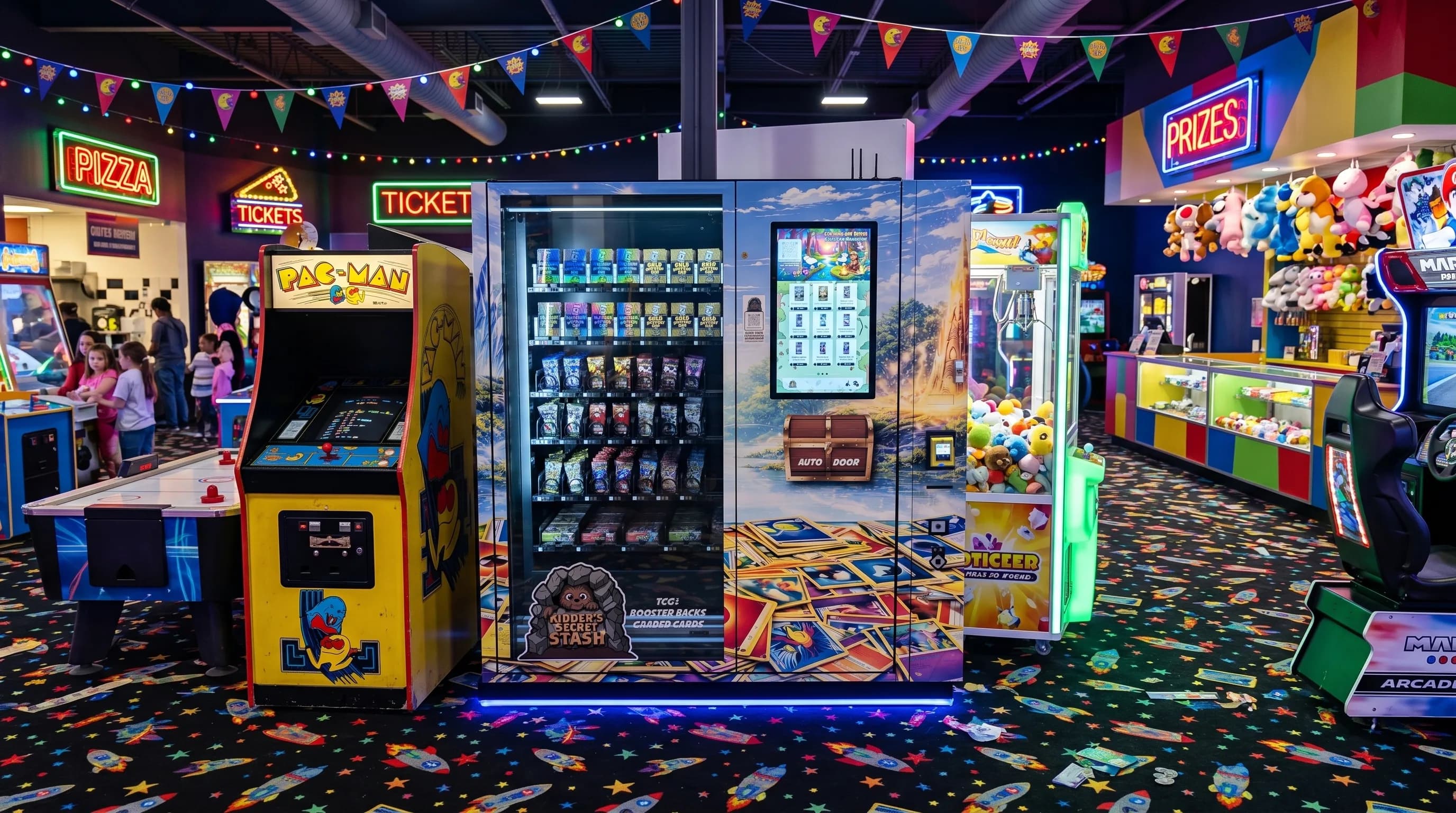
DMVI builds every machine with fully custom branding using the operator's identity: your business name, your logo, your colour palette, your design language. The Pokémon IP appears only in one place: the authentic, sealed product visible through the machine window. That product's packaging carries TPCi's marks. Your machine does not.
On the touchscreen interface, DMVI's software displays product names and images sourced from official product databases. This is factual, descriptive product identification — the same thing Amazon or any retailer does when listing a product for sale.
This approach is clean, professional, legally sound, and frankly better for your brand. Operators who build a recognizable brand identity around their machines — not around borrowed IP — build businesses with real equity.
Section 4: Use of Pokémon Imagery — When It's OK
Operators frequently ask about specific scenarios. Here's a plain-language breakdown:
| Situation | Legal? | Why |
|---|---|---|
| Product photos of authentic sealed product you own | Yes | You're photographing your inventory; this is standard retail practice |
| Listing product names and images on your touchscreen | Yes | Nominative fair use — accurately describing what you sell |
| Screenshots from the Pokémon TCG app for informational blog content | Generally yes | Editorial/informational use in context |
| Official product images from press kits for an article | Generally yes | Descriptive editorial use with attribution |
| Creating Pokémon fan art for your machine wrap | No | Requires TPCi license |
| Using the Pokémon logo in your business name or logo | No | Direct trademark infringement |
| Claiming "Official Pokémon Vending Machine" on your wrap | No | False affiliation — trademark infringement + consumer fraud |
| Designing a Pikachu character for your marketing materials | No | Requires TPCi license |
The working rule: describe what you sell accurately and specifically. Do not create — through imagery, text, or design — any impression that your business is officially affiliated with, endorsed by, or authorized by The Pokémon Company International.
Section 5: Business Structure — LLC vs. Sole Proprietor
The legal question operators spend the least time on often causes the most expensive problems. Your business structure determines what happens when something goes wrong — and in any business that involves physical equipment in a public location, something eventually goes wrong.
Sole proprietor
The simplest structure: no separate entity, no filings beyond a business name registration. Income flows directly to your personal tax return. But here's the problem: there is no legal separation between you and your business. If a customer claims injury near your machine, if a venue sues you for a contract dispute, or if your machine causes property damage, your personal assets — savings, home, car — are on the table.
For a vending machine operator with a $10,000–$40,000 machine in a public mall, this is an unacceptable risk level.
LLC (Limited Liability Company)
An LLC creates a legal entity separate from you personally. The business owns the machine, holds the contracts, and carries the liability. If something goes wrong, creditors can pursue business assets — not your personal ones. This protection is not absolute (gross negligence and fraud can pierce the veil), but for standard business liabilities it is highly effective.
LLC formation is not complicated or expensive:
- Cost: $50–$500 depending on state (Delaware and Wyoming are popular for their low fees and flexible statutes; your home state works fine for most operators)
- Time: 1–5 business days online in most states
- Process:
- File Articles of Organization with your state's Secretary of State
- Apply for an EIN from IRS.gov (free, instant)
- Open a dedicated business bank account
- Obtain your resale certificate from your state revenue department
- Draft an Operating Agreement (critical even for single-member LLCs)
Operating agreement
This document governs how your LLC operates. For a single-member LLC it seems unnecessary — but it is the document that proves your LLC is a real, functioning entity separate from you personally. Without it, a court could potentially disregard your LLC in a lawsuit and come after personal assets. One hour with a template (LegalZoom, Northwest Registered Agent, or a local attorney) is worth the protection.
S-Corp election
Once your machine generates meaningful profit — generally above $40,000–$50,000 net annually — an S-Corp tax election through IRS Form 2553 can reduce your self-employment tax burden significantly. Consult a CPA who works with small business owners before making this election.
Section 6: Required Permits and Registrations
Here is the complete compliance checklist. None of these are optional — each one covers a specific legal or contractual requirement for operating a commercial vending machine.
| Requirement | Where to Get It | Cost | Required Before |
|---|---|---|---|
| LLC formation | State Secretary of State website | $50–$500 | First sale |
| EIN (Employer Identification Number) | IRS.gov — free, instant | $0 | Opening business bank account |
| Business bank account | Any bank or credit union | $0–$25/month | First transaction |
| Resale certificate | State revenue department | $0 in most states | First wholesale purchase |
| Sales tax permit | State revenue department | $0–$100 | First sale |
| Business license | City/county clerk | $50–$200 | Operating machine |
| Vending machine permit | Some cities/counties require | $0–$200/year | Machine placement |
| Venue location agreement | Negotiated with venue | $0 (legal fee varies) | Machine placement |
A note on resale certificates: This document (also called a resale exemption certificate or seller's permit in some states) allows you to purchase inventory without paying sales tax — because you'll be collecting it from your customers instead. Present this to GTS Distribution, Alliance Game Distributors, or any other distributor when setting up your wholesale account.
A note on vending machine permits: Requirements vary significantly by city and county. Some jurisdictions require a dedicated vending machine permit or health department registration. Check with your city clerk and county assessor before placing machines — especially in cities like Chicago, Los Angeles, or New York where municipal licensing requirements are more extensive.
Section 7: Insurance Requirements
Insurance is not optional for a commercial vending machine operator. Virtually every mall, FEC, and commercial venue in the United States will require proof of insurance before allowing machine placement. "I'll get it later" is not an option — you need it before approaching venues.
Coverage types you need
General Liability (GL)
The foundational policy every operator needs. Standard coverage is $1 million per occurrence / $2 million aggregate. This covers claims arising from bodily injury or property damage connected to your business operations — if a customer claims they were injured near your machine, or if the machine damages venue property, GL is your first line of protection.
Most malls and commercial venues require a Certificate of Insurance (COI) naming the venue or property manager as an additional insured. Get this documentation before you approach any venue — it signals that you are a professional operator.
Inland Marine Insurance
Standard property insurance doesn't cover equipment that moves or is located off-premises. Inland Marine covers your machine against theft, vandalism, and damage during transport. Think of it as equipment insurance designed for assets that don't stay in one place permanently.
Business Personal Property (BPP)
Covers your inventory inside the machine — the Pokémon product you've stocked. For a fully loaded M1 carrying $3,000–$6,000 in inventory, this is meaningful coverage.
Business Owner's Policy (BOP)
A BOP bundles General Liability and property coverage into a single policy, typically at a lower combined cost than purchasing each separately. For a 1–3 machine operator, a BOP is usually the most cost-efficient option.
What it costs
A single-operator running 1–3 machines should budget $400–$1,200 per year for a BOP with adequate coverage limits. This is a business expense — it comes off your taxable income and is built into your operating cost model when you calculate margins.
Insurers that work well with vending operators include Hiscox, Next Insurance, and The Hartford. Your state's independent agent marketplace (Insureon) can compare multiple carriers.
Section 8: Sales Tax — How It Works for Vending Operators
Pokémon vending machine sales are taxable retail transactions in almost every US state. As the retailer, you are responsible for collecting sales tax from the customer and remitting it to the state on a regular schedule.
Key points:
- You are the retailer. Even though you're running a machine, not a store, you are making retail sales and are subject to the same sales tax obligations as any other retailer in your state.
- Register before your first sale. Most states require you to obtain a sales tax permit (sometimes called a seller's permit) before collecting tax. The application is free or low-cost and available through your state revenue department's website.
- Configure your payment terminal. DMVI machines use Nayax payment terminals, which can be configured for tax-inclusive pricing (the displayed price includes tax) or tax-exclusive pricing (tax added at checkout). Tax-inclusive is generally simpler for vending operations and avoids surprising customers at the point of sale.
- File and remit on schedule. States typically require monthly or quarterly filing depending on revenue volume. New registrants often start on monthly filing and transition to quarterly as their records establish a pattern.
- Keep transaction records. VendingTracker — the cloud management system built into DMVI machines — logs every transaction. These records are your sales tax documentation. Maintain them diligently; they are what you'll use to complete your returns and what auditors will request if the state ever reviews your filings.
Sales tax law is state-specific and occasionally complex (some states exempt certain food and drug products but have no vending-specific exemption; most treat vending sales as standard taxable retail). When in doubt, consult a CPA or your state revenue department's taxpayer services line.
Section 9: What IS Illegal
Everything above clarifies what you can do. Here is what you cannot — and the consequences are serious.
Selling counterfeit Pokémon cards
This is the line that ends businesses and can result in criminal charges. Counterfeit Pokémon products — cards printed without TPCi authorization — are not covered by the First Sale Doctrine. Selling them constitutes:
- Trademark infringement (civil liability, injunctions, damages up to $2 million per counterfeit mark under 15 U.S.C. § 1117)
- Criminal fraud if you knowingly misrepresent counterfeit product as authentic
- Potential seizure of your machine and inventory by federal law enforcement if the operation is large enough
The fix is simple: only buy from authorized distributors. The four distributors that maintain the authenticated supply chain for Pokémon TCG products in the US are:
- GTS Distribution
- Southern Hobby Supply
- Alliance Game Distributors
- ACD Distribution
These distributors source product directly from TPCi or through TPCi-authorized channels. Product in their inventory is authentic by definition. Do not source from overseas online marketplaces, unverified wholesalers, or any channel that offers product at prices too good to be true — counterfeit product is often priced aggressively to appear as a deal.
Selling opened or repackaged product as sealed
Removing cards from packs — whether to cherry-pick hits, replace damaged cards, or resell individual cards — and then resealing and selling the product as sealed is fraud. Customers are paying a premium specifically for the randomized, unmanipulated sealed experience. Misrepresenting opened product as sealed violates consumer protection laws in every state and exposes you to both civil and criminal liability.
False affiliation claims
Claiming to be an "Official Pokémon Vending Machine," an "Authorized Pokémon Retailer," or any formulation that implies endorsement or partnership with TPCi is trademark infringement and consumer fraud.
Operating without a sales tax permit
Collecting sales tax and not remitting it — or not registering to collect it at all — is tax evasion. States actively audit vending operators. The penalties include back taxes, interest, and in serious cases, criminal prosecution.
Using Pokémon imagery in your machine branding without a license
As covered in Section 3 — putting TPCi's trademarked logos, characters, or artwork on your machine wrap without a license is trademark infringement. It also creates the false impression of official affiliation. Brand your machine with your own identity.
Launch Legally with DMVI
The legal framework for Pokémon vending machine operation is straightforward once you understand it. The First Sale Doctrine is your foundation. Standard business registration — LLC, EIN, tax permits, insurance — is the same infrastructure any legitimate small business needs. Trademark compliance means branding your machine with your identity, not TPCi's. And supply chain integrity means buying from the four authorized distributors every time, no exceptions.
What makes DMVI operators different from operators who stumble into legal trouble is the infrastructure they start with. DMVI builds custom-branded machines that keep operators trademark-compliant by design — your brand on the wrap, not borrowed IP. The Nayax cashless payment system built into every machine handles sales tax configuration. VendingTracker provides the transaction records your accountant and the state revenue department will eventually ask for.
DMVI is a California-based manufacturer with a track record of helping independent operators launch legitimate, scalable businesses. The partnership model is built on operator success — if you are successful, DMVI is successful.
Ready to build your legal, profitable Pokémon vending machine business? View DMVI's Pokémon card vending machines and request a consultation. You can also explore our full compliance resource library: the LLC setup guide for Pokémon vending operators, the insurance guide, and the wholesale sourcing guide pick up where this post leaves off.
For the foundational business overview, start with How to Start a Pokémon Vending Machine Business — the Hub 5 companion piece to this guide.
Legal Disclaimer: This post is for informational purposes only and does not constitute legal advice. Laws vary by jurisdiction and change over time. Consult a qualified attorney for guidance specific to your situation and jurisdiction before making business decisions based on the information in this guide.
Want pricing, format guidance, or a launch plan?
DMVI can help you compare Pokemon vending machine formats, rollout strategy, financing, and location fit based on your route goals.