
Pokémon Vending Machine Startup Cost: A Complete Budget Breakdown (2026)
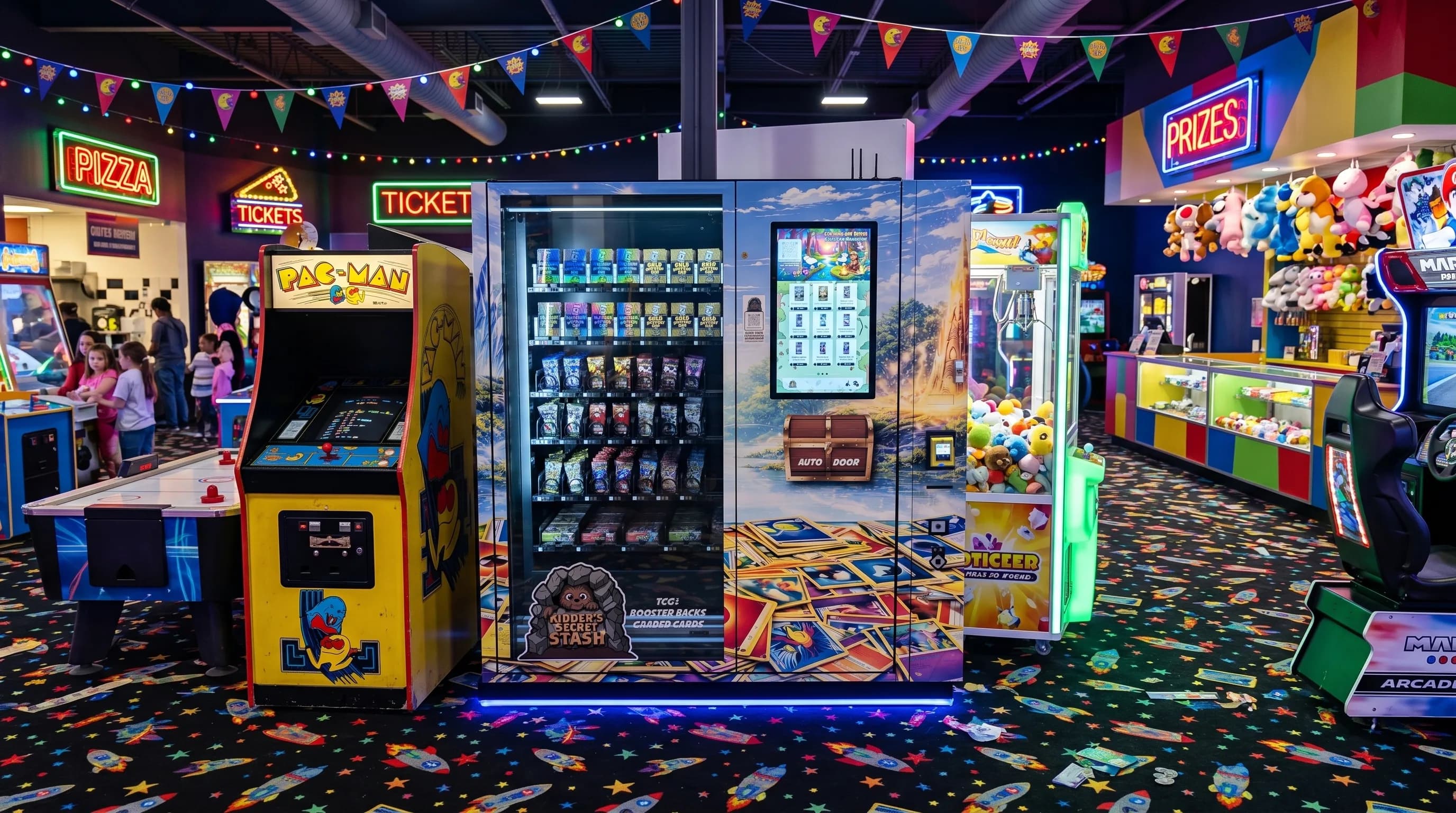
DMVI purchase financing: Subject to approval and not guaranteed; DMVI reserves the right to deny financing. A 25%–50% machine deposit is required depending on whether the machine is in stock, with the percentage specified in your quote. The remaining machine balance is paid in 12 monthly payments with 8% simple interest. All upfront costs are due at signing, including the wrap, optional topper, payment terminal, first-year software subscription, shipping, sales tax, and other quoted upfront charges. A UCC filing applies, and a personal guarantee may be required. See vending machine financing and your approved agreement for details.
TL;DR: DMVI's Pokémon vending machines range from $4,995 (Wall-Mounted) to $39,995 (M3 flagship). Illustrative cash-purchase startup budgets — machine, inventory, LLC, insurance, freight, and location costs — typically run $8,000–$45,000 depending on format. Approved financing requires a deposit and all signing costs upfront. The separate M1 lease example below uses $625/month; confirm current lease terms in a quote.
One of the most common questions from aspiring operators is simple: what does this actually cost, all-in?
Not just the machine price. The full picture — hardware, inventory, business registration, insurance, freight, and location fees. Most vending business guides stop at the sticker price and leave you to reverse-engineer everything else. This post does the opposite.
Below is a complete line-item breakdown of every cost category you'll encounter before your first sale, plus three real budget scenarios — lean, standard, and premium — so you can plan with actual numbers before you commit a dollar. Whether you're considering a single wall-mounted unit in a barbershop or an M1 flagship in a regional mall, this is the budget framework that will keep you from getting surprised.
Section 1: Machine Hardware Cost
The machine is a major startup cost. DMVI manufactures eight distinct formats, ranging from compact wall-mounted units to the full-scale M3 flagship. Purchase prices and ideal use cases are summarized below; financing requires a separate approved quote.
| Machine | Purchase Price | Best For |
|---|---|---|
| Wall Mounted | $4,995 | Barbershops, card shops, small venues |
| Wall Mounted XL | $5,995 | Higher-capacity wall placements |
| Standard (base) | $8,500 | Mid-tier locations |
| Standard | $10,000 | Mid-tier locations with higher SKU needs |
| Option 4 | $12,995 | Larger venues, 4-section layout |
| M1 | $21,995 | Malls, airports, flagship deployments — up to 140 SKUs |
| M2 | $30,995 | High-volume multi-category deployments |
| M3 | $39,995 | Largest footprint, maximum inventory capacity |
Financing budget: Start with the deposit and all signing costs, then add initial inventory, location costs, insurance, and operating reserves. The remaining machine balance is payable over 12 months if approved.
Approval: DMVI evaluates financing requests individually and may deny them. Business age or a credit score alone does not guarantee eligibility or acceptance.
The Lease Alternative
If you prefer not to deploy capital upfront, DMVI offers the M1 on a lease at $625/month all-inclusive. That price covers the machine, custom full-body graphic vinyl wrap, cloud management via VendingTracker.com, custom shelves, branded touchscreen UI, California-based tech support, remote diagnostics, and on-screen digital advertising capability. An optional backlit illuminated logo topper is available for $40/month additional.
For operators who want to test the model before making a six-figure commitment, the lease path removes the hardware risk entirely.
See the full Pokémon vending machine format guide for a deeper look at how formats compare by capacity, footprint, and revenue potential.
Section 2: Initial Inventory Cost
The machine is the infrastructure. Inventory is what generates revenue from day one.
Wholesale Economics
Pokémon booster packs are your highest-velocity, highest-margin product. At wholesale:
- Booster pack cost: ~$2.20–$2.50 per pack (vs. $4.49 MSRP retail)
- Booster box cost: ~$80–$90 per box of 36 packs (vs. ~$144 MSRP)
- Vend price: typically $8–$12 per pack
- Gross margin: 59–61% on booster packs
Authorized distributors — including GTS Distribution, Southern Hobby Supply, Alliance Game Distributors, and ACD Distribution — supply at these wholesale tiers. Sourcing exclusively through authorized distributors also protects you legally and ensures product authenticity.
How Much Inventory to Budget
The amount of inventory needed at launch depends on your machine format and how densely you want to stock it:
- Wall-mounted machine (40–60 slots): $400–$800 in booster packs to fill; recommended first-stock budget of $800–$1,500 to carry buffer stock
- Option 4: Recommended first-stock budget of $1,500–$3,000
- M1 (up to 140 SKUs, mixed product): $3,000–$8,000 depending on mix; plan for $5,000 as a solid baseline
The biggest revenue driver in practice is booster packs sold by the case — high velocity, predictable reorder cadence, and the highest total margin per square foot of machine shelf space. Current Scarlet & Violet sets — Prismatic Evolutions, Journey Together, Destined Rivals, and Mega Evolution — are the fastest-moving SKUs on DMVI machines as of May 2026.
A useful operating principle: do not understock. Running out of product in a high-traffic location means lost sales you can never recover. Build 2–3 weeks of buffer inventory into your initial order.
Section 3: Business Setup Costs
Getting your business entity and compliance infrastructure in place is a one-time cost category that operators frequently underestimate — or skip entirely, which creates larger problems later.
| Item | Cost |
|---|---|
| LLC formation | $50–$500 (avg. ~$150, varies by state) |
| Registered agent | $0–$150/year |
| EIN (Employer Identification Number) | Free (IRS website) |
| Business bank account | $0–$25/month |
| Resale certificate | Free in most states |
| Sales tax permit | $0–$100 |
| Business liability insurance (GL + inland marine) | $400–$1,200/year |
| Total business setup | $600–$2,000 |
A few notes on each line:
LLC formation is handled at the state level. Delaware, Wyoming, and your home state are the most common choices. Most operators file in their home state — it's simpler and avoids registered agent duplication costs.
General liability insurance covers third-party bodily injury and property damage. Inland marine (sometimes called commercial property floater) covers your machines and inventory while in transit and at location. Both policies together typically cost $400–$1,200/year, depending on the number of machines and your insurer.
Resale certificate is critical — it allows you to purchase inventory wholesale without paying sales tax on goods you'll resell. Free to obtain in nearly every state; just file with your state's department of revenue.
Properly structured, your total business setup cost is a one-time investment under $2,000 that protects the entire operation going forward.
Section 4: Payment Processing Setup
Every DMVI machine ships pre-equipped with a Nayax cashless payment terminal — there is no additional hardware to source or install.
Nayax accepts:
- Tap (NFC)
- Swipe (magnetic stripe)
- Chip (EMV)
- Apple Pay
- Google Pay
Processing fee: ~5% of gross transactions. This is standard across the vending industry — slightly higher than traditional retail point-of-sale processing, but consistent with what all smart vending operators pay.
No additional setup fee when purchasing or leasing through DMVI. The terminal is already installed, configured, and integrated with VendingTracker.com cloud reporting before the machine ships.
At $6,000/month in gross sales, processing costs run approximately $300/month — a predictable, volume-scaled expense rather than a fixed overhead item.
Section 5: Freight & Installation
Machine delivery is a real cost that belongs in every startup budget.
- Freight cost: $300–$1,200 depending on your location in the contiguous US
- Installation: Typically included or a minimal add-on for ground-floor placements. Machines requiring freight elevator coordination or complex placement may carry a small additional fee — confirm with DMVI during your ordering process.
- Lead time: In-stock machines ship promptly. Custom-wrapped machines (which is the standard for M1 lease units and many purchased configurations) take approximately 3–6 weeks from order to delivery.
Budget $500 as a midpoint estimate for freight on a single machine. If you're placing multiple units simultaneously, consolidated shipping may reduce per-unit cost.
Section 6: Location Costs
Location cost is the most variable line in your budget and the one that has the most direct impact on revenue potential. Higher-traffic locations cost more but typically return multiples more in sales volume.
Fee Structures
Locations typically charge in one of two ways:
Flat monthly rent: A fixed fee regardless of sales volume. Better for operators once sales are strong; higher risk in the early months.
Revenue share: A percentage of gross sales. Better for operators when launching into an unproven location; the venue shares the risk.
Cost by Venue Type
| Venue Type | Typical Cost |
|---|---|
| Barbershop / hair salon | $100–$300/month flat |
| Card shop / hobby store | $100–$300/month flat (or small revenue share) |
| FEC / arcade / entertainment center | 15–20% revenue share |
| Strip mall / retail corridor | $300–$600/month flat |
| Regional mall | $500–$1,500/month flat, or ~10% revenue share |
| Airport / transit hub | $500–$2,000/month flat (varies significantly by terminal) |
Mall placements are the highest-revenue opportunity in DMVI's operator network. Mall operators are actively seeking this category — collectibles vending fills dead square footage with a product that drives repeat foot traffic. DMVI provides direct mall introductions as part of its partnership program, which removes the cold-outreach barrier that slows most new operators.
For a deeper look at venue selection strategy, see /pokemon-vending-machine-best-locations.
Section 7: Three Complete Budget Scenarios
The following scenarios illustrate selected cash-purchase startup costs from lean to premium, not complete quotes. Add the quoted wrap, optional topper, payment terminal, first-year software subscription, applicable sales tax, and any other charges not itemized below. An approved financed purchase requires a deposit and all signing costs upfront, plus a 12-payment schedule; use those actual figures to model cash flow.
Scenario A: Lean Build — Wall-Mounted, Low-Rent Location
Ideal for: First-time operators testing the model with minimal capital exposure.
| Line Item | Cost |
|---|---|
| Machine (Wall Mounted, purchase) | $4,995 |
| Inventory (first stock) | $1,200 |
| Business setup (LLC, insurance) | $800 |
| Freight | $400 |
| Subtotal of listed startup items | ~$7,395 before additional quoted costs |
| Location (monthly) | $150/month |
| If financed | Use the approved quote; deposit and all signing costs are due upfront |
Scenario B: Standard Build — M1, Quality Mall Location
Ideal for: Operators ready to go big from day one with a flagship machine in a verified high-traffic venue.
| Line Item | Cost |
|---|---|
| Machine (M1, purchase) | $21,995 |
| Inventory (first stock) | $5,000 |
| Business setup | $1,500 |
| Freight | $800 |
| Subtotal of listed startup items | ~$29,295 before additional quoted costs |
| Location (monthly) | $750/month |
| If financed | Use the approved quote; deposit and all signing costs are due upfront |
| If leased: M1 at $625/month | Total monthly ~$1,700/month (no upfront hardware cost) |
At conservative M1 performance ($6,000–$7,000/month gross), this build can reach cash-flow positive from month one on the lease path.
Scenario C: Premium Flagship — M3, High-Traffic Mall
Ideal for: Operators with retail experience, access to capital, and a high-traffic confirmed location.
| Line Item | Cost |
|---|---|
| Machine (M3, purchase) | $39,995 |
| Inventory (first stock) | $8,000 |
| Business setup | $2,000 |
| Freight | $1,200 |
| Subtotal of listed startup items | ~$51,195 before additional quoted costs |
| Location (monthly) | $1,200/month |
| If financed | Use the approved quote; deposit and all signing costs are due upfront |
Section 8: How Long to Break Even?
Break-even timeline depends on your format, location, and whether you purchase or lease.
Purchase scenario: Most operators break even in 4–9 months from their first full month of operation, assuming a quality location and consistent restocking cadence.
Lease scenario: The M1 at $625/month can be cash-flow positive from month one, since there is no hardware capital to recoup.
Revenue Math on the M1
| Performance Level | Gross Monthly Revenue | Net After Lease + Rent + Processing |
|---|---|---|
| Conservative | $6,000–$7,000 | ~$4,300–$5,300 |
| Strong | $25,000–$30,000 | ~$23,250–$28,250 |
| Peak (proven) | $87,000 | ~$81,275 |
The $87,000 figure was achieved by a single DMVI operator in the San Francisco Bay Area in one month from one machine.
At $6,000/month gross on the M1 lease: $6,000 minus $625 (lease) minus $750 (mall rent) minus $300 (5% processing) = $4,325 net. That covers the initial inventory investment in 35–45 days.
At $25,000/month gross, the math becomes considerably more compelling. At peak, the machine is a cash machine by any conventional definition.
For a detailed walk-through of the revenue model, see the Pokémon vending machine ROI and profit calculator.
Ready to Build Your Budget?
The numbers are on the table. Now the question is which format fits your location, your capital, and your timeline.
Explore DMVI's full Pokémon vending machine lineup to compare hardware options and request a quote, including the financing review process if relevant.
If you're at the early research stage, start with the guide to how to start a Pokémon vending machine business — it covers location selection, distributor relationships, and the operational setup in full detail.
Whether you start with a $4,995 wall-mounted unit or go straight to an M1 flagship, the cost structure is transparent and the economics are proven. The inventory margin is there. The consumer demand is there. The infrastructure to run it is purpose-built.
View DMVI's Pokémon card vending machines and take the first step.
Want pricing, format guidance, or a launch plan?
DMVI can help you compare Pokemon vending machine formats, rollout strategy, financing, and location fit based on your route goals.