
Pokémon Vending Machine Profit: Real Revenue Data, Margin Math & Break-Even Timeline
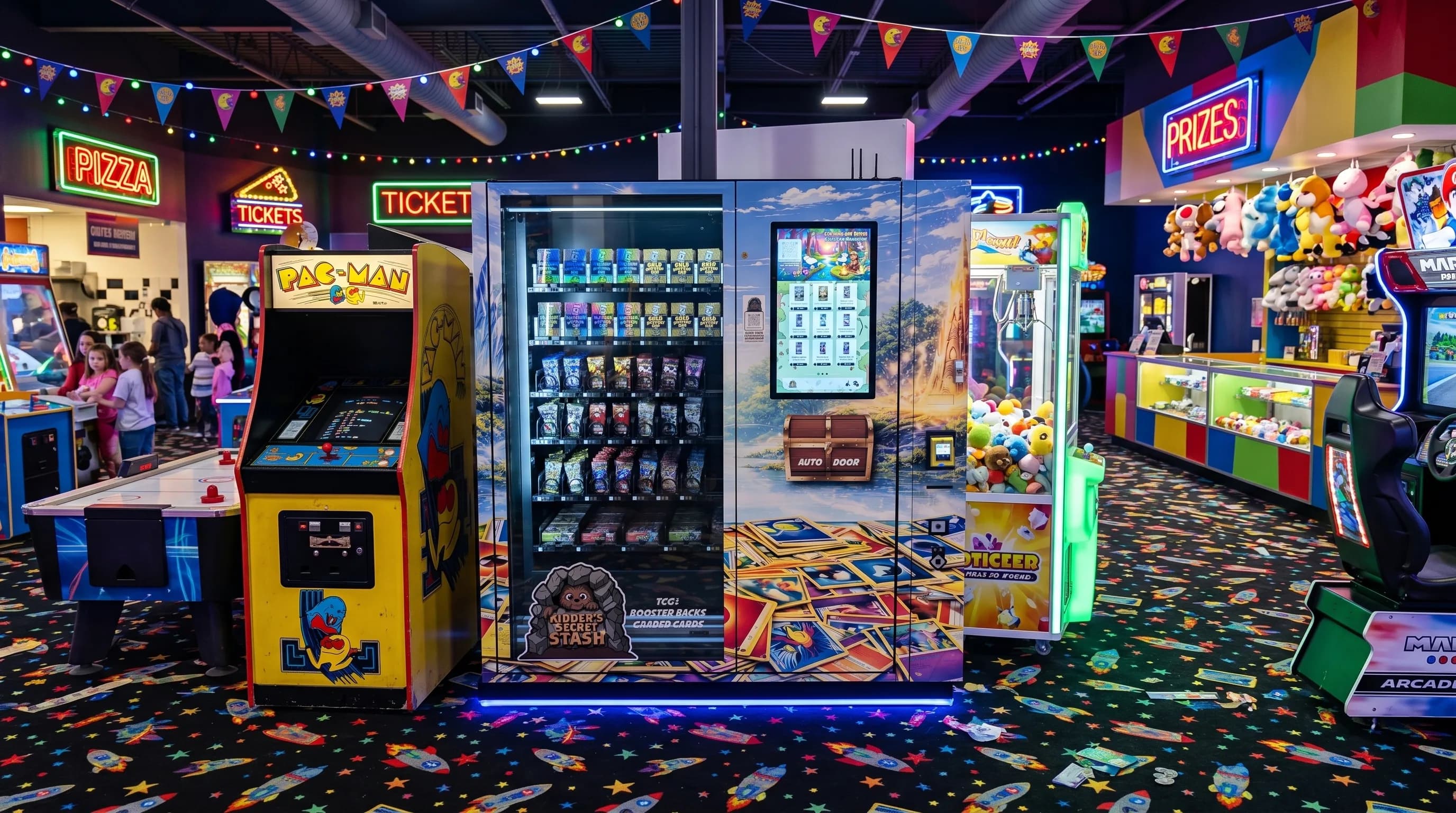
DMVI purchase financing: Subject to approval and not guaranteed; DMVI reserves the right to deny financing. A 25%–50% machine deposit is required depending on whether the machine is in stock, with the percentage specified in your quote. The remaining machine balance is paid in 12 monthly payments with 8% simple interest. All upfront costs are due at signing, including the wrap, optional topper, payment terminal, first-year software subscription, shipping, sales tax, and other quoted upfront charges. A UCC filing applies, and a personal guarantee may be required. See vending machine financing and your approved agreement for details.
TL;DR — Are Pokémon vending machines profitable?
Yes. DMVI field data from active M1 deployments shows conservative operators clearing $4,300–$5,300/month net and strong performers reaching $23,250–$28,250/month net. The proven peak: $87,000 gross in a single month from one operator in the San Francisco Bay Area. Gross margins on booster packs run 59–61% at MSRP, and significantly higher at typical vend prices of $8–$12 per pack.
Before committing capital, every operator asks the same question: is this actually profitable? The answer is yes — but the numbers depend on location, SKU mix, and how well you manage the machine. This post shows the real math: unit economics, monthly P&Ls at three performance levels, break-even timelines, and the specific products that drive the highest returns.
If you are evaluating a Pokémon vending machine investment, this is the data you need to make a sound decision.
Section 1: Unit Economics — Per-Pack Profit Math
The foundation of any vending operation is per-unit economics. For Pokémon TCG, the numbers are exceptionally favorable.
Wholesale cost for booster packs runs $2.20–$2.50 per pack through authorized distributors — roughly 50% off MSRP. MSRP is $4.49 per pack. Most vending operators price individual packs at $8–$12, reflecting the convenience premium of a 24/7 self-serve location. At a $10 vend price with a $2.35 wholesale cost:
- Gross profit per pack: $7.65
- Gross margin: ~76.5%
- After payment processing (~5%): $0.50 deducted
- Net per-pack contribution: ~$7.15
That margin holds at scale. A machine moving 30 packs per day produces ~$214 in net contribution daily before fixed costs — before a single case, ETB, or mystery box is sold.
The table below compares key SKUs across the margin stack:
| Product | Wholesale Cost | Vend Price | Gross Margin | Net After Processing |
|---|---|---|---|---|
| Booster Pack | ~$2.35 | $10 | ~76% | ~$7.15 |
| Booster Box (36 packs) | ~$85 | $180 | ~53% | ~$86 |
| Elite Trainer Box | ~$35 | $70 | ~50% | ~$66.50 |
| Mystery Box (curated) | ~$15 | $35 | ~57% | ~$33.25 |
| Graded Slab (PSA 9) | varies | $50–$500+ | varies | varies |
Cases produce the highest total margin per transaction. A single case sale at $150 generates the same gross revenue as 15 individual pack sales, but typically requires the same transaction time and zero additional slot management. Operators who stock and merchandise cases consistently outperform those running packs only.
Authorized distributors stocking these products include GTS Distribution, Southern Hobby Supply, Alliance Game Distributors, and ACD Distribution — all operating at standard ~50% off MSRP pricing for credentialed resellers.
Section 2: Daily, Weekly, and Monthly Revenue Scenarios
Individual pack sales are the entry point, but they are not where the biggest revenue lives. The table below models five common operator profiles against monthly net after a flat rent of $750 and 5% payment processing:
| Daily Transactions | Avg. Transaction Value | Monthly Revenue | Monthly Net (after $750 rent + 5% processing) |
|---|---|---|---|
| 5 packs/day | $10 | ~$1,500 | ~$600 |
| 15 packs/day | $10 | ~$4,500 | ~$3,525 |
| 30 packs/day | $10 | ~$9,000 | ~$7,800 |
| 10 cases/day | $150 | ~$45,000 | ~$41,500 |
| Mixed (packs + boxes + cases) | varies | ~$25,000 | ~$23,000 |
The math on cases is striking. Ten case sales per day at $150 each generates $45,000/month gross — a figure that requires 150 individual pack transactions per day at the same $10 vend price. A well-stocked M1 with 140 SKU slots can comfortably accommodate both pack and case inventory simultaneously, which is exactly the mixed-SKU model that drives the $25,000+ monthly figures.
The practical takeaway: the revenue ceiling of a Pokémon vending machine is not the machine itself — it is the SKU strategy. Operators who treat the machine as a pack dispenser leave substantial margin on the table. Operators who treat it as a multi-format TCG retail point consistently outperform baseline projections.
If you are evaluating formats, the best locations guide covers how location type interacts with SKU strategy.
Section 3: Real DMVI Operator Performance Data
DMVI publishes field data from active M1 deployments. These are not projections — they are outcomes from machines in operation:
| Scenario | Monthly Revenue | Machine Lease | Mall Rent (est.) | Processing (5%) | Est. Net Revenue |
|---|---|---|---|---|---|
| Conservative | $6,000–$7,000 | $625 | $750 | ~$325 | ~$4,300–$5,300 |
| Strong | $25,000–$30,000 | $625 | $750 | ~$1,375 | ~$23,250–$28,250 |
| Peak (Proven) | $87,000 | $625 | $750 | ~$4,350 | ~$81,275 |
$87,000 gross in a single month was achieved by a single operator in the San Francisco Bay Area. Results vary by location, inventory strategy, and market conditions. Conservative figures represent a realistic baseline for new operators entering their first deployment.
Even the conservative scenario outperforms the machine's cost structure by a wide margin. At $4,300–$5,300 net per month, the lease payment of $625 is covered more than six times over. Fixed costs are not the constraint in this business — SKU selection, restocking discipline, and location quality are.
The $87,000 peak also illustrates an important structural characteristic of this market: demand is not evenly distributed across the year. The highest-earning months correlate with major Pokémon TCG set releases, a dynamic explored in Section 5.
Section 4: Location and Commission Structure — Impact on Profit
Not all locations charge flat rent. Many high-traffic placements — particularly malls negotiating with newer operators — prefer a revenue share model. Understanding how each structure interacts with your volume is essential before signing a placement agreement.
Revenue share benchmarks:
- Standard range: 10–20% of gross revenue
- Common rate for mall placements: 15%
Revenue share vs. flat rent at key volume levels:
| Monthly Gross | Flat Rent ($750) | Revenue Share (15%) | Retained — Flat | Retained — Share |
|---|---|---|---|---|
| $6,000 | $750 | $900 | $5,250 | $5,100 |
| $10,000 | $750 | $1,500 | $9,250 | $8,500 |
| $20,000 | $750 | $3,000 | $19,250 | $17,000 |
| $30,000 | $750 | $4,500 | $29,250 | $25,500 |
Flat rent wins at high-volume locations. Once you are consistently above ~$5,000/month, flat rent preserves significantly more margin. Revenue share wins at uncertain or unproven locations where you want downside protection — if revenue comes in soft, your occupancy cost scales down with it.
DMVI provides direct mall introductions to operators as part of its partnership program, which means you are not negotiating placement from scratch. Established relationships with mall management teams give operators access to high-traffic locations that independent operators often cannot secure. See more on the revenue share vs. flat rent comparison for a detailed breakdown.
Section 5: New Set Release Revenue Spikes
The Pokémon TCG release calendar is not incidental to the revenue model — it is the revenue model.
Major sets ship quarterly. The current Scarlet & Violet era includes Prismatic Evolutions, Journey Together, Destined Rivals, and Mega Evolution. Each launch generates a demand spike that materially affects vending machine revenue in the days and weeks immediately following release.
What happens during release week:
- Vend prices for new-set packs can command 2.5–3.5× normal pricing due to immediate supply constraints and collector demand
- A machine averaging $7,000/month in steady-state can produce $15,000–$25,000+ during a single release month
- Secondary demand often sustains elevated prices for 2–4 weeks post-launch, particularly for high-chase sets like Prismatic Evolutions
How operators capture this upside:
- Pre-order allocation secured before street date through authorized distributors
- Remote pricing adjustments via VendingTracker (built into DMVI's M1 lease) — no physical visit required to update vend prices
- Separate slot inventory dedicated to new-set product, with existing SKUs shifted to secondary positions
The operators achieving $25,000–$30,000+ months consistently are not doing anything structurally different from conservative performers. They are executing the same machine model with better timing on set releases and faster repricing. For a full tactical breakdown, see the Pokémon TCG new set release vending strategy guide.
Section 6: 12-Month Worked P&L Example
The following scenario models a first-time M1 operator on a $625/month lease, placed in a mid-tier mall location. No purchase financing, no down payment — lease only.
Assumptions:
- Machine lease: $625/month
- Location rent (flat): $750/month
- Payment processing: 5% of gross
- One Scarlet & Violet major set release in months 5–6
Month-by-month projection:
| Period | Monthly Gross | Fixed Costs (Lease + Rent) | Processing (5%) | Est. Net |
|---|---|---|---|---|
| Month 1 | $3,000 | $1,375 | $150 | $1,475 |
| Month 2 | $4,500 | $1,375 | $225 | $2,900 |
| Month 3 | $6,500 | $1,375 | $325 | $4,800 |
| Month 4 | $6,500 | $1,375 | $325 | $4,800 |
| Month 5 | $14,000 | $1,375 | $700 | $11,925 |
| Month 6 | $10,000 | $1,375 | $500 | $8,125 |
| Month 7 | $8,500 | $1,375 | $425 | $6,700 |
| Month 8 | $8,500 | $1,375 | $425 | $6,700 |
| Month 9 | $9,000 | $1,375 | $450 | $7,175 |
| Month 10 | $9,000 | $1,375 | $450 | $7,175 |
| Month 11 | $10,000 | $1,375 | $500 | $8,125 |
| Month 12 | $10,000 | $1,375 | $500 | $8,125 |
12-month totals:
- Gross revenue: ~$99,500
- Total fixed costs: $16,500 (lease + rent)
- Total processing fees: ~$4,455
- 12-month net: ~$78,545
Months 1–2 are the ramp period — learning the location, dialing in SKU mix, identifying which price points move fastest. By Month 3, the machine is fully optimized and generating ~$4,800 net. The set release in Month 5 produces a $11,925 net month — nearly double the steady-state figure — without any structural change to the operation.
For operators who purchase rather than lease: Do not substitute a purchase-financing payment into this lease example and assume the same return. Model the quoted deposit, all signing costs, 12 monthly balance payments, interest, and operating costs. Cash-flow break-even and total investment payback are different measures; neither is guaranteed by gross revenue. See the Pokémon vending machine startup cost breakdown.
Section 7: What Separates High Earners from Average Earners
The machines are identical. The product category is the same. What drives the performance gap between a $6,000/month operator and a $30,000/month operator comes down to five operational factors:
1. Location quality. Mall placement consistently outperforms strip mall or independent shop placement. Foot traffic, demographic match, and dwell time all favor enclosed malls. DMVI's mall introduction program exists specifically to reduce the friction of securing high-quality placements.
2. SKU diversity. Operators running packs only are leaving case and ETB margin on the table. The highest earners stock cases + ETBs + booster packs + mystery boxes simultaneously, capturing every purchase occasion — the $5 impulse buyer and the $200 collector in the same machine.
3. Set release execution. Pre-ordering allocation, updating vend prices via VendingTracker before street date, and merchandising new-set product prominently are the three levers that turn a normal month into a $15,000+ month.
4. Remote pricing discipline. VendingTracker (included in every M1 lease) allows operators to adjust prices remotely without a site visit. High earners reprice weekly based on secondary market conditions. Average earners set prices at launch and do not revisit them.
5. Restocking velocity. Empty slots are lost revenue. A machine that runs out of new-set product on Day 3 of a release week has forfeited its highest-margin window. Top operators maintain buffer stock and schedule restocks around release calendars. For more context on location-specific strategy, see how to start a Pokémon vending machine business.
DMVI's operator network and placement support are structured to compress the learning curve on all five factors. The partnership model is straightforward: if you succeed, DMVI succeeds.
Ready to Run the Numbers on Your Own Machine?
The data above reflects real operator outcomes — not projections built to justify a sale. If you are evaluating whether a Pokémon vending machine makes sense for your situation, the next step is a direct conversation about placement strategy, machine format, and realistic revenue expectations for your target location.
View DMVI's Pokémon vending machine formats and pricing — or request a quote and discuss placement strategy directly with the DMVI team.
DMVI provides mall introductions, custom machine branding, cloud management via VendingTracker, and California-based technical support. If you already operate a TCG store and want 24/7 automated revenue in additional locations without additional staff, the M1's Pokémon vending machine model is purpose-built for that expansion.
Call +1-800-490-1108 or request a quote online to get started.
Related reading:
- How to start a Pokémon vending machine business
- Pokémon vending machine startup cost breakdown
- Revenue share vs. flat rent — which structure wins?
- Pokémon TCG new set release vending strategy
- Best locations for a Pokémon vending machine
Want pricing, format guidance, or a launch plan?
DMVI can help you compare Pokemon vending machine formats, rollout strategy, financing, and location fit based on your route goals.