
Where to Place a Pokémon Vending Machine: 12 Venue Types Ranked by Revenue Potential
DMVI purchase financing: Subject to approval and not guaranteed; DMVI reserves the right to deny financing. A 25%–50% machine deposit is required depending on whether the machine is in stock, with the percentage specified in your quote. The remaining machine balance is paid in 12 monthly payments with 8% simple interest. All upfront costs are due at signing, including the wrap, optional topper, payment terminal, first-year software subscription, shipping, sales tax, and other quoted upfront charges. A UCC filing applies, and a personal guarantee may be required. See vending machine financing and your approved agreement for details.
TL;DR
The best locations for a Pokémon vending machine are high-footfall venues with collector-friendly demographics: shopping malls, family entertainment centers (FECs), arcades, card shops, airports, and barbershops. Avoid grocery stores (TPCi's exclusive territory) and low-traffic professional offices. DMVI provides direct mall introductions as part of its operator partnership — you don't have to cold-pitch venue managers on your own.
Introduction
Location is the single biggest driver of vending machine revenue. The same M1 machine in a mall corridor can generate $25,000 per month; placed in a low-traffic office lobby, that same machine might generate $500. Same machine. Same product. Completely different outcome.
Most first-time operators spend the bulk of their planning on machine selection and inventory and treat location as an afterthought. That's a costly mistake. The venue you choose determines your foot traffic ceiling, your demographic match, your average transaction value, and your repeat-customer rate — every number that feeds into your monthly net.
This guide ranks the 12 best venue types for a Pokémon vending machine by revenue potential, explains what makes each one work (or not work), gives realistic monthly revenue ranges drawn from real DMVI operator data, and identifies the venues you should walk away from entirely. By the end, you'll have a clear picture of exactly where to put your machine — and why.
Section 1: What Makes a Great Pokémon Vending Location?
| Location Question | Strong Signal | Weak Signal |
|---|---|---|
| Is the audience a fit? | Families, collectors, gamers, or hobby traffic already exist onsite | Foot traffic is high but the audience has no TCG overlap |
| Do people dwell? | Customers wait, browse, or linger long enough to notice the machine | Everyone passes through quickly with no pause time |
| Is the machine visible? | Natural line of sight near an entrance, queue, or attraction | Hidden corner placement or poor sightline |
| Is access easy? | Reliable power, sensible loading access, predictable hours | Awkward service access or uncertain operating hours |
| Is the venue partner cooperative? | Staff and management understand the revenue-share model quickly | Staff resistance or unclear decision maker |
| Can the economics work? | Rent / share terms leave room for healthy machine-level profit | Great foot traffic but impossible deal terms |
Before ranking individual venues, it helps to understand the four criteria that determine whether a location will perform. Every venue in this guide is scored against all four.
1. Foot Traffic Volume
A standalone floor unit like the M1 needs a minimum of 5,000–10,000 visitors per week to generate consistent revenue. Below that threshold, you're relying on a tiny pool of potential buyers and the numbers simply don't compound. High-traffic venues — malls, airports, convention floors — provide the volume necessary for Pokémon's impulse-purchase dynamic to work at scale.
2. Demographic Match
The core Pokémon collector demographic is 8–35 year olds, with the sweet spot around 12–24. But that's not the whole picture. Parents buying for kids, adults who grew up with the franchise, gaming and anime enthusiasts, and sports card crossover collectors all convert well. Venues that concentrate this audience — arcades, card shops, university campuses — punch above their raw foot traffic numbers.
3. Dwell Time
Venues where people stand, wait, or linger produce dramatically higher conversion rates than pure pass-through environments. An airport gate area with a 90-minute average wait time converts far better than a building lobby where people are in motion with a destination. Dwell time gives the machine visibility and gives the customer permission to browse and spend.
4. Exclusivity
One of the most powerful advantages of a Pokémon vending machine is novelty. In most venues — FECs, barbershops, bowling alleys, university food courts — there is no competing TCG vending machine. You have the category entirely to yourself. Protect that advantage by negotiating exclusivity clauses in your location agreements wherever possible.
Venue Scoring Table
| Venue Type | Foot Traffic | Demographic Match | Dwell Time | Exclusivity | Overall Score |
|---|---|---|---|---|---|
| Shopping Mall | Very High | High | Medium | High | ⭐⭐⭐⭐⭐ |
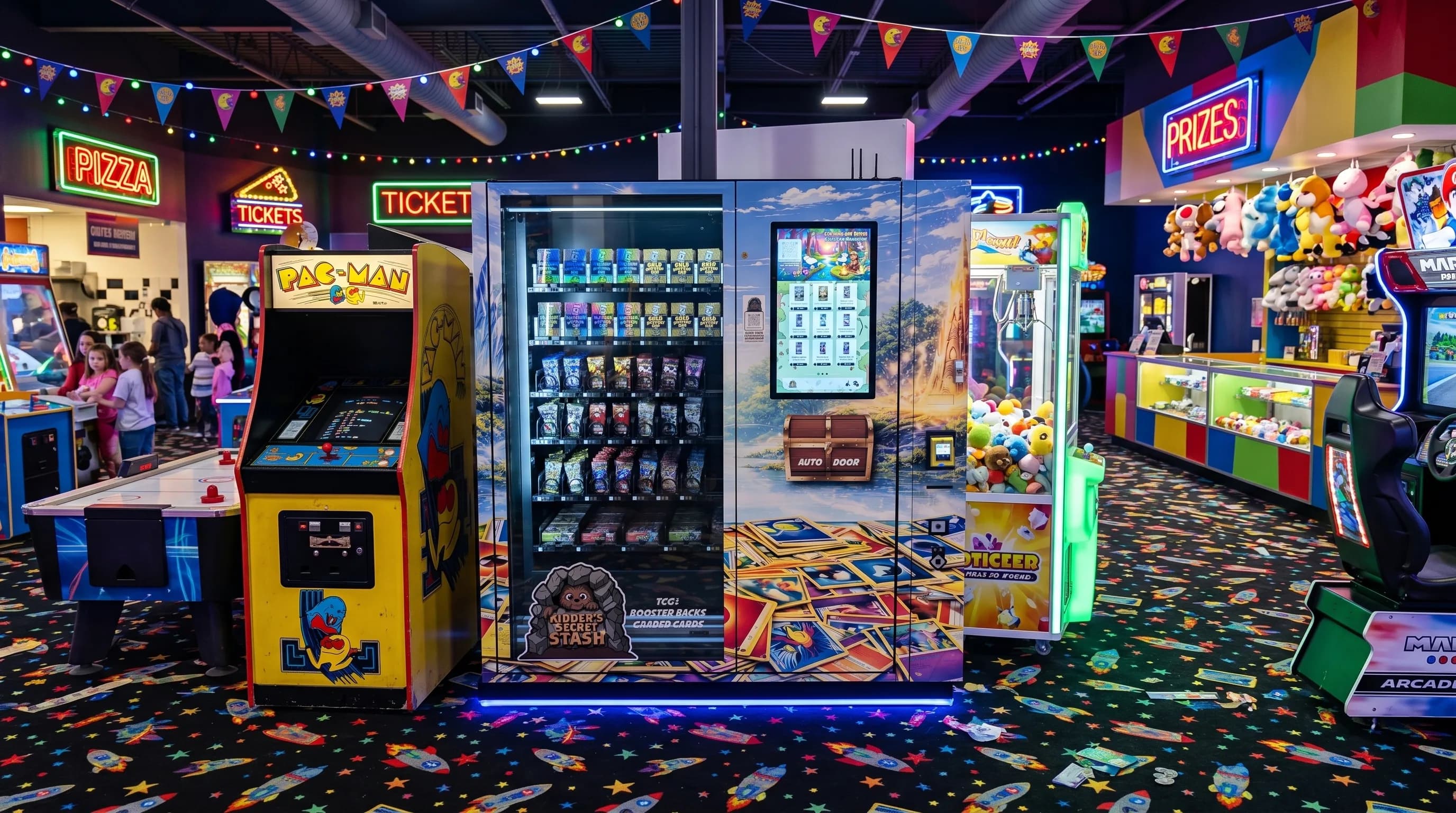
| FEC / Arcade | High | Very High | Very High | High | ⭐⭐⭐⭐⭐ |
| Card Shop | Medium | Very High | High | Medium | ⭐⭐⭐⭐ |
| Airport | Very High | Medium | Very High | Very High | ⭐⭐⭐⭐ |
| Convention / Expo | Very High (bursts) | Very High | High | High | ⭐⭐⭐⭐ |
| Barbershop | Low–Medium | High | High | High | ⭐⭐⭐ |
| Movie Theatre | High | Medium–High | Medium | High | ⭐⭐⭐ |
| University Campus | High | High | Medium | High | ⭐⭐⭐ |
| Hotel / Resort | Medium | Medium | Medium–High | High | ⭐⭐⭐ |
| Bowling Alley | Medium | Medium–High | Medium–High | High | ⭐⭐⭐ |
| Sports Card / Comic Show | Very High (bursts) | Very High | High | High | ⭐⭐⭐ |
| Gym / Fitness center | Medium | Low–Medium | Low | High | ⭐⭐ |
| Office Building | Low | Low | Low | High | ⭐ |
| Grocery Store | Very High | Low | Low | None (TPCi) | ❌ |
Section 2: The 12 Best Venue Types, Ranked
Venue 1 — Shopping Mall
Monthly revenue range: $6,000–$87,000+
Shopping malls are the top-performing venue type across every DMVI operator data point. The ceiling is real: one operator in the San Francisco Bay Area generated $87,000 in a single month from a single M1 unit in a mall corridor. That's not a projection — that's documented field data.
What makes malls work is the convergence of every positive factor at once. You have very high foot traffic concentrated in a circuit that people walk repeatedly. You have family demographics, weekend spikes, and a culture of discretionary spending. New Pokémon set release weekends — Scarlet & Violet sets like Destined Rivals and Mega Evolution are shipping now — create extraordinary demand bursts in mall environments where collectors and their parents are already in a buying mindset.
The M1 is strongly recommended for mall placements. The machine's full-body graphic wrap commands attention in busy corridors, its 140-SKU capacity means you can merchandise packs, ETBs, tins, and booster boxes simultaneously, and the premium machine appearance justifies the premium location cost.
Rent structure: $500–$1,500/month flat, or 10–15% revenue share.
Key advantage: DMVI provides direct introductions to mall management as part of its operator partnership. You don't have to cold-pitch. This alone is worth hundreds of hours of prospecting time.
Venue 2 — Family Entertainment centers (FECs) & Arcades
Monthly revenue range: $4,000–$20,000+
If malls are the highest-revenue venue, FECs and arcades are the highest-conversion venue. The demographic match is nearly perfect: kids and teens with spending money, parents willing to buy, and a cultural environment built around "spend money for fun." Collectors who frequent arcades already have the habit of spending $20–$50 in a single visit. A Pokémon vending machine is a completely natural extension of that behavior.
Dwell time at FECs is exceptional — 2–4 hours per visit on average. Repeat visit rates are also high; weekly regulars who buy from the machine on every visit compound your revenue quickly. The machine doesn't feel out of place here; it feels like an upgrade to the venue's existing product mix.
Format: M1 or Option 4 depending on floor space.
Rent structure: Typically 15–20% revenue share, which most operators find highly favorable given the volume.
Key consideration: Negotiate TCG exclusivity within the venue. If you're the only TCG vending option in the building, you own that category entirely.
Venue 3 — TCG and Card Shops
Monthly revenue range: $1,500–$8,000+
No venue has a higher demographic match than a card shop. Everyone who walks through the door is already a collector. The machine provides something the store itself cannot: 24/7 automated sales after closing hours. A well-stocked DMVI machine in a card shop generates revenue between 6pm and 10pm that would otherwise be zero.
Rent is typically the lowest of any venue type here. Card shop owners understand TCG margins and the value of the category. A flat $200–$400/month arrangement is common and entirely reasonable given the alignment of interests.
There's also a bigger strategic angle for TCG store owners: DMVI's store partnership program — "Your Store. Every Mall. No Extra Staff." — allows a brick-and-mortar TCG retailer to put a branded M1 machine in nearby malls, airports, or FECs simultaneously, using their existing inventory infrastructure and supplier relationships, without hiring additional staff. One store can have a presence across five venues with a single team.
Format: Wall-mounted (in-store) or M1/Option 4 for a dedicated corner.
Key consideration: Negotiate exclusivity on the TCG vending category within the broader venue if the shop is located inside a mall or entertainment complex.
Venue 4 — Airports
Monthly revenue range: $5,000–$30,000+
Airports are one of the most underutilised venue types for TCG vending — and one of the highest-potential. The foot traffic is enormous, the dwell time is extreme (1–4 hours per passenger in most terminals), and the psychology of airport spending is uniquely favorable. Travellers are already in a high-spend mindset. A parent killing time at a gate who spots a Pokémon vending machine will spend $20–$100 without hesitation — both as a gift and as entertainment for the journey.
Average transaction values at airport locations are among the highest of any venue type because travellers have less price sensitivity than typical retail shoppers. Booster boxes and Elite Trainer Boxes perform particularly well here.
The approval process for airport concession agreements is longer than most other venues — typically 3–6 months — but the upside justifies the timeline. Once you're placed, airport locations are extremely stable and rarely subject to competitive displacement.
Format: M1 (flagship visibility and 140-SKU capacity match the high-demand, high-variety airport buyer).
Rent structure: Airport concession agreements managed by terminal authority; variable by airport size and terminal.
Venue 5 — Gaming Conventions & Anime Expos
Monthly revenue range: $10,000–$80,000+ during the event
Conventions are not a steady monthly revenue source — they're compressed, extremely high-intensity revenue events. A single well-placed M1 at a mid-to-large gaming convention or anime expo can generate more in three days than some permanent placements do in a month.
The demographic match is as high as it gets: 100% of attendees are in the collector-entertainment category. Pack-opening culture is actively celebrated at these events. Convention attendees arrive with budget allocated specifically for collecting purchases, and a vending machine offering Pokémon packs is exactly what they're looking for.
Timing matters enormously. Positioning a convention appearance to coincide with a new Pokémon set release window (Destined Rivals, Mega Evolution) multiplies revenue significantly — collectors who couldn't find product at retail will spend heavily.
Format: M1 for maximum inventory capacity. Pre-stock aggressively; running out of product mid-event is the only serious operational risk.
Structure: Short-term event agreements; requires active scheduling across the convention calendar.
Venue 6 — Barbershops
Monthly revenue range: $800–$3,500
Barbershops are the best entry-level venue for first-time operators. They're easy to negotiate with (owner-operated, no corporate approval chains), the rent is minimal, the wall-mounted format requires almost no floor space, and the customer demographic is a strong match.
The waiting customer with 20–40 minutes to kill and a phone in their pocket is exactly the customer profile that converts. Predominantly male collectors aged 8–35 sit in barbershop waiting areas and either browse social media or, when a Pokémon vending machine is on the wall, spend $8–$30 on packs.
This is often the right first location for an operator who wants to build operational confidence before pursuing a mall placement. The revenue ceiling is lower, but so is every other barrier — rent, approval time, setup complexity, and risk.
Format: Wall-mounted (minimal footprint; fits cleanly alongside existing shop decor).
Rent structure: $100–$300 flat rate per month, or 10% revenue share.
Venue 7 — Movie Theatres
Monthly revenue range: $2,000–$8,000
Movie theatres offer a strong combination of family demographics, weekend spikes, and lobby dwell time. Families with kids — the core Pokémon buyer profile — arrive early, wait in lobbies, and have both the budget and the inclination to add a pack or two to a cinema outing that's already a discretionary spend event.
Premium-priced products perform well in theatre settings. ETBs and tins at the $20–$50 price point sell alongside single packs because the theatre context primes customers for leisure spending.
Format: Wall-mounted for smaller lobbies; Option 4 or M1 for multiplex environments with larger footprints.
Rent structure: $200–$500/month flat rate or percentage.
Venue 8 — University Campuses
Monthly revenue range: $1,500–$6,000
The 18–24 age bracket is the core adult collector demographic — and universities are where they congregate at highest density. Student unions, food courts, and gaming common areas see consistent high traffic on a predictable schedule tied to the academic calendar.
Semester start (September and January) and exam periods produce notable spending spikes as students reward themselves and decompress. Year-round traffic in student unions makes university placements more stable than they might initially appear on paper.
The vendor approval process through campus administration can be slow, but once approved, university placements tend to be very stable. Stocking One Piece TCG and Magic: The Gathering alongside Pokémon captures the broader gaming audience and increases per-visit transaction values.
Format: Wall-mounted for smaller common areas; Option 4 for high-traffic student union environments.
Venue 9 — Hotel Lobbies and Resorts
Monthly revenue range: $1,000–$5,000
Family-friendly resorts and hotel lobbies serve a specific buyer type: parents on holiday who need to keep kids entertained and who have loosened their budget constraints for the duration of the trip. A Pokémon vending machine in a resort lobby is a gift purchase and an entertainment purchase rolled into one, and repeat visits during a multi-night stay compound the revenue.
Business hotels underperform significantly in this category — the demographic is almost entirely wrong. Focus on family resorts, waterpark hotels, and destination properties with a strong leisure mix.
Format: Wall-mounted or Option 4 depending on lobby footprint.
Venue 10 — Bowling Alleys
Monthly revenue range: $1,500–$5,000
Bowling alleys share several of the FEC's most attractive characteristics: family demographics, meaningful dwell time between turns, and a teen demographic that converts well on impulse purchases. The "waiting for your turn" moment is highly analogous to the barbershop waiting room — a captive customer with time and a phone in their pocket.
Weekend family bowling sessions are the peak revenue window, and birthday parties bring groups of kids with spending money into the venue at concentrated intervals.
Format: Option 4 or Wall-Mounted depending on available space near the seating and counter areas.
Rent structure: Flat fee is common; easy to negotiate with independent operators.
Venue 11 — Sports Card and Comic Book Shows
Monthly revenue range: High burst revenue per event
Card and comic shows are convention-style events on a smaller, more local scale. The audience is entirely composed of collectors, making the demographic match as high as any venue in this guide. These events are ideal for operators who want to build revenue across a portfolio of short-duration placements.
The operational model here is active rather than passive. You schedule events, transport the machine, set up, and manage inventory on-site. For operators who enjoy being involved in the hobby community, this is both profitable and genuinely enjoyable. For operators who want fully passive income, this is a supplementary stream, not a primary strategy.
Format: M1 for maximum inventory to capitalise on the high-demand, short-duration window.
Venue 12 — Gyms and Fitness centers
Monthly revenue range: $500–$1,500
Gyms are the lowest-performing venue on this list that still warrants inclusion, and they work only under specific conditions. Adult members who are collectors represent a genuine buyer segment, and the novelty factor drives a strong initial burst when the machine is first installed.
The limitation is demographic alignment. Most gym members are not in the collector mindset when they're working out. Conversion rates are lower than every other venue type on this list, and revenue tends to plateau quickly after the novelty period.
Treat a gym placement as a location to validate carefully, not a guaranteed primary revenue source. A wall-mounted unit has a $4,995 purchase price; compare the full quote and any approved financing obligations with conservative net cash flow for that gym.
Format: Wall-mounted (low footprint, minimal upfront investment to test).
Section 3: Venues to Avoid
Not every high-traffic venue is a good Pokémon vending location. These four should be excluded from your scouting list entirely.
Grocery Stores
This is the most important venue to avoid. The Pokémon Company International (TPCi) has exclusive placement agreements with national grocery chains including Kroger, Safeway, and Albertsons for its official vending machines. Independent operators are not welcome in this channel. Don't waste time pursuing it — the door is closed.
Office Building Lobbies
Wrong demographic, zero impulse-purchase culture, and low dwell time. The working professionals who pass through office lobbies are not stopping to buy booster packs on their way to a meeting. Revenue will disappoint regardless of how much foot traffic the building sees.
Laundromats
Revenue potential is structurally limited by the demographic and spending patterns of the typical laundromat visitor. This is not a TCG buyer environment, and the economics don't support even a wall-mounted investment.
Hospitals
Hospital environments are entirely inappropriate for impulse collectible purchases. The emotional context is wrong, the demographic is misaligned, and many healthcare facilities have vendor restrictions in patient-facing areas. This is not a viable location category.
Section 4: Venue-to-Format Matching Guide
The right machine format for a location depends on available floor space, foot traffic volume, and the revenue ceiling of that venue type. Use this table as a quick reference when evaluating a new placement.
| Venue | Recommended Format |
|---|---|
| Shopping Mall | M1 or M2 |
| FEC / Arcade | M1 or Option 4 |
| TCG Card Shop (in-store) | Wall-Mounted |
| Airport | M1 |
| Barbershop | Wall-Mounted |
| University Campus | Option 4 or Wall-Mounted |
| Movie Theatre | Option 4 |
| Hotel / Resort | Option 4 or Wall-Mounted |
| Bowling Alley | Option 4 or Wall-Mounted |
| Convention / Expo | M1 |
| Gym | Wall-Mounted |
For a complete breakdown of every machine format — dimensions, SKU capacity, price, and use cases — see the Pokémon vending machine format guide.
Stat Callout
$87,000 in a single month. That's the peak documented revenue from one DMVI M1 operator in the San Francisco Bay Area — a single machine, a single mall location. The conservative operator average for a well-placed M1 runs $6,000–$7,000/month net after machine lease, rent, and payment processing. Every dollar of that gap is location.
Next Steps
Location is the variable that separates a $500/month machine from an $87,000/month machine. Everything else — inventory, pricing, machine format — matters far less than where that machine is standing.
If you're ready to identify your first high-performing location, or if you're planning a multi-unit rollout and need placement strategy support, DMVI's operator partnership is the fastest path from decision to revenue. Browse DMVI's Pokémon vending machines for sale to see the full machine lineup, financing options, and partnership details — or explore the full TCG vending machine range if you want to merchandise beyond Pokémon from day one.
For operators at any stage, the single best move is talking to a team that has already placed machines in the venues you're targeting and knows exactly what those locations produce. That's DMVI.
Contact: +1-800-490-1108 | digitalmediavending.com
Want pricing, format guidance, or a launch plan?
DMVI can help you compare Pokemon vending machine formats, rollout strategy, financing, and location fit based on your route goals.