How to Start a Vending Machine Business in 2026: The Honest Version
Every "how to start a vending machine business" guide on the internet starts the same way. Step one: buy a machine. Step two: find a location. Step three: collect money.
Current DMVI vending machine financing: DMVI financing is subject to approval, with a 25%–50% machine deposit depending on stock status and the remaining machine balance paid in 12 monthly payments at 8% simple interest. The quote confirms the deposit percentage. All applicable upfront costs are due at signing, including the wrap, optional topper, payment terminal, first-year software subscription, shipping, and sales tax. Financing is not guaranteed; DMVI reserves the right to deny financing. A UCC filing applies, and a personal guarantee may be required. See the vending machine financing terms for details.
That framing is why so many first-time operators end up with a machine sitting in a storage unit or generating $300 a month in a break room they chose because someone said yes. The passive income narrative — buy a machine, walk away, cash arrives — is real for a narrow set of circumstances and completely wrong for most others. The actual business requires decisions, in a specific order, that most guides never mention.
This is the version that tells you what actually matters.
Step 1: Decide What You Are Selling Before You Think About a Machine
The most common mistake new vending machine operators make is starting with the machine question: what machine should I buy? What is the cheapest? What do other people use?
The machine question is the third question. The first question is: what are you selling?
This is not a trivial distinction. The type of product you sell determines the machine you need, which determines the manufacturer you buy from, which determines the price you pay. A machine built for protein powder has different shelving, different dispensing mechanics, and different software requirements than one built for Pokémon mystery packs or artisan chocolates or Narcan. A standard snack machine retrofitted for specialty products delivers a worse customer experience and higher jam rates than a machine built for the product from the start.
The vertical-first operators — the ones who start with "I sell cupcakes and I want to expand into autonomous retail" rather than "I want to get into vending and I'll figure out the product later" — consistently outperform the machine-first operators. They know their product, they know their customer, and they buy hardware that serves both. The product-without-a-business operators buy a machine, fill it with whatever is easiest to source, and wonder why the numbers don't work.
Before evaluating a single machine option, answer these questions:
- What specific product am I selling?
- What are its physical properties — dimensions, weight, fragility, perishability?
- Who is my customer and where do they already spend time?
- What price will they pay in that context?
The answers shape every subsequent decision.
Step 2: Validate Your Location Before Spending Anything on a Machine
This is the step most guides skip entirely, or mention briefly and then move on.
The location determines everything. The same machine, stocked with the same product, priced identically, generates dramatically different revenue depending on where it sits. A protein vending machine at a premium fitness club with 800 committed members can generate $4,000 to $8,000 per month. The same machine in a mid-tier gym with high turnover and a casual demographic generates $600 to $1,500. The machine is identical. The location is not.
Location validation means getting real data, not verbal assurances from venue management. Venue operators describe their foot traffic generously in placement negotiations — they have incentive to. Independently verifiable data means: turnstile counts, parking data, transaction data from other vendors already in the space, or physical observation across multiple days and time windows.
The questions to answer before committing to a location:
- How many people who actually match my customer profile pass this machine per day?
- What are the peak hours and do they align with my product's purchase context?
- What are other vendors in this facility generating? (Ask. Some tell you.)
- What commission rate is the venue asking, and does it work in my unit economics?
- Is the placement agreement renewable, and on what terms?
A location that you cannot validate with real data is a location you are taking on blind faith. Sometimes that works. When it doesn't, you have a machine in the wrong place and a lease agreement that commits you to it.
Key Finding: Location selection is the single highest-leverage decision in starting a vending machine business. Operators who validate foot traffic and commission terms before purchasing a machine consistently outperform those who reverse the order.
Step 3: Choose the Machine That Fits Your Product — Not the Cheapest Option
Once you know what you're selling and where you're selling it, the machine decision becomes much more specific.
The wrong way to choose: browse machines by price, pick the cheapest one that seems functional, and figure out how to make it work for your product.
The right way: specify the machine by working backward from product requirements.
What dispensing mechanism does your product need? Standard coil dispensing works for uniformly packaged snacks and beverages. It fails — with regularity — for fragile items, irregular shapes, heavy containers, and specialty products. If your product would be damaged by dropping 12 inches onto a retrieval shelf, or would jam a coil mechanism designed for chips, you need a different dispensing system.
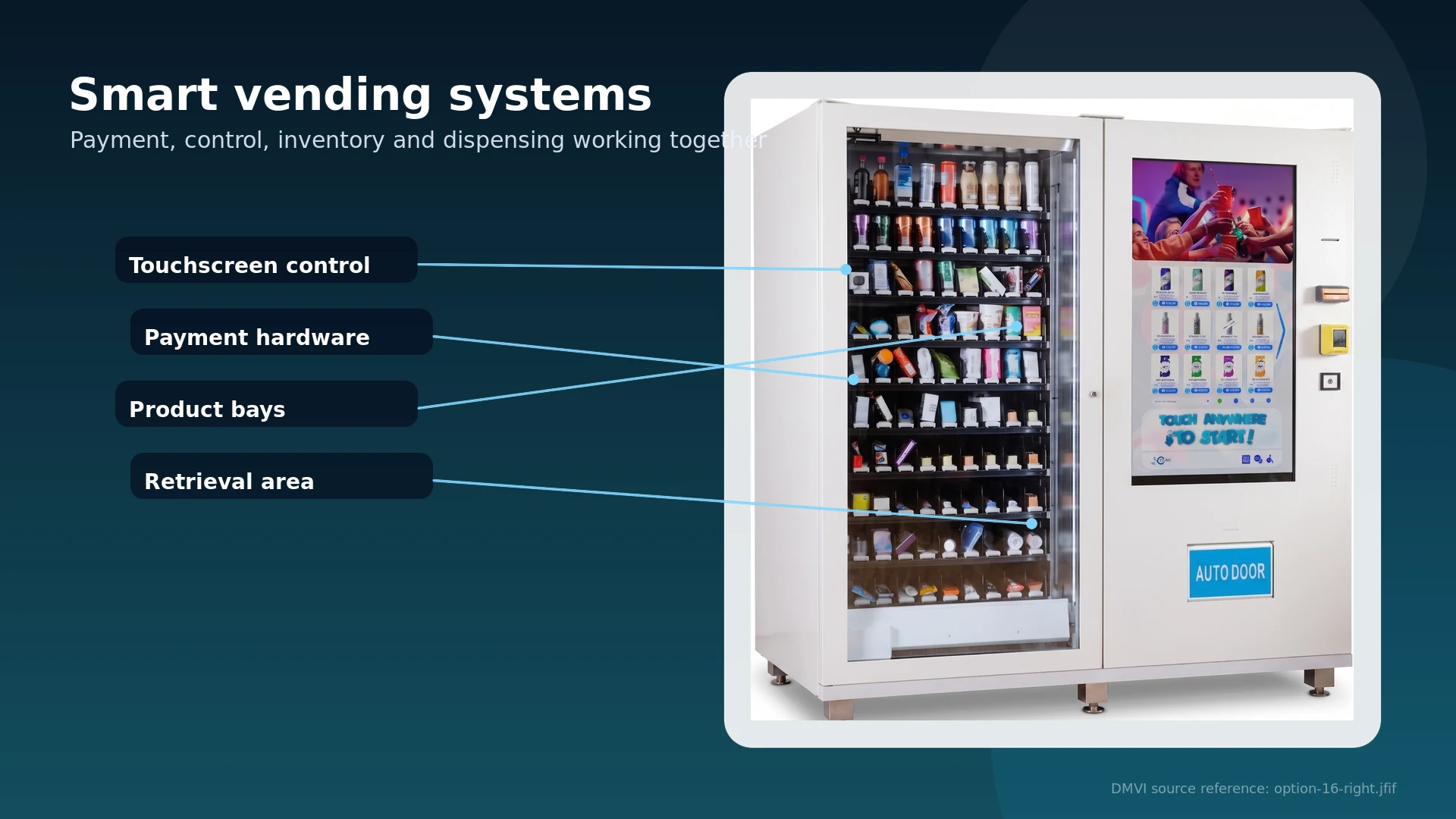
Digital Media Vending International builds custom vending machines with conveyor belt shelving and elevator or door-based delivery specifically for products that standard machines handle poorly. Their machines start at approximately $4,995. For a product category that demands custom dispensing — cupcakes, trading cards, beauty products, supplements, electronics — the price difference between a custom machine and a standard machine is not the relevant comparison. The relevant comparison is the revenue difference between a machine that dispenses your product reliably and one that jams, damages product, and creates customer service problems.
Ask these questions when evaluating any machine:
- How does this machine advance and dispense my specific product?
- What is the touchscreen size and how will it present my product to customers?
- What does the software platform show me, and can I access it remotely?
- What happens when something breaks — who supports the machine and how fast?
- Where is this machine built and who handles installation?
DMVI handles installation, operator training, and ongoing US-based support as part of every deployment. Their VendingTracker software platform provides live inventory, pricing, and machine health monitoring from any browser. These are not luxury features — they are operational requirements for running a vending machine business without physically visiting every machine every day.
Step 4: Understand the Placement Agreement Before Signing Anything
The placement agreement is the legal document that governs your relationship with the venue where your machine lives. Most first-time operators sign them without reading them carefully, and discover their implications later.
Key terms to understand and negotiate:
Commission structure. Commission is typically a percentage of gross revenue paid to the venue operator. Common ranges are 10 to 30% depending on venue type. Model the commission rate against your average transaction value and expected daily volume. A 25% commission that works at $15 average transactions is problematic at $5 average transactions.
Exclusivity. Does the agreement prevent the venue from placing another vending machine in your category? Exclusivity protects your market; a non-exclusive agreement means the venue can bring in a competing machine at any time.
Term and renewal. How long is the agreement, and on what terms does it renew? A one-year agreement with automatic renewal gives you stability. A 30-day termination clause gives the venue the ability to end the arrangement quickly if a competing operator makes them a better offer.
Location specification. Where exactly is the machine placed? A vague agreement that says "somewhere in the facility" is different from one that specifies the corridor, the square footage allocated, and the visibility requirements. If your placement is demoted from a high-traffic corridor to a storage room adjacent to the bathrooms, you want agreement language that protects against that.
Liability and insurance. Most venues require the machine operator to carry general liability insurance naming the venue as an additional insured. This is standard and not onerous — a general liability policy for a small business typically costs $400 to $1,000 per year.
Negotiate from a position of knowing exactly what your machine needs to generate. If the commission rate or terms make the placement unviable, say so. Venue operators would rather have a productive long-term relationship with a viable operator than an operator who is underwater from month one.
Step 5: Get Your Machine Installed and Configured Properly
A vending machine that ships and sits in a corridor, power connected but not configured, is not an operating business. Configuration — the process of setting up the software, entering your product inventory, setting prices, configuring the planogram, and testing the dispensing mechanism — is the step between receiving a machine and operating one.
Digital Media Vending International handles installation, machine configuration, and operator training as part of every deployment. For a first-time operator, this is not a minor convenience — it is the difference between arriving at a working machine and spending the first week troubleshooting a setup process that could have been handled by the manufacturer.
What proper setup covers:
- Physical installation in the agreed placement location
- Software configuration: product entry, pricing, planogram setup in VendingTracker
- Payment hardware testing: cashless systems verified before going live
- Dispensing test runs with your actual product to confirm channel configuration is correct
- Operator training: how to use VendingTracker, how to restock, how to monitor machine health
- Contact protocol: who to call when something needs service, and how fast the response is
A machine that goes live configured correctly, with the operator trained on the software and restocking process, performs better from day one than a machine launched without those steps. The early weeks of a new placement establish customer behavior — customers who have a good experience return; customers who find a jammed machine or an empty slot do not.
Step 6: Build Your Monitoring and Restocking Routine From the Start
This is the operational discipline that separates operators who build a sustainable business from those who watch revenue erode from neglect.
VendingTracker's live inventory monitoring tells you when specific SKUs are running low without requiring a physical visit to the machine. The alert fires before the product runs out, enabling proactive restocking rather than reactive recovery from an empty machine. An empty machine generates zero revenue. A machine that runs out of the top-selling SKU at peak hours and isn't restocked until the next scheduled trip loses sales for every hour it sits depleted.
Build your restocking routine around the data, not a fixed schedule. A machine that sells faster than expected needs more frequent attention. One that sells slower than expected does not need a restocking trip every 48 hours.
Beyond inventory, monitor these regularly:
- Machine health alerts from VendingTracker — address flagged issues before they become downtime
- Sales data by SKU — identify slow movers before they become expired inventory problems
- Revenue trends by day and week — spot patterns that inform restocking scheduling
- Commission statements from venues — verify they match your own transaction data
The operators who build a monitoring routine from the first week of operation know what their business is doing at any moment. Those who check in monthly are consistently surprised by what they find.
Step 7: Know Your Numbers Before You Scale
The moment a vending machine starts generating revenue, there is an urge to buy another one. That is not always the right next move.
Scale the business only after you understand the unit economics of the first machine clearly. That means knowing:
- Gross revenue per month, consistently tracked
- Product cost as a percentage of gross revenue
- Venue commission as a percentage of gross revenue
- Machine financing cost per month
- Restocking labor time and any travel cost
- Net contribution after all of the above
If machine one is producing consistent, positive net contribution with your full cost structure accounted for, you have a model worth replicating. If it is producing gross revenue that looks good but thin or negative contribution when all costs are factored in, scaling adds machines to an unresolved problem.
The vending machine business scales well when the model works — the same product, similar locations, the same operational routine, one more machine at a time. It does not scale a broken model into a profitable one. Know the difference before committing to machine two.
Bottom Line: How to start a vending machine business in 2026 means starting with the product, validating the location before buying anything, choosing hardware that matches the product, negotiating a placement agreement you understand, launching with proper setup and training, building an operational routine from day one, and scaling only when the first machine's economics are proven. In that order.
The Questions First-Time Vending Machine Operators Ask Most Often
Is the vending machine business actually profitable in 2026?
Yes, for operators who follow the steps above. The category is healthy — the North America vending machine market is generating billions annually, and the smart vending segment is growing at double digits year over year according to Kande VendTech's industry data. The challenge is not market size. The challenge is location quality and product fit. Operators at strong placements with the right product generate meaningful net contribution from a single machine. Operators at weak placements with the wrong machine generate frustration.
How much money do I need to start a vending machine business?
Digital Media Vending International's entry-level machines start at approximately $4,995. Build the startup budget from the deposit in your quote, all upfront costs due at signing, initial product inventory, insurance, and working capital. Include 12 monthly balance payments at 8% simple interest if financing is approved; do not use older low-monthly-payment examples to estimate first-year cash needs.
Do I need prior business experience to start a vending machine business?
No prior vending experience is required. Prior business experience helps — understanding unit economics, reading a contract, managing supplier relationships — but it is not a prerequisite. DMVI provides installation, operator training, and ongoing support. VendingTracker provides operational visibility that does not require technical expertise. The operational demands of a single machine are manageable for a first-time business owner who is willing to stay attentive to the data.
How long before a vending machine business is profitable?
Profitability timeline depends almost entirely on machine revenue relative to fixed costs. A machine at a premium location generating $4,000+ per month in gross revenue can be cash flow positive within the first month when financed at DMVI's rates. A machine at a marginal location generating $500 per month takes much longer — and may never reach meaningful net contribution. The location decision made in Steps 1 and 2 above determines this timeline more than any other variable.
What products should I avoid in a vending machine?
Products with regulatory restrictions — alcohol, tobacco, certain pharmaceuticals — require compliance measures specific to each jurisdiction. Products with extremely short shelf lives or temperature requirements need machines configured for those conditions. Products with dimensions or weights outside the machine's specified range create jam and dispensing problems. Before stocking any product, verify that the machine you have is configured for it, and that the product is legally permissible in the venue and jurisdiction where you're operating.
Should I buy used or new vending machines?
For specialty retail operators using custom-engineered machines, the used market is nearly irrelevant — you are buying a machine configured to your product, not a generic cabinet. For standard snack machines, used is an option but carries unknown maintenance history and limited warranty coverage. For a first-time operator whose revenue depends on machine reliability, a new machine with manufacturer support and warranty is the lower-risk path.
What is the difference between a vending machine operator and a vending machine owner?
In traditional vending, operators often lease machines from manufacturers or distributors and pay a monthly fee or revenue share rather than owning the hardware outright. In the specialty retail and custom vending space, most operators own their machines — either outright or through financing. DMVI's financing model makes ownership accessible at low monthly cost. Ownership means you control the machine, the product assortment, the pricing, and the placement relationships rather than operating within a franchisor's or lessor's constraints.
How many machines do I need to make the business worth running?
One machine at the right location is a viable supplemental income stream. Two or three machines at strong placements generate income that rivals or exceeds many part-time employment arrangements. Five or more machines, managed with VendingTracker's centralized dashboard, constitute a meaningful small business with real scalability. The entry point is one machine — the scale potential is limited primarily by your ability to find and secure strong locations.
The vending machine business rewards operators who do the groundwork — product selection, location validation, placement negotiation, machine configuration — before expecting revenue. Skipping those steps produces the outcomes that fuel the "vending machine passive income is a scam" narrative online. Doing them produces a business that compounds quietly and reliably. The difference is entirely in execution.
Conclusion
The vending machine business is not passive income. It is a real business with real operational demands, real location-dependent revenue variation, and real consequences for skipping the foundational steps. It also works — consistently, for operators who approach it honestly.
Digital Media Vending International has been building custom vending machines for specialty retail operators since 2009, with more than 2,000 deployments in 22 countries and machines starting at $4,995. If you're serious about starting a vending machine business with a specific product in mind, the conversation starts at digitalmediavending.com.
Sources
- Digital Media Vending International — Official Website
- Kande VendTech — Vending Machine Industry Statistics 2024
- GetBiopak — The Ultimate Guide to the Vending Machine Business in 2026
- IBISWorld — Vending Machine Operators in the US
- Statista — US Vending Machine Industry
- US Small Business Administration — Starting a Business
Starting a vending machine business the sensible way?
DMVI helps operators work backward from product, location, and unit economics before choosing the right custom vending machine and software setup.