What to Sell in a Vending Machine: How to Choose Products That Actually Vend Well
Every decision in a vending machine business traces back to the product selection. The machine you buy depends on it. The location you pursue depends on it. The pricing you set depends on it. The economics you can build depend on it.
Most vending machine advice treats product selection as the easy part: stock snacks that people want. That framing applies if you are operating a traditional break room snack route. It does not apply if you are a specialty retail entrepreneur using a vending machine to expand your existing business into autonomous retail, which is the profile of most buyers evaluating custom vending machines in 2026.
For specialty vending operators, product selection is a five-criteria decision. Every product worth considering either passes all five or reveals specific problems that will show up in operations. This guide works through each criterion with enough specificity to make the evaluation useful.
Criterion 1: Physical Fit. Can This Product Actually Be Dispensed?
Before any commercial consideration, a product has to be physically compatible with the machine's dispensing mechanism. This is not a soft preference. It is a hard constraint.
Standard coil-based vending machines are designed for products within a specific dimensional and structural profile: flat-ish, packaged in material that has enough structural integrity to be pushed forward by a rotating coil and survive a drop to the retrieval bin. Chips in a mylar bag. Candy bars in cardboard sleeves. Canned beverages. These products work because they were essentially designed around coil dispensing.
Most specialty products are not. Trading card packs are too lightweight and flexible. Cupcakes in presentation packaging cannot survive a drop. Cylindrical supplement containers do not advance reliably through channels designed for flat bags. Glass or rigid fragile containers in beauty products cannot be dropped without risk of damage.
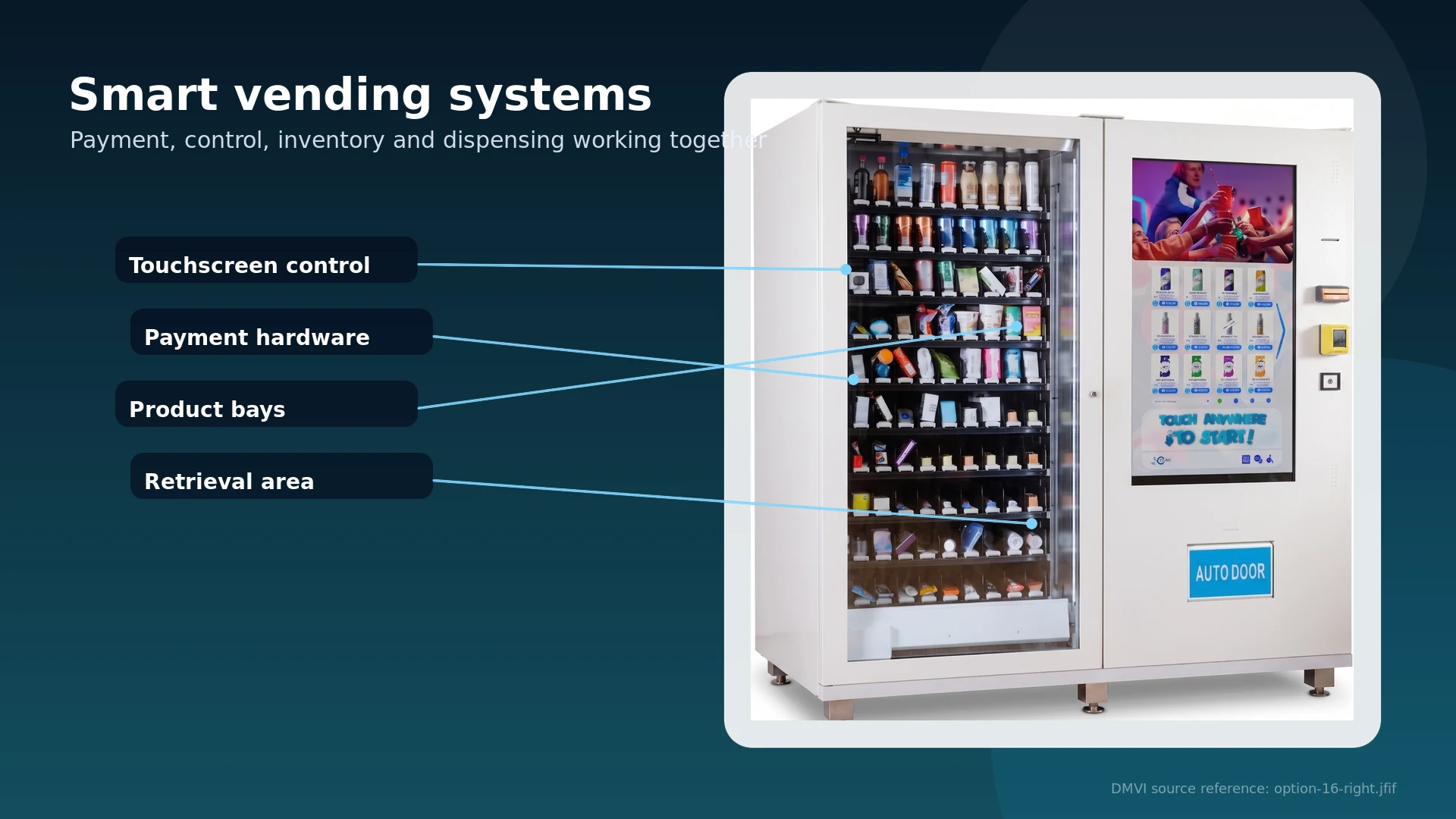
This is why Digital Media Vending International builds machines with conveyor belt shelving and elevator or automatic door delivery. The conveyor belt advances product gently forward without the rotation-and-push mechanics of a coil. The elevator carries the product to the customer without dropping it. These mechanisms were chosen specifically to expand the range of products that can be reliably dispensed.
When evaluating a product, ask: what happens to it in transit through the machine? Does it advance consistently? Does it survive delivery? A product that jams coil mechanisms repeatedly or arrives at the customer damaged has failed the physical fit criterion. It will not improve through optimism or repeated restocking.
The practical test: describe your product's packaging dimensions, weight, and fragility to the manufacturer before purchasing. A manufacturer who builds machines for your product category, not adapts a standard cabinet to it, can tell you immediately whether the product is compatible and what configuration it requires.
Criterion 2: Purchase Context. Does the Product Match the Moment?
Vending machines sell to people who are physically present in a specific location at a specific time, often in a specific state of mind. The product being sold has to be right for that moment, not just right for the customer in the abstract.
This is the criterion that separates a product the customer might buy from a product they will buy from a machine in this location at this hour.
Consider the difference between: a gym member finishing a workout versus a hotel guest at midnight, versus a Pokémon collector at a mall on a Saturday afternoon. These are not the same buyer, the same need, or the same purchase context. A gym member finishing a workout has an immediate, physiologically driven need for protein or hydration. A hotel guest at midnight has an immediate convenience-driven need for a personal care item they forgot. A Pokémon collector on a Saturday afternoon has a discretionary, excitement-driven impulse to buy a mystery pack.
The product has to fit the moment. Pokémon mystery packs at a corporate office gym do not fit the moment. Protein supplements at a hotel corridor do not fit the moment as well as personal care products. The product-moment alignment is what converts foot traffic into buyers.
To evaluate a product for purchase context fit: identify the specific population that will encounter this machine at this location at peak hours. What have they been doing immediately before they encounter the machine? What do they need, want, or feel right now? Does this product answer that question? If the answer is "maybe" or "they might want it," that product probably fails this criterion. The strongest vending products produce an immediate, obvious yes.
Criterion 3: Price Point. Does This Product Support the Location's Economics?
Not every product can be priced to support a vending machine deployment at every location. The price point has to be high enough to cover product cost, venue commission, machine financing, and restocking labor while still generating meaningful net contribution. And it has to be an amount customers will pay in this location without significant hesitation.
Two things affect price point viability. The first is the product's cost of goods. A product with 70% gross margin supports the economics of a vending machine much more easily than one with 30% margin, because more of each transaction flows through to net contribution after expenses. The second is the location tier. A $15 beauty product in a boutique hotel lobby is priced appropriately for the context. The same product at $15 in a mid-tier office break room may face more resistance.
Price ceiling varies by venue. Premium venues, hotels with high average daily rates, premium mall corridors, boutique gyms, airport post-security terminals, support higher prices than budget-conscious environments because the customer base in those environments has higher purchasing power and lower price sensitivity. Products that cannot be priced high enough to work at a given venue are the wrong product for that venue, regardless of their quality.
The practical framework: before committing to a product, build a simple unit economics model. Estimated retail price minus cost of goods minus venue commission as a percentage of retail minus an allocated portion of machine financing. If the result is positive and meaningful, the economics support the product. If the result is thin or negative, the product either needs a higher price point, a lower-commission venue, or is simply the wrong choice.
Criterion 4: Margin Structure. What Stays After the Machine Costs?
Margin in vending is more complex than the difference between retail price and product cost. The full margin picture includes product cost, venue commission (which is a percentage of gross revenue, not profit), machine financing allocation per unit, and restocking labor cost.
Products with high gross margins, the ratio of retail price to product cost, generate more net contribution per transaction than low-margin products, even at the same retail price. A specialty beauty product that costs $8 and retails for $22 has a 64% gross margin. A snack product that costs $0.75 and retails for $2.50 has a 70% gross margin. At first look, the snack has a better gross margin percentage. But at those price points, the beauty product generates $14 in gross margin per transaction and the snack generates $1.75. At 20% venue commission, the beauty product yields $9.60 in net-of-commission margin per transaction and the snack yields $1.25.
Volume determines whether the low-margin, high-velocity snack model can compete with the high-margin, lower-velocity specialty model at a specific location. In most vending machine deployments outside of very high-traffic industrial and transit environments, specialty products with higher per-unit margins produce more net contribution per machine per month than commodity snacks.
This is the fundamental economics of why custom vending machines built for specialty products generate stronger per-machine results than standard snack machines: the margin per transaction is structurally higher, and VendingTracker's pricing controls allow operators to optimize price points based on actual sales data.
Criterion 5: Restocking Manageability. Can You Sustain the Operation?
A product that passes the first four criteria but requires daily restocking at a location two hours away is not a viable vending product for that operator. The operational sustainability of restocking is a real constraint that shapes product selection as much as any commercial consideration.
Restocking manageability depends on three variables: how fast the product sells, how much of it the machine can hold, and how far the operator is from the location. VendingTracker's live inventory monitoring solves the first variable by showing exactly when a product slot is running low, enabling proactive restocking trips. But it cannot change the machine's slot capacity or the distance between the operator and the machine.
Products with longer shelf lives tolerate lower restocking frequency. A sealed collectible product with a six-month shelf life requires restocking based on sales velocity only, not expiration. A fresh cupcake with a 48-hour window requires more frequent attention. Products with higher selling prices and lower transaction volume require less frequent restocking than commodity products at low prices with very high volume.
For operators building their first vending machine business, choosing a product that requires restocking no more than two or three times per week at a single location is a reasonable operational starting constraint. As the business scales and restocking logistics improve, the constraint loosens.
Products That Consistently Work Well in Vending Machines
Across the specialty vending machine category, certain product characteristics consistently translate to strong vending performance. These are not specific products but patterns:
Mystery and blind products. Trading card packs, blind boxes, mystery accessories, products where the customer does not know exactly what they will receive. The unknown creates urgency and repeat purchase behavior that commodity products cannot match.
Immediate-need personal care. Travel-size toiletries, dry shampoo, pain relievers, phone chargers. Products that address a specific need the customer has right now, in the location where the machine is placed.
Post-activity nutrition. Protein bars, supplements, hydration products consumed in the immediate post-workout window at gyms and fitness facilities. The physiological need is time-sensitive and the machine is in the path.
Premium impulse accessories. Jewelry, fashion accessories, specialty gifts in the $25 to $75 range at luxury hotel lobbies, resort properties, and premium retail corridors. The purchase is discretionary, impulse-driven, and gift-occasion-motivated.
Limited and collectible editions. Products with scarcity signals, limited availability, or collector series dynamics that motivate the purchase now rather than later. Scarcity accelerates impulse conversion.
Products That Consistently Fail in Vending Machines
Certain product categories fail in vending with enough consistency that they warrant specific mention:
Heavy, large, or irregularly shaped products. Products outside the dimensional and weight range of the machine's dispensing system jam or fail to advance reliably regardless of demand.
Products with very short shelf lives and low price points. Fresh sandwiches priced at $6 at a location with moderate traffic cannot generate sufficient volume before expiration unless restocking is extremely frequent. The economics rarely survive.
Products without a clear purchase context fit. A product the customer might buy if they happened to think of it is different from a product they want right now in this location. Vending machines capture in-the-moment demand. Products that require consideration or planning do not convert well.
Commodity products in premium locations. Standard snack products at premium hotel corridor prices face customer resistance compared to specialty alternatives at similar price points. The customer expectation at a luxury hotel lobby is not a $4 chip bag.
DMVI and Product Fit Engineering
Digital Media Vending International's machine configuration process starts with the product. Before specifying a machine, DMVI works through the product's physical properties, the target location context, and the operator's product mix to recommend the machine format, dispensing configuration, and slot layout that fits the specific product.
This engineering-first approach is why DMVI's machines work for trading cards, cupcakes, beauty products, supplements, jewelry, toys, and harm reduction supplies, while a standard snack machine works for none of them. The machine is built to the product, not the other way around.
Machines start at approximately $4,995. Visit digitalmediavending.com to discuss product-specific machine configuration.
How to Validate a Product Before Stocking It
Understanding the five criteria is useful. Having a practical validation process that applies them before committing to a product and machine purchase is more useful.
Step 1: Physical compatibility check. Contact the machine manufacturer with your product's exact dimensions, height, width, depth, and packaging material. Ask which dispensing mechanism the machine uses for that product profile. Ask for confirmation that the machine has been successfully configured for similar products. Do not rely on assurances that it will work. Ask for specifics.
Step 2: Purchase context assessment. Visit the target location at peak hours. Observe the people there. What have they just done? What are they about to do? What do they need right now? Would they buy your product from a machine in this spot at this hour without any explanation? If the answer is a clear yes, the product passes this criterion. If the answer requires storytelling or context, it may not.
Step 3: Price point modeling. Research what comparable products retail for at similar venue tiers. Check what other vending machine operators at similar locations are charging for comparable items. Build the unit economics at your target price: retail price minus cost of goods minus anticipated venue commission as a percentage of retail. If the result is positive and meaningful, proceed. If it is thin, raise the price in the model and ask whether that price is realistic for the location.
Step 4: Restocking frequency estimation. At your best estimate of daily sales velocity, how long would it take to deplete a full slot? How frequently would you need to restock to prevent stockouts? Does that frequency fit within your operational capacity given the location's distance from your base and your other operational commitments? If the restocking burden is unsustainable at realistic sales velocity, the product fails this criterion at this location even if it passes the others.
Step 5: Run a small test before committing to scale. If you have flexibility to introduce a new product into an existing deployed machine before building a new deployment around it, do that first. Real sales data from a deployed machine at a real location is more valuable than any projection. A product that sells well in an existing machine at a similar location type is a product with validated demand. A product that underperforms despite correct physical fit and context alignment is telling you something you need to know before investing in more of it.
Product selection in vending is not a one-time decision. It is an ongoing process. The first assortment is a hypothesis. The first 30 to 60 days of sales data, captured in VendingTracker, is the first evidence. The first planogram adjustment is the first optimization. Operators who treat product selection as a living, data-informed process rather than a fixed launch decision consistently arrive at more profitable assortments over time than those who stock based on initial judgment and leave the assortment unchanged. The five criteria above give the first hypothesis structure. The data gives the subsequent decisions evidence.
The custom vending machine market rewards operators who are specific about their product and deliberate about their deployment. A cupcake in a hotel lobby at midnight is not a random product choice. It is a precisely evaluated match of a product with a specific purchase context, a specific dispensing requirement, and a specific margin structure. The five criteria above are the framework for arriving at that specificity before committing capital, not after. Every product evaluation that eliminates a mismatch before deployment prevents a more expensive discovery after the machine is installed and running.
The right product in the right machine at the right location is the complete formula. Any one of the three being wrong undermines the other two. The five criteria above evaluate the product dimension of that formula. Getting all five right before deployment is the preparation that makes the other two decisions productive. Digital Media Vending International engineers machines for the product and trains operators at installation. The product-to-machine fit conversation starts at digitalmediavending.com. The five criteria above make that decision structured. The data from the first deployment makes the next one more precise.
Conclusion
What to sell in a vending machine is the first decision and the most consequential one. Physical fit, purchase context, price point, margin structure, and restocking manageability are the five criteria that determine whether a product will actually vend successfully. A product that passes all five is a product worth deploying. One that fails any of them will surface that failure in the first month of operation.
The operators who get this decision right build businesses. The operators who skip the analysis and fill a machine with whatever seems logical discover the criteria the hard way.
Sources
Choosing products before choosing hardware?
DMVI helps operators match the product, machine format, and location economics before committing capital.