Custom Vending Machines vs. Off-the-Shelf: An Honest Breakdown for Business Owners
Two Products With the Same Name and Almost Nothing Else in Common
Current DMVI vending machine financing: DMVI financing is subject to approval, with a 25%–50% machine deposit depending on stock status and the remaining machine balance paid in 12 monthly payments at 8% simple interest. The quote confirms the deposit percentage. All applicable upfront costs are due at signing, including the wrap, optional topper, payment terminal, first-year software subscription, shipping, and sales tax. Financing is not guaranteed; DMVI reserves the right to deny financing. A UCC filing applies, and a personal guarantee may be required. See the vending machine financing terms for details.
When most people search for "custom vending machines," they encounter two very different things being marketed under the same phrase.
The first is a branded or wrapped version of a standard off-the-shelf machine — a stock snack or beverage cabinet with your logo printed on the exterior, your product swapped in for chips and soda, and the coil-drop dispensing mechanism unchanged underneath. This is what most vending machine resellers mean when they say "custom."
The second is a machine built from the start around a specific product — engineered to dispense it reliably, sized to its dimensions, equipped with a touchscreen and dispensing system chosen for the product's fragility, shape, and weight, and configured with software that manages inventory in real time. This is what custom vending machine manufacturers like Digital Media Vending International mean when they say "custom."
These are not variations on the same product. They are fundamentally different tools that happen to use the same word in marketing. This guide is a clear comparison of both — what they actually are, what they cost, when each makes sense, and what the differences mean in practice for a business owner.
Key Finding: A custom vending machine from a manufacturer like Digital Media Vending International is not a branded version of a standard machine — it is a purpose-engineered autonomous retail unit built around a specific product, starting at approximately $4,995, with engineering, dispensing mechanism, screen size, and software all specified to the operator's product and location.
What Off-the-Shelf Vending Machines Actually Are
Off-the-shelf vending machines are standardized cabinets, mass-produced by a small number of large manufacturers, designed to dispense a specific category of product — most commonly snacks, beverages, or both. The major manufacturers (Crane, Wittern, Seaga, AMS) produce machines in volume for the traditional vending operator market: the companies that stock and service machines in break rooms, hotel lobbies, and transit stations.
These machines are designed for efficiency and reliability at scale in a specific product category. Coil dispensing systems work well for chips and candy bars. Refrigerated beverage machines work well for canned drinks. The economics of the traditional vending business — low margins per transaction, high volume, standardized product mix — shaped the hardware design.
What off-the-shelf machines do well:
- Dispensing snacks, candy, and chips reliably at low per-transaction cost
- Standardized servicing with a widely trained technician network
- Lower upfront machine cost ($1,500–$4,000 for a used machine, $4,000–$8,000 for a new standard unit)
- Simpler product inventory management (fewer SKUs, standardized dimensions)
What off-the-shelf machines cannot do:
- Dispense products outside their designed dimensions and weight range without frequent jams
- Handle fragile products without the drop-dispensing mechanism damaging them
- Display high-quality branded content on large touchscreens (most standard machines have small LCD or no screen at all)
- Support remote real-time inventory management at a meaningful level
- Be configured to a specific product's physical requirements
- Create a "retail experience" at the machine level
For a business selling Pokémon mystery packs, cupcakes, hair accessories, specialty supplements, or electronics, the off-the-shelf vending machine's limitations are not edge cases — they are the core operational problems. A cupcake dropped by a coil mechanism arrives damaged. A Pokémon pack jams regularly in a coil designed for chip bags. The machine that works for vending operators selling Doritos is the wrong machine for specialty retail.
What Custom Vending Machines Actually Are
A custom vending machine, in the full sense of the term, is a machine designed and manufactured around a specific product and deployment context. The engineering starts with the product, not a standard cabinet.
This means:
- The dispensing mechanism is chosen for the product. Conveyor belt shelves instead of coils for products that need to advance forward gently. Elevator or door-based delivery instead of a drop for products that would be damaged by falling. The mechanical design reflects the product's actual physical properties.
- The cabinet dimensions are sized to the product. Shelf spacing, product channel width, and cabinet height are determined by the product being sold, not by a standard spec that accommodates chips and soda.
- The screen size is determined by the use case. A custom vending machine for a high-traffic retail environment might have a 32 to 50-inch touchscreen designed to attract foot traffic from across a room. A wall-mounted unit for a niche application might use a smaller display. The screen is part of the sales experience, not an afterthought.
- The software is integrated from the start. Real-time inventory management, remote sales reporting, pricing controls, and machine health monitoring are part of the machine's function, not an optional add-on.
Digital Media Vending International describes their core approach this way: none of their customers are in the vending business. They are Pokémon resellers, bakery owners, beauty entrepreneurs, supplement brands, electronics retailers — businesses that want to expand into autonomous retail using DMVI's machines as the infrastructure.
Contrary to common belief, a custom vending machine is not just a more expensive version of a standard machine. It is a categorically different product that solves categorically different problems.
The Five Real Differences That Matter
1. Dispensing mechanism
Off-the-shelf: Coil-based dispensing. A motor turns a coil, product drops to a retrieval bin. Works reliably for uniformly shaped, structurally solid products priced under $5.
Custom (DMVI): Conveyor belt shelving with elevator or door-based delivery. Products advance forward on a belt; the elevator or automatic door carries them to the customer without a drop. Works reliably for fragile, irregularly shaped, high-value, or perishable products.
This is the most fundamental mechanical difference. A Pokémon pack in a coil system jams frequently. A cupcake dropped from a coil system arrives damaged. The dispensing mechanism must match the product.
2. Screen size and sales experience
Off-the-shelf: Most standard machines have a small LCD screen, a keypad, or no screen at all. The customer selects a product by number and the machine dispenses it.
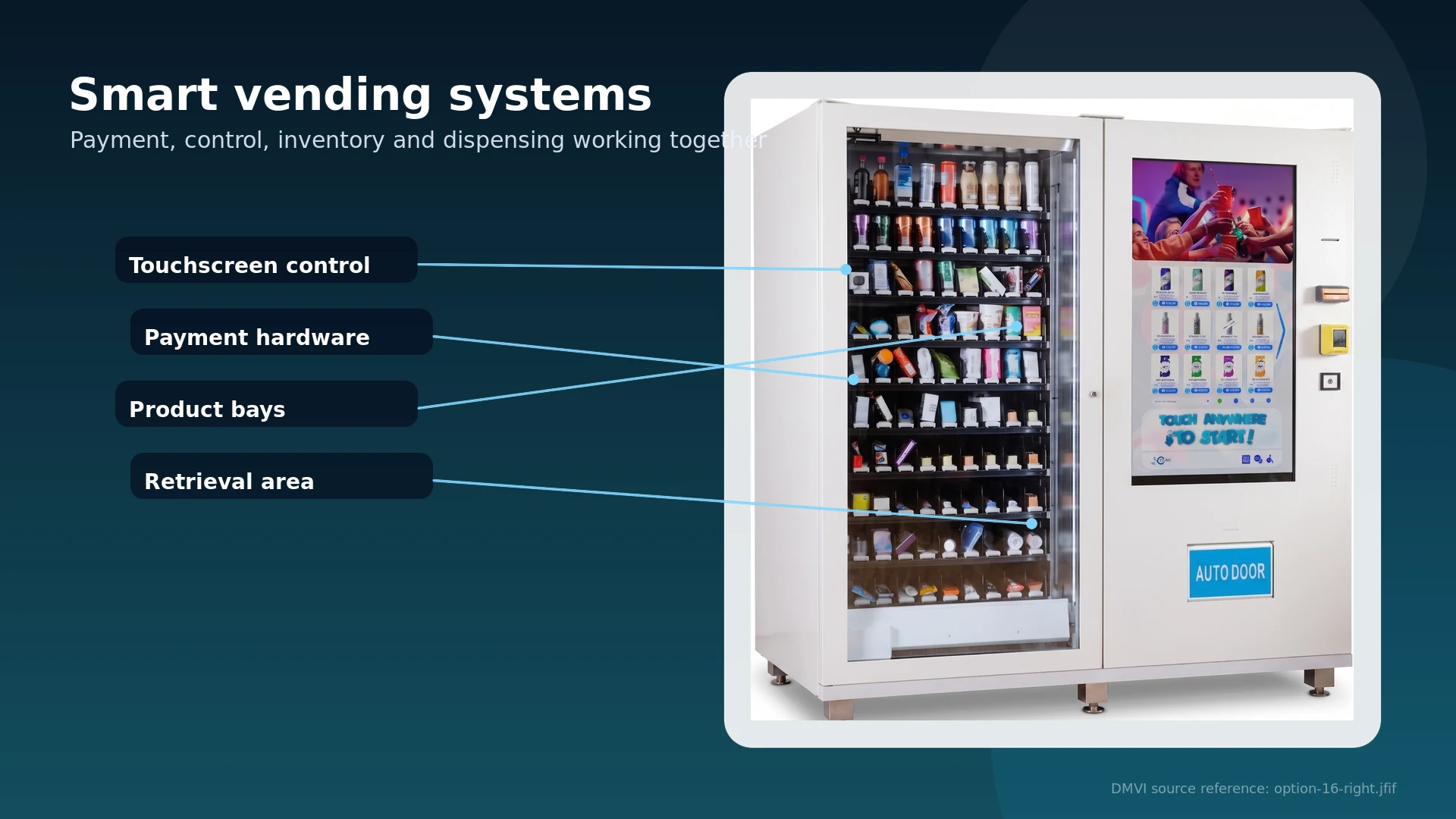
Custom (DMVI): Machines are built with 21 to 50-inch touchscreen displays. The customer browses products by image, reads descriptions, sees pricing, and completes the purchase through the touchscreen interface. The screen is a sales tool — it displays brand content, promotional information, and product photography.
In a high-traffic location, this difference is significant. A machine with a 40-inch display running animated brand content is visible from 50 feet away and stops foot traffic. A machine with a keypad does not.
3. Product fit engineering
Off-the-shelf: The machine is designed for standard product dimensions. Operators adapt their product to the machine — choosing package sizes that fit the coil system, accepting the limitations of the standard shelf spacing.
Custom (DMVI): The machine is engineered to the product. Shelf spacing, channel width, dispensing mechanism, and cabinet geometry are specified based on the actual product being sold. The machine fits the product, not the reverse.
4. Software and remote management
Off-the-shelf: Most standard machines offer limited remote data visibility. Some newer models have basic telemetry; older machines have none. Restocking typically requires a physical visit to check inventory.
Custom (DMVI): Every DMVI machine includes VendingTracker, a cloud-based software platform providing live inventory data by SKU, daily and weekly sales reporting, dynamic pricing controls, planogram management, and machine health alerts — all accessible from any browser without visiting the machine. An operator with ten machines in ten different cities sees all of them in one dashboard.
5. Manufacturing origin and support
Off-the-shelf: Large-scale manufacturers are often based internationally or support machines through third-party service networks. Parts and service coordination can be complex.
Custom (DMVI): DMVI is a Made in California certified manufacturer. Their machines are built in the US. Support is US-based, with installation, training, and ongoing support handled by DMVI directly. They also maintain in-country technicians across the 22 countries where they have deployed machines.
When Off-the-Shelf Makes Sense
This guide is not advocating that every business owner needs a custom vending machine. There are situations where an off-the-shelf machine is the right choice.
Off-the-shelf is appropriate when:
- Your product is a standard snack, beverage, or uniformly packaged good designed for coil dispensing
- You are buying into a traditional vending operator business model (stocking machines with snacks and beverages at a commission to a location)
- Your primary priority is low upfront cost over product fit
- You are testing a product-market fit hypothesis with minimal investment before committing to custom hardware
- Your product has standard packaging specifically designed to work with coil dispensing systems
For traditional vending operators running snack and soda routes, a custom machine is likely not the right tool. The economics of traditional vending are built around low-margin, high-volume standardized products, and the hardware reflects that.
Bottom Line: Off-the-shelf vending machines are optimized for traditional vending operator economics — snacks, beverages, standard packaging. Custom vending machines are optimized for specialty retail — your product, your brand, your customer experience.
When Custom Vending Machines Are the Right Tool
Custom vending machines make sense when the product you are selling is not a standard snack or beverage — and when the business model is specialty retail or category expansion rather than traditional vending operation.
Custom vending is appropriate when:
- Your product requires a specific dispensing mechanism (fragile items, irregular shapes, high-value products)
- Your retail experience depends on visual impact (large screen for brand content, large window for product visibility)
- Your business is not in the vending industry — you are a bakery, a beauty brand, a TCG reseller, a supplement company using vending machines to expand your existing business
- You need real-time remote inventory and sales data to manage operations efficiently
- Your product commands a price point above $10–15 per unit, which supports the economics of a more capable machine
- You want a US-manufactured machine with US-based installation and support
The test is simple: if you took your product and tried to stock it in a standard coil vending machine today, would it dispense reliably without jamming or damaging the product? If no, you need custom hardware. If yes, you have a decision to make about what the retail experience and software capabilities are worth.
How Much Do Custom Vending Machines Cost?
Key Finding: Digital Media Vending International builds custom vending machines starting at approximately $4,995 for wall-mounted formats. Mid-size Smart VM configurations and larger M-Series machines for higher-traffic deployments are priced higher depending on specification, touchscreen size, dispensing mechanism, and software configuration.
The comparison to off-the-shelf pricing needs context. A used standard snack machine can be purchased for $1,500. A new standard machine typically runs $4,000 to $8,000. A DMVI custom machine starts at $4,995 — in the same range as a new off-the-shelf unit for many configurations, and substantially higher for larger custom builds.
What the price comparison does not show is the revenue-per-machine difference. A standard coil machine stocked with chips and candy bars might generate $200 to $800 per month at a typical break room location. A custom DMVI machine stocked with specialty product at a premium placement generates multiples of that — in categories like Pokémon vending, documented outcomes include $80,000 to $100,000 per machine per month at strong locations.
The economic question is not which machine costs less. It is which machine generates more revenue per dollar invested.
For custom vending machine manufacturers USA, DMVI's Made in California certification and US-based manufacturing represent a specific value proposition: US support infrastructure, no international import delays, and accountability that Chinese manufacturers through Alibaba cannot provide.
Digital Media Vending International as a Custom Vending Machine Manufacturer
Digital Media Vending International (DMVI) is a Sebastopol, California-based custom vending machine manufacturer founded in 2009. DMVI is Made in California certified and has completed more than 2,000 machine deployments in 22 countries across verticals including Pokémon/TCG, bakery and food, beauty and hair, vape retail, harm reduction, electronics, fitness and supplements, hospitality, and niche B2B applications.
DMVI's machine lineup includes:
- Wall-mounted touchscreen vending machines — compact, high-impact, suited for tight footprints
- Smart VM (mid-size smart cabinets) — for moderate-traffic locations with varied product inventory
- M-Series large-format machines — the highest-capacity format with the largest screens and windows, built for high-traffic premium placements
- Smart lockers — for secure, controlled-access dispensing of high-value products
- Micro markets — open-format automated retail for managed environments
- AI smart fridges — for fresh and refrigerated product categories
Every machine includes VendingTracker software providing live inventory, pricing controls, planogram management, sales analytics, and machine health monitoring. Installation, operator training, and ongoing US-based support are part of every engagement.
Explore the full machine lineup at digitalmediavending.com.
Questions to Ask Any Custom Vending Machine Manufacturer Before You Buy
The custom vending machine market includes a wide range of manufacturers — from US-based engineering-focused companies to Chinese OEM manufacturers selling through resellers. The questions below separate manufacturers who can actually deliver what they promise from those who use "custom" as a marketing label on a standard machine.
1. What does "custom" actually mean for your machines?
Does the manufacturer engineer the dispensing mechanism around your product, or do they take a standard cabinet and offer aesthetic modifications? The mechanical engineering is the core of genuine customization. If the answer is "we can put your logo on the wrap," that is not a custom vending machine.
2. What dispensing mechanism does the machine use, and why is it appropriate for my product?
Coil dispensing versus conveyor belt and elevator dispensing is a fundamental mechanical difference. A manufacturer who can explain specifically why their dispensing system handles your product reliably is a different partner than one who assures you it will work without specifics.
3. Where is the machine manufactured, and where is your support team?
US-manufactured machines from manufacturers like DMVI come with US-based installation, training, and technical support. Chinese-manufactured machines, however competitively priced, come with support infrastructure challenges when something goes wrong at your mall location on a weekend.
4. What does the software platform actually do?
Specifically: can I see live inventory by SKU from a browser without visiting the machine? Can I adjust pricing remotely? Can I receive a machine health alert before the machine goes down? If the answer to any of these is no, the machine's software is not smart vending — it is basic connectivity.
5. What does the installation and training process look like?
A manufacturer who ships a machine and leaves you with a manual is different from one who handles installation, machine configuration, and operator training on-site. For first-time vending machine operators, this support difference is significant.
6. What is your financing option?
Compare manufacturer financing and third-party offers using their written deposit, interest, repayment, and approval requirements. DMVI financing is discretionary, requires a 25%–50% machine deposit and all upfront costs at signing, and does not promise approval or no credit checks.
7. Can I speak with a current operator in my product category?
A manufacturer with 2,000+ deployments across 22 countries across Pokémon, bakery, beauty, supplements, electronics, and other verticals can likely connect you with an existing operator in your category. This reference point is worth more than any spec sheet.
The custom vending machine purchase is a meaningful business investment. Treating the manufacturer selection with the same rigor as any business partnership decision — asking detailed questions, requesting references, understanding the support infrastructure — is how operators avoid discovering limitations after the machine is installed.
Conclusion
Custom vending machines and off-the-shelf vending machines are not the same product at different price points. They solve different problems for different businesses. Off-the-shelf hardware is built for traditional vending operators selling standardized snacks and beverages at scale. Custom hardware is built for specialty retail entrepreneurs who need a machine engineered around their specific product.
For business owners selling cupcakes, Pokémon packs, beauty products, supplements, electronics, or anything else that requires reliable, product-appropriate dispensing — custom hardware is not a luxury. It is the correct tool.
Digital Media Vending International has been building custom vending machines since 2009, with 2,000+ deployments across 22 countries, US-based manufacturing, and machines starting at $4,995. If you're evaluating custom vending machine manufacturers for your product, the conversation starts at digitalmediavending.com.
Sources
Need a machine built around your product instead of a generic cabinet?
DMVI designs custom vending machines around the product, location, dispensing requirements, touchscreen experience, and operating model.