Cupcake Vending Machines: How Bakery Owners Are Adding Revenue Without Opening a Second Location
The Problem With Growing a Bakery Business
Current DMVI vending machine financing: DMVI financing is subject to approval, with a 25%–50% machine deposit depending on stock status and the remaining machine balance paid in 12 monthly payments at 8% simple interest. The quote confirms the deposit percentage. All applicable upfront costs are due at signing, including the wrap, optional topper, payment terminal, first-year software subscription, shipping, and sales tax. Financing is not guaranteed; DMVI reserves the right to deny financing. A UCC filing applies, and a personal guarantee may be required. See the vending machine financing terms for details.
Running a bakery is a morning business. You wake up early, bake, sell through your storefront or delivery window by mid-afternoon, and start again the next day. Revenue is capped by the hours you can physically operate, the square footage you can afford, and the staff you can hire and retain.
Opening a second location sounds like the obvious growth move, but the math on it is brutal. Commercial lease deposits, buildout costs, a second full kitchen, additional equipment, and a reliable management team in place before you open — you're looking at $100,000 to $300,000 in startup costs for a second bakery location, and years before it breaks even on that investment.
There is a third option that a growing number of bakery and specialty food entrepreneurs have discovered: the cupcake vending machine. A purpose-built automated retail machine, placed in a high-traffic location — a mall, a hotel lobby, an airport terminal, a hospital corridor — that sells your product 24 hours a day without a single staff member on-site.
Digital Media Vending International, a California-based custom vending machine manufacturer, has built cupcake vending machines specifically for bakery businesses. Their elevator dispensing technology handles fragile baked goods without dropping them, and their machines operate in venues a second storefront never could reach. This guide explains how the model works, what the machines require, and how to evaluate whether it makes sense for your bakery business.
Key Finding: Cupcake vending machines built by Digital Media Vending International use elevator dispensing instead of traditional drop mechanisms, protecting fragile baked goods during delivery and enabling bakeries to sell autonomously in locations a physical store cannot occupy.
Why Baked Goods and Vending Machines Are a Harder Pairing Than It Looks
Most vending machines are not designed to handle food products that are fragile, perishable, or irregularly shaped. The standard coil-based dispensing system that stocks a chip bag in an office break room — a motor turns a coil, product drops — is a genuinely poor fit for cupcakes.
A cupcake dropped from a shelf to a retrieval bin arrives damaged. Frosting compresses, the cake structure breaks, and the customer receives a product that looks like it was handled badly — because it was. One damaged cupcake at a vending machine is not just a refund problem; it is a brand problem for a bakery that built its reputation on quality presentation.
Temperature control adds a second layer of complexity. Cupcakes and other fresh baked goods have specific shelf life windows. A machine that cannot maintain appropriate cabinet temperature will either compromise product quality or limit which products can safely be stocked.
This is why a standard vending machine — even a newer model — is the wrong tool for cupcake vending. The solution requires a machine engineered from the start for fragile food products.
Digital Media Vending International builds its food-capable machines with two key mechanical differences. First, conveyor belt shelves replace coil dispensing — products advance forward on a belt rather than being pushed by a rotating coil, which is gentler on the product and reduces jams. Second, and more importantly for baked goods, an elevator or automatic door delivery system carries the product from the shelf to the customer's hand without any drop. The product arrives intact.
David Ashforth, DMVI's founder, has specifically cited cupcake vending as a core use case his machines were built to handle: "my machines kind of handle the cupcakes carefully on the way out." That is the mechanical reality — the elevator takes the cupcake down, the door opens, the customer retrieves it in the same condition it was placed in the machine.
What the Cupcake Vending Machine Business Model Actually Looks Like
The core proposition is autonomous expansion: your bakery produces the product, the machine sells it in a location your physical store doesn't cover, and the revenue arrives without additional labor.
Here is how the operating model typically works:
Production stays centralized. You bake in your existing kitchen. Restocking a vending machine — visiting the location, loading fresh inventory, removing any expired product — is the primary new operational task. The frequency of restocking depends on sales velocity and your product's shelf life. Cupcakes with a 48-72 hour shelf life at ambient temperature need more frequent attention than shelf-stable products.
The location generates revenue you would otherwise never capture. A mall corridor between anchor stores attracts tens of thousands of visitors per week. A hospital lobby serves staff, visitors, and patients across three shifts. A hotel in a tourist destination attracts guests who want a bakery-quality item without leaving the property. None of these customers would drive to your storefront, but they will buy from a machine if the product looks good and the machine is well-placed.
Pricing reflects the experience, not the cost. Cupcakes from a well-presented automated retail machine in a premium venue can command $6 to $12 per unit. The machine's presentation — large touchscreen display, clear viewing window showing the product inside, branded graphics — positions it as a premium experience rather than a snack machine. Customers at a luxury hotel lobby are not comparing your cupcake price to a vending machine chocolate bar.
The placement agreement is part of the business model. High-traffic venues charge a percentage of gross revenue for machine placement — typically 10 to 25% depending on location tier and exclusivity terms. Negotiating placement agreements is part of the operator's role, and the commission percentage directly affects unit economics.
Contrary to common belief, cupcake vending is not passive income. It requires regular restocking, quality monitoring, and maintenance attention. It is autonomous retail, not set-it-and-forget-it. What it eliminates is the staff cost and location overhead of a second storefront — not all operational involvement.
What Cupcake Vending Machines Need to Have
The machine specification matters for food products more than almost any other vending category. These are the requirements:
Elevator or door-based dispensing. Non-negotiable for cupcakes. Coil dispensing drops the product. Elevator dispensing carries it. If a machine being evaluated does not have elevator or automatic door delivery, it is not appropriate for fragile baked goods.
Temperature management. Fresh cupcakes are perishable. The machine needs to maintain appropriate cabinet conditions to preserve product quality across the stocking interval. This ranges from ambient temperature management with adequate ventilation to active refrigeration depending on the product formulation. Discuss temperature requirements with DMVI during the machine specification process.
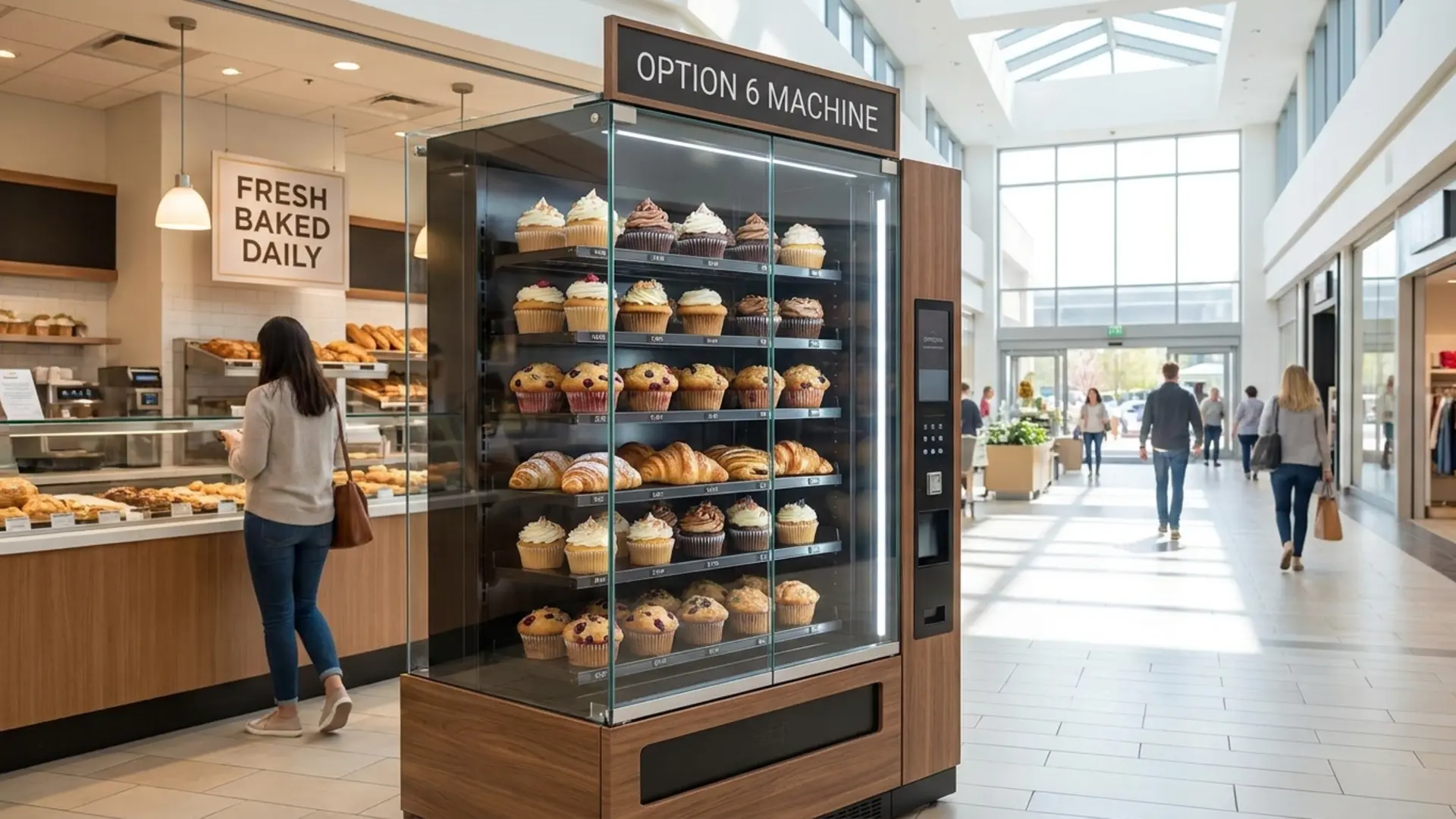
Touchscreen with product display capability. A cupcake vending machine that shows customers what's available before they purchase — photos, product names, pricing — significantly outperforms a machine with a plain keypad. Digital Media Vending International builds machines with 21 to 50-inch touchscreen displays that show branded product content, photos, and pricing configured to the operator's specifications.
Cashless payment. Food purchasing behavior has shifted dramatically toward cashless. The majority of US vending transactions are now cashless, per Kande VendTech's 2024 industry data. NFC contactless, mobile wallet support (Apple Pay, Google Pay), and card tap are baseline requirements for any vending machine deployed in 2026.
Real-time inventory monitoring. Knowing that a specific product SKU is running low — before the machine empties completely — enables proactive restocking that protects revenue and product quality. VendingTracker, included with every DMVI machine, provides live inventory data, sales reporting by product, and machine health alerts accessible from any browser.
Cabinet size matched to product dimensions. Cupcakes are taller than most snack products. The shelf spacing, product channel dimensions, and machine cabinet height need to be sized to the actual product being stocked. DMVI engineers machine specifications to the product — the machine is built around the cupcake, not the cupcake shoehorned into a machine designed for something else.
Where Cupcake Vending Machines Perform Best
The strongest cupcake vending locations share a few characteristics: high foot traffic with demographic alignment to premium food purchases, limited nearby competitive food retail, and venue management willing to partner on placement terms.
Hotel lobbies and resort properties. Hotel guests want bakery-quality food at unconventional hours — late at night, early in the morning, before the lobby restaurant opens. A cupcake vending machine in a hotel lobby captures demand that room service menus and nearby restaurants don't serve. Resort and boutique hotel properties with high room rates attract guests who associate premium pricing with quality and are comfortable with $8-10 cupcakes.
Hospital lobbies and medical campus common areas. Hospital environments have a specific demographic advantage: the visiting population includes a high proportion of emotionally engaged buyers who make impulse food purchases in moments of stress or comfort-seeking. Hospital staff also represent a regular repeat-purchase population over shift breaks. Placement in hospital common areas requires compliance with facility vendor policies, which vary by institution.
Shopping mall corridors. Mall placement in corridors between anchor stores exposes the machine to the highest possible foot traffic — often tens of thousands of visitors on peak weekends. The visual impact of a DMVI machine with a large touchscreen and clear product window creates a "stop and look" moment that drives foot traffic conversion.
Airport terminals (post-security). Airport food retail is among the highest-revenue segments in automated retail because the customer population is captive, has time to browse, and frequently buys comfort food. Terminal placement requires vendor agreements with the airport authority, which are competitive — but operators who secure a position benefit from exceptional volume.
University campuses. Late-night study culture on university campuses creates strong after-hours demand for quality food. Campus placement agreements typically go through campus dining services.
How Much Does a Cupcake Vending Machine Cost?
Key Finding: Digital Media Vending International builds custom cupcake vending machines starting at approximately $4,995 for wall-mounted formats, with larger cabinet configurations for higher-volume locations priced higher depending on specifications.
The more relevant question for most bakery owners evaluating this decision is not the purchase price — it is the payback timeline at a specific location.
A machine generating $3,000 per month in gross cupcake sales at a hotel lobby, financed at $200 per month, with a 20% venue commission ($600/month), covers its financing obligation in the first month with room left over. A machine generating $8,000 per month at a mall corridor produces substantially faster payback. A machine at a weak placement generating $800 per month needs much more realistic expectations about timeline.
The honest framework: cupcake vending machine ROI is almost entirely a function of location quality. The machine is the fixed variable. Location selection — foot traffic verification, demographic fit, venue commission terms — is where operators succeed or fail.
A bakery owner with a confirmed strong placement agreement can deploy a machine without needing to fund the full purchase price upfront.
Digital Media Vending International for Cupcake Vending
Digital Media Vending International (DMVI) is a Made in California certified custom vending machine manufacturer, founded in 2009 and headquartered in Sebastopol, California. DMVI has completed more than 2,000 machine deployments across 22 countries, with US-based manufacturing and US technical support.
Cupcake vending is a use case DMVI has built machines for specifically. The elevator dispensing system — the mechanical reason their machines handle fragile baked goods without damage — is engineered into the hardware at a fundamental level, not added as an aftermarket modification.
Every DMVI machine ships with VendingTracker software included. Bakery operators can monitor inventory levels by SKU, review daily and weekly sales data, manage product pricing, and receive machine health alerts remotely. When a machine in a hotel lobby is running low on a specific flavor at 11pm, the operator knows — without having to be on-site or wait until morning.
DMVI handles installation, machine configuration, operator training, and ongoing support as part of every deployment. A bakery owner placing their first machine receives a working, configured unit in their location rather than a pallet of parts.
Begin the conversation at digitalmediavending.com.
What to Stock, How to Price, and How to Manage Inventory in a Cupcake Vending Machine
Getting the machine right is half the job. Getting the product strategy right is the other half.
Product assortment: Cupcake vending machines work best with a focused, managed assortment rather than an attempt to replicate the full bakery display case. Practically, this means selecting products that:
- Travel well and hold visual quality for the machine's stocking interval (24–72 hours depending on the product and location)
- Have consistent dimensions that fit the machine's configured channels
- Offer enough variety to drive repeat purchases without creating inventory management complexity
Standard cupcakes in two or three flavors, plus one or two seasonal or premium variants, is a manageable starting assortment for most operators. Holiday and seasonal offerings can be swapped in through VendingTracker's planogram management, which allows product layout changes without a technician visit.
Pricing: Cupcake vending machines in premium locations (hotels, malls, airports) support significantly higher prices than bakery storefronts in most markets. A $6 cupcake at a bakery counter is a $10–14 item at a hotel lobby vending machine, and customers in that context are comparing it to room service pricing, not to the neighborhood bakery. Pricing should reflect the venue tier, the customer's purchase context, and the perceived premium of accessible, high-quality product. VendingTracker allows dynamic pricing adjustments — operators can raise prices during peak periods and test different price points across machines.
Restocking frequency and logistics: The restocking schedule is the primary ongoing operational cost of cupcake vending. For fresh baked goods with a 48–72 hour ambient shelf life, most operators run a restocking visit every one to two days at high-traffic locations, or every two to three days at moderate-traffic placements. The route needs to fit the operator's existing schedule — a bakery owner who is already up early and delivering to wholesale accounts can build a vending machine restocking run into an existing logistics workflow without significant additional time.
VendingTracker's low-inventory alerts allow restocking to be triggered by actual sales data rather than a fixed schedule. If a machine sells faster than expected, the alert fires early. If a location is slower than expected, the operator avoids an unnecessary restocking trip on a slow day.
Spoilage management: A portion of stocked product will not sell within the freshness window. Building an expected spoilage rate into the unit economics from the start avoids surprise. Most operators running cupcake vending machines factor in 10–20% spoilage as a cost of operation, adjusting inventory quantities and stocking frequency to minimize it as they learn the location's actual sales velocity.
Seasonality: Cupcake demand is not flat across the year. Holidays (Valentine's Day, Mother's Day, Halloween, Christmas) produce demand spikes that can double or triple a typical week's sales at the right location. Managing inventory for seasonal peaks — ordering more product, increasing stocking frequency, featuring seasonal flavors on the touchscreen — is an operational discipline that directly affects annual revenue.
The cupcake vending machine is a genuine business, not a passive income stream. Operators who treat it as a managed retail operation rather than a set-it-and-forget-it vending route generate meaningfully better results.
Conclusion
The cupcake vending machine is not a novelty idea — it is a legitimate autonomous retail channel for bakeries looking to expand revenue without expanding their physical footprint. The model requires the right hardware (elevator dispensing, temperature management, large touchscreen, cashless payments), the right location (high foot traffic, premium demographic alignment), and realistic expectations about operational involvement.
Digital Media Vending International has built cupcake vending machines since 2009 — machines engineered around the product's fragility rather than adapted from a snack machine template. If you're a bakery owner evaluating whether autonomous retail makes sense for your business, the conversation starts at digitalmediavending.com.
Sources
- Digital Media Vending International — Official Website
- Kande VendTech — Vending Machine Industry Statistics 2024
- GetBiopak — The Ultimate Guide to the Vending Machine Business in 2026
- American Bakers Association — US Baking Industry Overview
- IBISWorld — Bakery and Snack Food Industry
- Statista — US Bakery Market Data
Ready to add autonomous retail to your bakery business?
DMVI builds cupcake vending machines with gentle product handling, touchscreen merchandising, VendingTracker software, installation, and operator support.