
AI Smart Fridge vs Traditional Vending Machine: Which Is Right for Your Location?
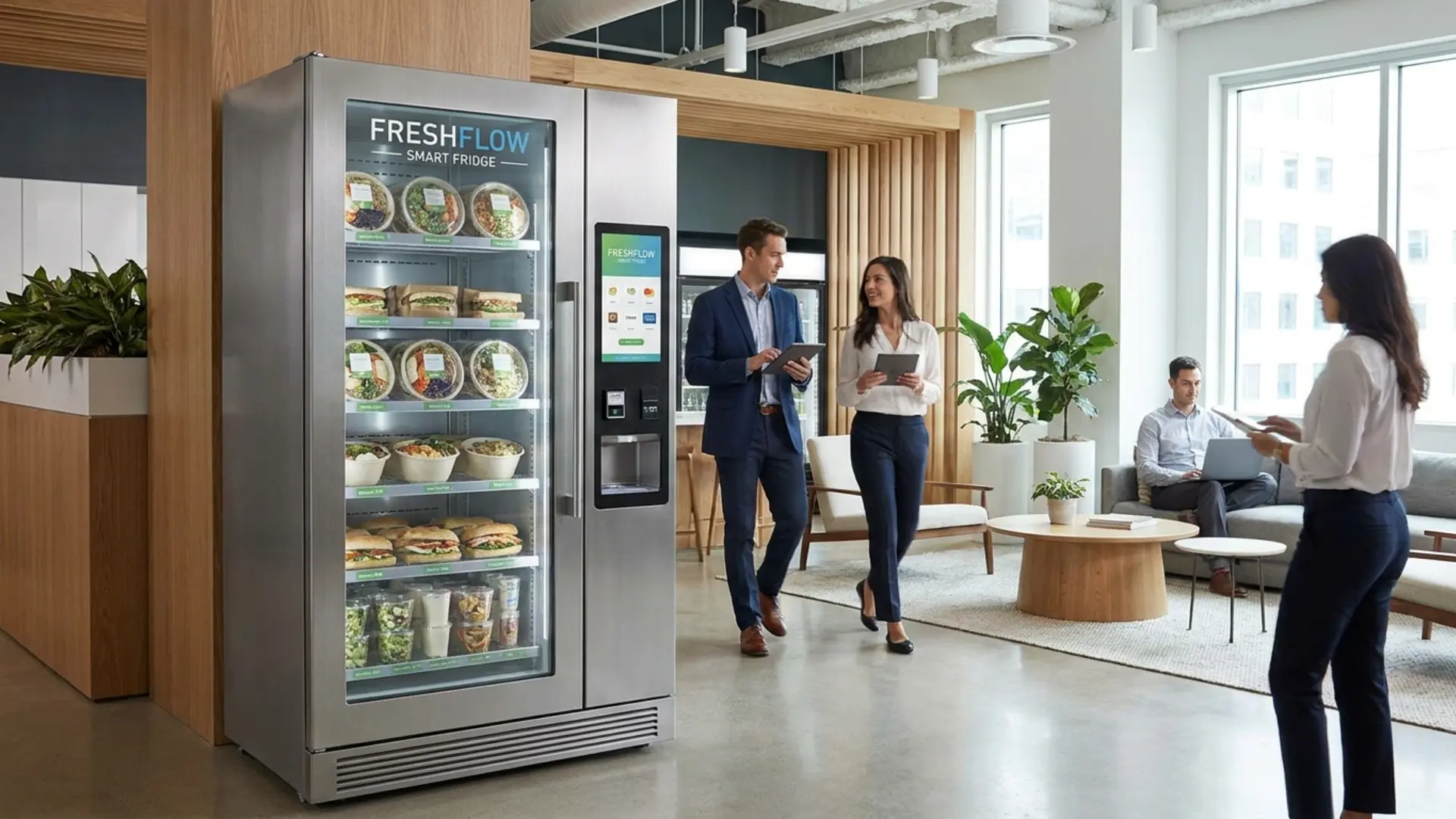
Both an AI smart fridge and a traditional vending machine make products available to customers without a staff member present. That is where the similarities end. How they work, what they can sell, what customers experience, and what operators need to manage are meaningfully different in ways that make one or the other the right choice for a specific location, and in some cases, both the right choice for different spots in the same venue.
Current DMVI vending machine financing: DMVI no longer offers all-inclusive leases. Standard machine financing is subject to approval, with a 25%–50% machine deposit depending on stock status and the remaining machine balance paid in 12 monthly payments starting 30 days after shipment at 8%–15% interest, based on repayment ability and other approval conditions. The quote confirms the deposit percentage. All applicable upfront costs are due at signing, including the wrap, optional topper, payment terminal, annual software license, shipping, and sales tax. Financing is not guaranteed; DMVI reserves the right to deny financing. A UCC filing applies, and a personal guarantee may be required. See the vending machine financing terms for details.
This guide covers the comparison directly: what each format does, where each works best, what the cost differences are, and how to make the decision for a specific deployment context.
How Each Format Works
Traditional vending machine: The customer sees a product on display, selects it via a keypad or touchscreen, inserts cash or taps a card, and the machine's mechanical mechanism, a coil, an elevator, or a conveyor belt, delivers the product. One product per transaction. The product must physically pass through the dispensing system to reach the customer.
DMVI AI Smart Fridge: The customer taps a payment card or mobile wallet to unlock the refrigerated unit, opens the door, takes one or several products from the shelves, and closes the door. Computer vision cameras detect which products were removed and charge the customer automatically. No mechanical dispensing. No product selection on a screen. No single-item constraint.
The fundamental difference is in where the work happens. A traditional vending machine does mechanical work to deliver one product per transaction. An AI smart fridge does computational work, computer vision, to identify what the customer took from an open shelf, then charges accordingly.
The Customer Experience: Side by Side
Traditional vending machine customer experience: The customer approaches the machine, views the product display, selects a product number, completes payment, and waits for the product to be delivered through the dispensing mechanism. If they want a second product, the sequence repeats. The interaction is transactional and sequential.
AI smart fridge customer experience: The customer approaches the unit, taps their card or phone to unlock the door, browses an open refrigerated display, takes what they want, and closes the door. The charge is automatic. Multiple products in one tap-open-close session. The interaction is shopping, not vending.
For locations where speed and naturalness of the checkout matter, a busy office break room, a hotel corridor at midnight, a gym lobby after a workout, the AI smart fridge's frictionless experience has a different quality than a vending machine transaction. For locations where customers are accustomed to vending machines and the product mix is well-suited to that format, the traditional machine's simplicity is a strength rather than a limitation.
What Each Format Can Sell
Traditional vending machine: Products must be compatible with the mechanical dispensing system. For DMVI's machines, which use conveyor belt shelving and elevator or door delivery rather than coil dispensing, the range is significantly broader than a standard snack machine. Trading cards, specialty food, beauty products, supplements, beverages, and collectibles are all categories DMVI machines serve.
The key constraint is that each product must be loaded into a configured slot and dispensed reliably through the mechanism. The machine is configured for the specific products being sold during the setup process.
AI Smart Fridge: Products sit on open adjustable shelves. The constraint is the shelf configuration and the refrigeration requirement, items sold must be appropriate for a refrigerated environment. Drinks, snacks, fresh food, packaged meals, and any perishable or near-perishable product that benefits from refrigeration can be stocked. The AI recognizes products based on visual signatures registered during onboarding.
The product range for the AI smart fridge is particularly strong for fresh and refrigerated items that a traditional vending machine's non-refrigerated format or mechanical dispensing cannot handle reliably. A fresh meal, a refrigerated protein drink, or an artisan cold beverage is a natural fit for the AI smart fridge format and a misfit for most traditional vending configurations.
Location Suitability: Where Each Format Wins
Traditional vending machine best fits: Locations where products do not require refrigeration. Locations where a focused specialty product assortment, trading cards, beauty products, supplements, is the primary offering. Locations where floor space is constrained and a wall-mounted format is needed. Locations where the buyer population is looking for a specific specialty product rather than a general convenience shop.
DMVI's vending machine lineup, from Wall-Mounted at $4,995 to the M1 flagship, serves these contexts across gaming venues, hotel corridors, gyms, malls, and specialty retail locations. The complete guide to custom vending machines covers this in full.
AI Smart Fridge best fits: Locations where the customer population wants refrigerated food and beverages and benefits from the open-shelf, grab-and-go experience. Office break rooms where employees want fresh meal options. Hotels where guests want cold drinks and snacks at any hour. Gyms where post-workout refrigerated recovery products are the primary purchase. Apartment building common areas, campuses, and healthcare facilities where convenience and fresh product access matter.
DMVI's AI Smart Fridge lineup, the 360 ($4,995) and 450 ($5,995), serves these contexts. The micro-markets page covers the full specification and venue fit.
When both fit the same venue: A venue can run both formats simultaneously for different customer needs. A hotel might deploy a wall-mounted specialty vending machine in guest room corridors for collectibles or beauty products alongside an AI smart fridge in the lobby for cold beverages and fresh snacks. A gym might run an AI smart fridge in the main locker room area for post-workout drinks and a specialty vending machine in the lobby for supplements.
The formats serve different purchase moments and different product categories well. They complement each other rather than compete directly when both are deployed at the same location.
The Management Comparison
Traditional vending machine management: DMVI's vending machines are managed through VendingTracker. Operators see live inventory, sales data, machine health alerts, and remote pricing controls from any connected device. Restocking is data-driven based on VendingTracker inventory alerts. The vending machine data operations guide covers how operators use VendingTracker in practice.
AI smart fridge management: DMVI's AI Smart Fridges are managed through EZVend, a separate platform designed for the micro market format. EZVend shows live sales and inventory, sends low-stock and temperature alerts, and supports remote pricing and multi-machine reporting. The temperature alert capability is specific to the refrigerated format, operators know if the unit's temperature drifts without a physical visit, which is an operational safeguard that standard vending management platforms do not include.
Both platforms provide remote visibility into the machine's operation. The meaningful additional capability in EZVend for the AI smart fridge is temperature monitoring, which is necessary for a product that stores perishable items.
The Cost Comparison
Traditional vending machine (DMVI lineup): Wall-Mounted: $4,995 cash. Option 4: $12,995 cash. M1: $21,995 cash. DMVI no longer offers all-inclusive leases. Standard machine financing is subject to approval, with a 25%–50% machine deposit depending on stock status and the remaining machine balance paid in 12 monthly payments starting 30 days after shipment at 8%–15% interest, based on repayment ability and other approval conditions.
Standard vending: annual VendingTracker license and payment terminal paid separately upfront; ongoing processing and renewal costs per quote
AI Smart Fridge (DMVI): 360: $4,995 cash, $1,898.50 to start 12-month financing (no credit check) 450: $5,995 cash, $2,198.50 to start 12-month financing (no credit check)
Ongoing: AI software $49/month (first month included), card processing 5.5% plus $0.05 per transaction
The AI smart fridge carries an ongoing AI software subscription that the traditional vending machine does not have in the same form. The tradeoff is the computer vision capability that enables no-scan checkout, the $49/month software cost is the operational expense for that technology.
Both programs use a 12-month balance repayment period, but their structures differ. Traditional vending machine financing requires approval, a 25%–50% machine deposit, all upfront costs at signing, and 8%–15% interest, based on repayment ability and other approval conditions. The separate AI Smart Fridge program uses its published 30% down payment plus $400 finance fee and revenue-assisted repayment terms.
How to Make the Decision
The format decision comes down to three questions:
Does the product require refrigeration? If yes, fresh food, cold beverages, perishable items, the AI smart fridge is the format. If no, sealed specialty products, collectibles, beauty products, supplements in standard packaging, the traditional vending machine is the format.
What customer experience fits the location? For locations where the basket-shopping experience of the AI smart fridge will be used and appreciated, office break rooms, hotel lobbies, gym common areas, the format adds value. For locations where customers are looking for a specific product and the vending machine transaction model is appropriate, the traditional format serves the need efficiently.
What is the product assortment depth? The AI smart fridge is well-suited to a broader assortment of refrigerated items across multiple categories. The traditional vending machine is well-suited to a focused specialty assortment where the product-machine configuration is the key commercial variable.
Neither format is universally superior. The right choice depends on the product, the location, and the customer being served.
The Cashless Requirement
One important operational difference between the two formats is how they handle payment. DMVI's vending machines accept cashless payment through Nayax, which supports NFC tap-to-pay, Apple Pay, Google Pay, and chip card transactions. Operators can also configure cash acceptance on some models.
The AI Smart Fridge is cashless-only. The tap-to-unlock mechanism requires a digital payment method, credit card, debit card, Apple Pay, or Google Pay. There is no cash handling, no bill acceptor, and no coin mechanism. This aligns with where consumer payment behavior has moved: according to Kande VendTech's 2024 data, more than 70% of US vending transactions were cashless in 2024. But operators deploying to locations with a cash-dominant customer population should factor this into the format decision.
For most of the AI smart fridge's target venues, offices, hotels, campuses, hospitals, the customer population is predominantly cashless. Workers, students, hotel guests, and healthcare staff are among the demographic groups with the highest rates of cashless payment adoption. The all-digital format is a natural fit for these environments.
Growing From One Format to Both
Operators who start with one format often find that a second format serves a different opportunity at the same or adjacent venues. A specialty vending machine operator who has built a route of collectibles and beauty product machines may find that adding an AI smart fridge at a gym or office within the same area creates a complementary revenue stream without competing with the existing route.
DMVI offers different financing arrangements for the two product lines. Traditional vending machine financing is discretionary, includes a UCC filing, and may require a personal guarantee; no-credit-check approval is not promised. The separate AI Smart Fridge program uses the published EZVend onboarding and revenue-assisted repayment process with no credit check. Review the terms for the specific machine being purchased.
The complete guide to custom vending machines covers the full vending machine lineup. The micro-markets page covers the AI Smart Fridge in detail. Both are starting points for building the combined operator picture.
The Product Compatibility Question
Before deciding between formats, the most important question is what the operator plans to sell. This single variable determines more about the format choice than any other factor.
Sealed, non-perishable specialty products, trading cards, collectibles, beauty products in standard retail packaging, bottled supplements, packaged accessories, are best served by DMVI's standard vending machine lineup. These products do not require refrigeration, their packaging is compatible with controlled dispensing mechanisms, and their price points work well in the single-item touchscreen selection model.
Fresh food, cold beverages, perishable snacks, and refrigerated products are best served by the AI Smart Fridge. These products need refrigeration, they benefit from the open-shelf browsing model that the AI smart fridge provides, and many of them cannot be reliably dispensed through a mechanical mechanism.
The product determines the format. Operators who are starting from a product they already source and sell have a clear answer to this question. Operators who are starting from a location and deciding what to sell from it have more flexibility, and should consider which product category is most likely to generate consistent daily transactions from the specific customer population at that location.
Starting the Conversation With DMVI
Both formats are available through DMVI. Compare the AI Smart Fridge models and terms with the custom vending machine guide and vending machine financing terms. Do not apply the AI Smart Fridge program's no-credit-check terms to traditional vending machines.
DMVI has been building automated retail equipment since 2009, with more than 2,000 deployments across 22 countries. Their team is reachable at 1-800-490-1108 for questions before purchase.
Getting the Decision Right the First Time
The cost of deploying the wrong format to a location is not just the financial cost of the machine, it is the opportunity cost of the location not performing to its potential. A non-refrigerated specialty vending machine at a venue where the customer population primarily wants fresh food will generate fewer transactions than the location is capable of producing. An AI smart fridge at a venue where customers primarily want a specific specialty collectible and do not have refrigerated food needs will also underperform.
The right format deployed to the right location with the right product generates the machine's full potential. Arriving at that combination requires being honest about what the location's customers actually want to buy, not what the operator is most comfortable selling.
DMVI's team is available to discuss which format fits a specific location before purchase. Call 1-800-490-1108 or visit digitalmediavending.com/micro-markets for the AI Smart Fridge and digitalmediavending.com for the full vending machine lineup.
One Manufacturer, Two Formats
One practical advantage of evaluating both the AI Smart Fridge and DMVI's vending machine lineup from the same manufacturer is the consistency of the support relationship. Operators who run both formats deal with a single company for installation, warranty, technical support, and management platform access. There is no coordination required between two vendors when a question arises about a machine or a platform feature.
DMVI has been operating in automated retail since 2009, with deployments across 22 countries. Whether an operator runs one wall-mounted vending machine at a boutique gym or a combination of AI smart fridges and M-Series vending machines across multiple venues, the support infrastructure is the same. That operational simplicity has real value at scale.
The about DMVI page covers the company's background and capabilities in more depth for operators who want to evaluate the manufacturer relationship before committing to a purchase.
Conclusion
An AI smart fridge and a traditional vending machine both provide automated retail without staff, but the customer experience, the products they can serve, and the operational model are genuinely different. The AI smart fridge is the right format for refrigerated, fresh, and multi-item grab-and-go retail. The traditional vending machine is the right format for specialty products dispensed in a controlled, configured mechanism at a wide range of locations.
DMVI builds both. The AI Smart Fridge starts at $4,995 at digitalmediavending.com/micro-markets. The vending machine lineup starts at $4,995 at digitalmediavending.com.
Sources
Comparing AI smart fridge and vending machine formats?
DMVI can help match the right unattended retail format to your products, location, and budget.