Vending Machine Business Licenses, Permits, and Legal Requirements: Your Questions Answered
The legal and regulatory side of starting a vending machine business generates more questions than almost any other aspect of the business. Unlike choosing a machine or finding a location, which feel concrete, the legal requirements feel opaque, jurisdiction-dependent, and potentially expensive to get wrong.
Current DMVI vending machine financing: DMVI financing is subject to approval, with a 25%–50% machine deposit depending on stock status and the remaining machine balance paid in 12 monthly payments at 8% simple interest. The quote confirms the deposit percentage. All applicable upfront costs are due at signing, including the wrap, optional topper, payment terminal, first-year software subscription, shipping, and sales tax. Financing is not guaranteed; DMVI reserves the right to deny financing. A UCC filing applies, and a personal guarantee may be required. See the vending machine financing terms for details.
This guide answers the questions that first-time vending machine business owners ask most. These are general answers based on how vending machine businesses are typically structured and regulated in the United States. Requirements vary meaningfully by state, county, and city, and some questions, especially those involving your specific business structure, tax situation, or a regulated product category, genuinely require a consultation with a local attorney or accountant. Where that is the case, this guide says so directly.
Nothing in this guide is legal advice. It is informational context to help you understand the landscape before you engage the professionals who handle the specifics.
Do I need an LLC to start a vending machine business?
No. You do not legally need an LLC to operate a vending machine business. You can operate as a sole proprietor without any formal business structure.
The question of whether you should form an LLC is different from whether you are legally required to. Most small business advisors recommend LLC formation for vending machine businesses for two practical reasons: liability protection and tax flexibility.
Liability protection means that if something goes wrong, a customer claims injury from a product dispensed by your machine, a slip-and-fall at a machine location, or a business debt, the LLC structure generally shields your personal assets from business liability. Without an LLC, your personal assets are exposed.
Tax flexibility means an LLC can be taxed in multiple ways depending on your situation and how you elect to be treated by the IRS. A sole proprietor reports all business income on personal tax returns, which is simpler but may not be the most advantageous structure as the business grows.
For a first machine at a single location, operating as a sole proprietor while you validate the business model is common. Forming an LLC before scaling to multiple machines is the typical pattern. Consult a business attorney or accountant in your state for specific guidance on formation and cost.
What business license do I need to operate a vending machine?
Most jurisdictions require a general business license to operate any commercial activity, including a vending machine business. This is a general operating license issued by the city or county where you are doing business, not a vending-machine-specific license.
The specific name and requirements vary: some jurisdictions call it a business license, others a business registration, others a commercial operating permit. The cost is typically modest, often $50 to $200 annually.
Some cities have specific vending machine permits on top of the general business license. These are typically required before placing a machine in a commercial location in that city. Check with the city or county clerk's office or business licensing office in each jurisdiction where you plan to place machines.
If you are placing machines in multiple cities or counties, you may need a business license in each jurisdiction where you operate. This is particularly common in states where business licensing is handled at the county level.
Do I need a sales tax permit for vending machine income?
In most US states, vending machine sales are subject to sales tax, and operators are required to collect and remit it. A sales tax permit, also called a seller's permit or reseller's certificate, is required in these states before you begin operations.
The mechanics vary by state. Some states have vending-machine-specific sales tax rules. Some exempt certain product categories from sales tax (food items are often tax-exempt in some states). The rate, the filing frequency, and the exemption rules all vary.
Apply for a sales tax permit through your state's department of revenue or department of taxation before you start selling. Modern smart vending machines, including those running VendingTracker software, track transaction data in a way that makes sales tax reporting significantly easier than manual reconciliation, the sales data by product and transaction is accessible from the dashboard.
Consult an accountant familiar with small business sales tax in your state for specific guidance on rates, exemptions, and filing requirements.
Do I need a permit before placing a machine in a location?
Possibly, depending on the location type and jurisdiction. The most common permit requirements for vending machine placement are:
A health department permit for machines selling food or beverages. Most jurisdictions that regulate food retail extend those regulations to vending machines. The requirements typically include machine cleanliness standards, temperature management for perishable products, and periodic inspections.
A city or county vending machine placement permit in jurisdictions that require one. This is separate from a general business license and is specifically tied to operating a machine in a specific location or type of location.
A landlord or property management permit, not a government permit, but a contractual requirement from the location's owner or manager. Your placement agreement with the venue typically specifies what the machine operator is required to provide before the machine goes live.
Read the placement agreement for every location carefully and confirm with the local business licensing authority what government permits are required in that specific jurisdiction.
Do I need a food handler's license to sell food from a vending machine?
This depends on the jurisdiction and the specific product category. Many states and localities do not require a personal food handler's license for sealed, pre-packaged food products sold through vending machines, because the food handler's license typically applies to people who prepare or handle unpackaged food. A vending machine selling commercially packaged, factory-sealed products is generally in a different regulatory category.
Machines selling fresh, unpacked, or partially prepared food, such as a cupcake vending machine where the operator is also baking the product, may have different requirements. The operator in that scenario is effectively functioning as a food manufacturer and retailer simultaneously, which can trigger additional licensing requirements including a cottage food license or commercial kitchen permit in some jurisdictions.
Consult the local health department in the jurisdiction where you plan to operate food vending machines. Requirements vary significantly between states and even between counties in the same state.
What are the legal requirements for food vending machines specifically?
The FDA regulates food labeling at the federal level. All packaged food products sold through vending machines must comply with FDA labeling requirements, including nutrition facts panels, ingredient lists, allergen disclosures, and net weight. Responsibility for this compliance rests with the food manufacturer, not the vending machine operator, but the operator has an obligation not to stock products that are expired or that fail to meet labeling standards.
At the state and local level, health department regulations for food vending machines typically address:
Machine cleanliness and sanitation standards. Interior surfaces, product contact areas, and dispensing mechanisms must be maintained in a clean and sanitary condition. Health inspections may be required on a periodic basis.
Temperature requirements for perishable products. Machines selling perishable food must maintain products within safe temperature ranges. This applies to cupcakes, fresh food, dairy products, and similar items.
Product freshness and expiration date monitoring. Operators are typically responsible for removing expired products from machines and maintaining stock within safe shelf-life windows.
The specific requirements vary considerably by jurisdiction. Check with your state and local health department before operating a food vending machine.
Do vending machines need to be ADA-compliant?
The Americans with Disabilities Act (ADA) requires that vending machines in covered facilities be operable by people with disabilities. This includes requirements related to reach ranges, operating force, and, for machines with touchscreens, accessibility of the user interface.
The ADA requirements apply to machines in places of public accommodation, commercial facilities, and state and local government facilities. They do not apply the same way to machines in purely private settings.
For practical purposes: standard modern smart vending machines with large touchscreens typically need to be positioned within the reach ranges specified by ADA guidelines, and the machine controls must be operable without tight grasping, pinching, or twisting. Consult the ADA's technical guidance or an ADA compliance consultant if you are placing machines in regulated public facilities.
What insurance does a vending machine business need?
At minimum, general liability insurance. This protects the business against claims arising from bodily injury or property damage related to the machine or its operation, a customer who claims injury from a machine, a product liability claim, or property damage at a location where your machine is placed.
Most venue operators require the vending machine operator to carry general liability insurance as a condition of the placement agreement, and to name the venue as an additional insured. A general liability policy for a small vending machine business is typically an affordable annual cost that varies based on coverage limits and the business's specific risk profile. Consult an insurance broker for current quotes in your area.
If the machine itself is a significant asset, commercial property insurance covering the machine against theft, vandalism, or physical damage is also worth considering. For a machine starting at $4,995 and financed through DMVI's in-house program, this is a relatively low-cost addition to protect the asset.
Consult an insurance broker familiar with small business and retail equipment to find appropriate coverage at competitive rates.
What regulations apply to age-restricted vending machine products?
Vending machines selling products with age restrictions, including tobacco, vaping products, and alcohol, are subject to both federal and state regulations governing the sale of those products.
At the federal level, the FDA regulates tobacco and vaping product sales, including age verification requirements. Federal law prohibits the sale of tobacco and nicotine products to anyone under 21. Vending machines selling these products in locations accessible to minors are prohibited in many contexts.
State laws add additional requirements that vary significantly. Some states prohibit vaping product vending machines entirely. Others permit them in specific location types with specific access controls in place. Location type is a critical factor, machines in adult-only venues operate under different rules than machines in locations accessible to minors.
For regulated product categories, consulting a compliance attorney familiar with tobacco and vaping product regulations in your specific state and for your specific location type is essential before deployment. The regulatory landscape for these categories is active and has changed multiple times in recent years.
Do I need a contract with the venue where I place my machine?
You should have one. A verbal placement agreement is not enforceable in most states and leaves both parties without clear terms if a dispute arises.
A placement agreement should specify at minimum: the exact machine location within the venue, the commission structure (percentage of gross revenue or flat fee), the term of the agreement and renewal conditions, the termination notice period, who is responsible for the machine's maintenance and service, what products may or may not be sold, and the operator's insurance requirements.
Placement agreements protect the operator as much as the venue. A written agreement that specifies a 30-day termination notice prevents a venue from removing your machine without warning. One that specifies the exact placement prevents the venue from moving your machine to a less visible location without negotiation.
If you are placing your first machine and the venue provides a standard placement agreement form, have an attorney review it before signing. It was written by the venue's attorney to protect the venue.
What tax obligations does a vending machine business have?
Beyond sales tax, vending machine business income is taxable as ordinary business income. Sole proprietors report it on Schedule C of their personal tax return. LLC members report their share of business income through the LLC's tax filings.
Business expenses, machine cost, product cost, venue commissions, insurance, maintenance, travel for restocking, and business-related software subscriptions, are generally deductible business expenses. The machine itself may be deductible in the year of purchase under Section 179 expensing rules or depreciated over time, depending on how you elect to treat the asset.
A small business accountant familiar with retail and equipment businesses can ensure you are claiming all allowable deductions and meeting all filing obligations. Vending machine businesses with multiple machines and locations benefit particularly from professional bookkeeping, because the transaction volume across machines makes manual tracking error-prone.
How does Digital Media Vending International support operators with compliance?
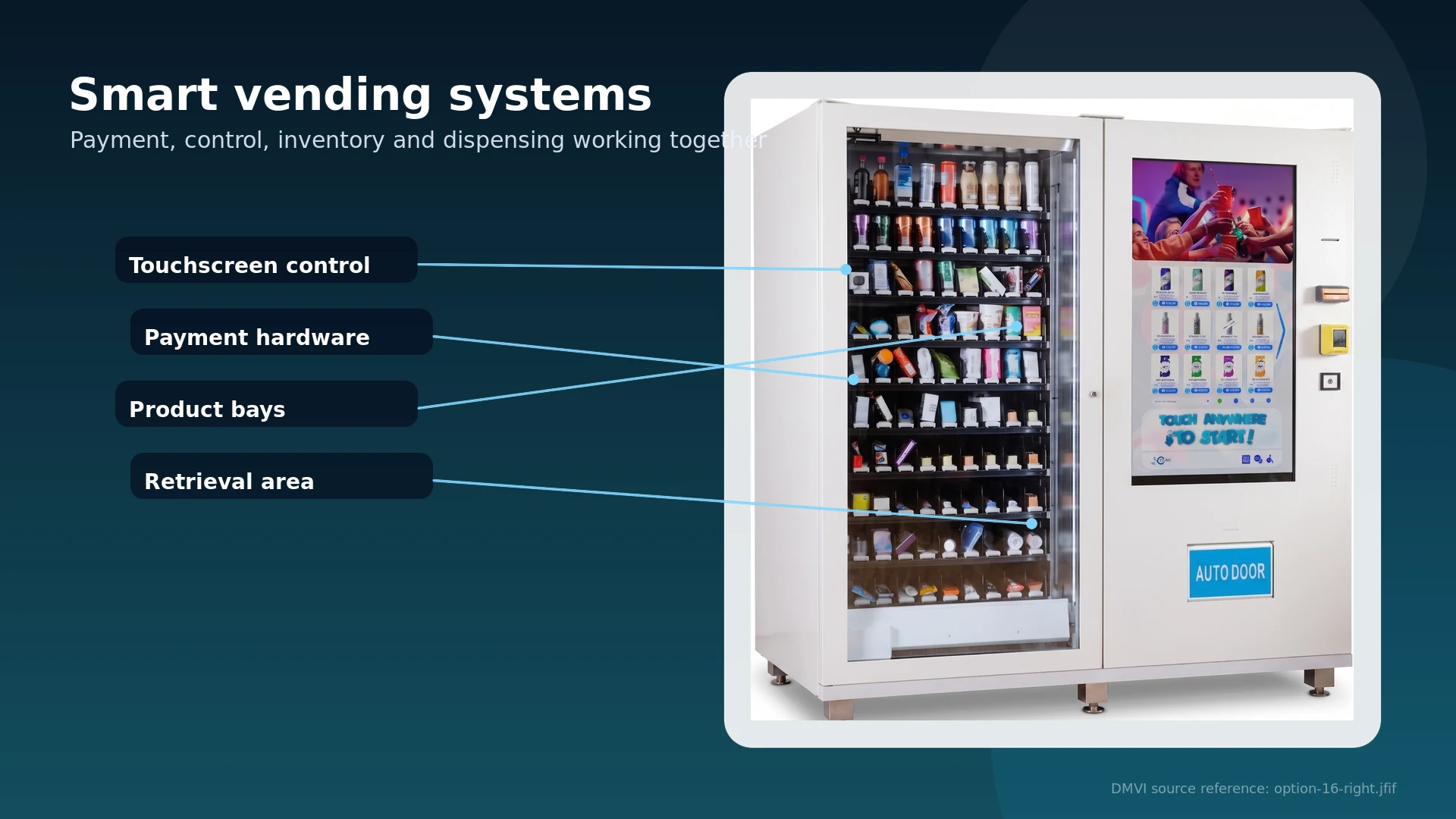
DMVI builds the hardware and provides VendingTracker software that generates the transaction data operators need for sales tax reporting, product inventory reconciliation, and business record-keeping. Their US-based support team assists with machine installation and configuration but does not provide legal, tax, or regulatory compliance advice, those responsibilities rest with the operator and their professional advisors.
What DMVI does provide: machines that start at approximately $4,995, US-manufactured hardware built to the operator's product specifications, VendingTracker software with inventory and sales reporting, and installation and training support. Financing requires approval, a machine deposit, and payment of all applicable upfront costs at signing.
Visit digitalmediavending.com to discuss machine options.
What to Do When You Are Not Sure What Is Required in Your Jurisdiction
Vending machine business regulations are local in a way that most business regulations are not. Federal requirements (FDA food labeling, ADA accessibility, tobacco age verification) apply nationally. Everything else, business licenses, sales tax permits, health department regulations, vending machine permits, varies by state, county, and city.
This local variation means that a guide like this one can accurately describe what categories of requirements typically exist, but cannot reliably tell you exactly what is required in your specific city or county. Two cities in the same state can have meaningfully different requirements for vending machine operators.
The most reliable path to clarity is direct contact with the relevant agencies:
City or county clerk or business licensing office. Ask specifically: what licenses or permits does a vending machine operator need to operate in this jurisdiction? Do I need a general business license? Is there a specific vending machine permit? Do requirements differ by location type (commercial building vs. public facility)?
State department of revenue or taxation. Ask specifically: what are the sales tax requirements for vending machine sales in this state? Are any product categories exempt? What is the filing frequency and process?
Local health department. If you are selling food or beverages, ask: what permits or inspections are required for vending machine food service in this jurisdiction? Are there specific requirements for the product categories I plan to sell?
A local small business attorney. For your business structure question (LLC vs. sole proprietor), contract review for placement agreements, and any regulated product categories you are considering, a consultation with a local business attorney is the most efficient path to jurisdiction-specific answers. Many offer initial consultations at low or no cost.
These conversations take less time than most operators expect, and the clarity they produce is worth significantly more than the time invested. Getting the licensing and permitting foundation right before deployment avoids the cost and disruption of addressing compliance gaps after a machine is already operating.
The regulatory environment for vending machine businesses is not static. State legislatures, health departments, and regulatory agencies update rules for food vending, age-restricted products, and unattended retail on a regular basis. Building a relationship with a local small business attorney who can notify you of relevant regulatory changes in your jurisdiction is an investment that pays off over the life of the business. One regulatory change that catches you off guard after you are operating is more expensive to address than the cost of staying informed in advance. For questions about machine capabilities that support compliance, transaction logging, inventory tracking, sales reporting. Digital Media Vending International's VendingTracker software provides the data infrastructure most compliance documentation requirements need. Contact DMVI at digitalmediavending.com.
Running a compliant vending machine business is not complicated once the requirements are clear. The initial research, license applications, and professional consultations are a one-time investment that establishes the foundation for every machine you deploy afterward.
Staying informed and compliant from the start is always less expensive than correcting compliance gaps after they are identified.
Every jurisdiction is different, and the professional consultations described in this guide are the path to clarity for your specific situation.
Conclusion
The legal and regulatory requirements for a vending machine business are manageable and generally not prohibitive. A general business license, a sales tax permit, appropriate insurance, a written placement agreement, and, for food vending, compliance with applicable health department requirements cover the majority of what most operators need for a standard deployment.
Regulated product categories, specific state requirements, and complex business structures benefit from professional guidance. Engage a local attorney and accountant before you launch, and revisit your compliance picture as the business grows and the regulatory landscape evolves.
Sources
- Digital Media Vending International — Official Website
- US Small Business Administration — Business Licenses and Permits
- IRS — Self-Employed Business Expenses
- FDA — Vending Machines and Food Labeling
- ADA National Network — Vending Machine Accessibility
- Kande VendTech — Vending Machine Industry Statistics 2024
Planning a compliant vending machine business?
DMVI helps operators choose the right machine format, software, and deployment plan before they scale into multiple locations.