Pickleball and Sports Vending: Plan a Product-Fit and Demand Pilot
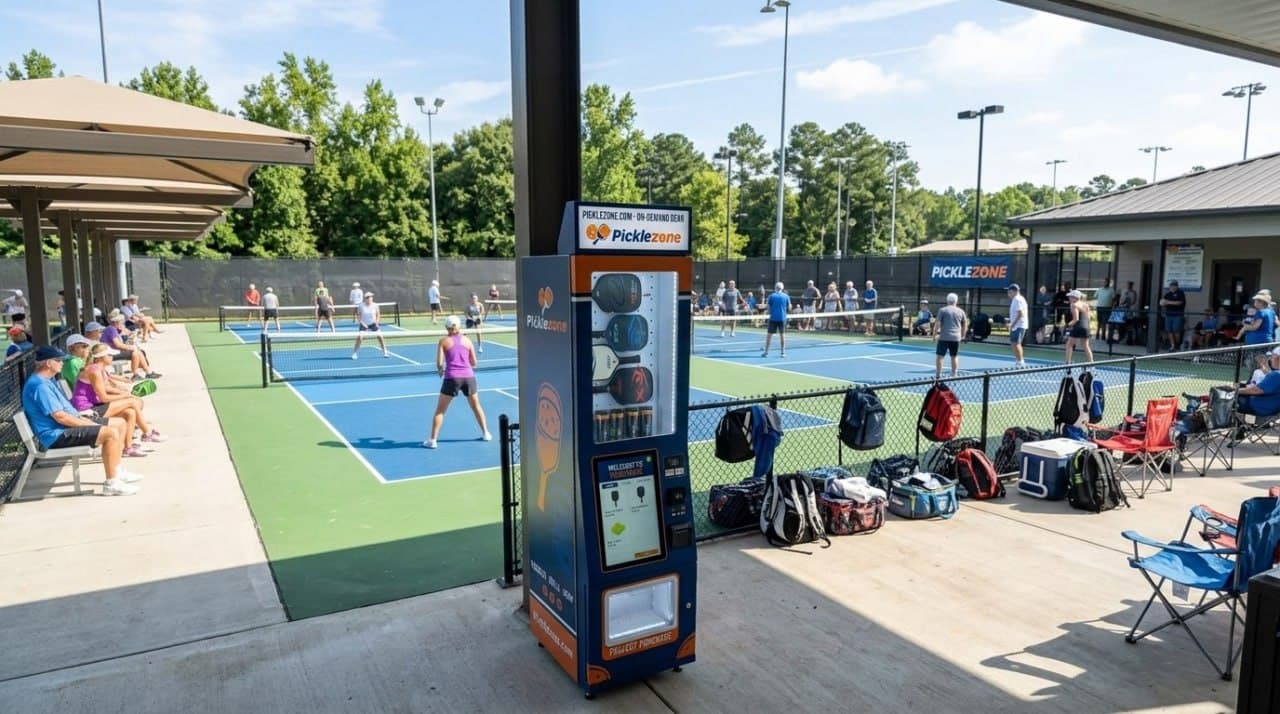
A player arriving without the right ball or an overgrip has a specific problem. A vending machine may help solve it when the pro shop is closed—but only if the right product is available, the package dispenses reliably, and the player can reach the machine.
For a pickleball club or sports facility, start with a small, measurable retail pilot rather than a revenue promise. The questions are practical: what do players request, which items fit the equipment, who replenishes them, and does the placement cover its costs?
This guide focuses on answering those questions before expanding a sports vending program. It does not assume that membership growth, a busy tournament, or a particular sport guarantees sales.
1. Define the player need before choosing the assortment
Ask front-desk and pro-shop staff to record requests they cannot fulfill, including the time, item, and reason. Distinguish an item that is unavailable after staffed hours from one that is already easy to buy at the venue.
For pickleball, possible test items include packaged balls appropriate to the facility's play conditions, overgrips, and small accessories. These are candidate products, not a ranking of proven sellers. Ask the venue which ball types and brands players actually use.
Other sports require a different list:
| Venue | Candidate need to investigate | Product-fit question |
|---|---|---|
| Tennis facility | Replacement balls or overgrips | Will the exact can, pack, or pouch dispense reliably? |
| Golf facility | Tees, ball markers, or gloves | How will small packs and multiple sizes be presented? |
| Indoor court center | Sport-specific accessories or packaged refreshments | Do the packages and required storage conditions match the equipment? |
| Yoga or Pilates studio | Grip socks or compact accessories | Can customers identify the correct size before paying? |
| Aquatic center | Replacement goggles or swim caps | Can the equipment be placed in a suitable dry or appropriately rated environment? |
Do not build the initial assortment around every possible item. Shoes, paddles, large towels, long training aids, and bulky packages need their own format and dispensing review. Keeping the test assortment focused makes it easier to identify why an item sells—or does not.
2. Test each package in the proposed configuration
Send actual retail samples, not just a product-category list. Record each item's packaged dimensions, weight, rigidity, and intended orientation. Confirm the mechanism and loading arrangement for the quoted machine.
For each candidate, agree a practical acceptance test with the supplier. Check repeated dispensing, retrieval, packaging condition, and what happens as stock runs low. Record the package version used in the test so a later supplier change does not silently invalidate it.
Do not assume compact accessories fit every wall-mounted machine, or that a larger cabinet automatically handles long or fragile items. Refrigerated products require equipment and operating procedures suitable for their storage needs; an ambient accessory cabinet is not a substitute.
If member credentials, discounts, club accounts, or pro-shop software are part of the plan, specify and verify those functions separately. An ordinary card-payment setup does not establish support for those integrations.
3. Check the position during real operating hours
Compare candidate positions by observing player movement and access. An entrance, waiting area, or route between reception and courts may be worth testing, but there is no universally highest-converting position.
Check whether a customer can browse and retrieve an item without blocking a door, walkway, queue, or court access. Include accessibility, service clearance, power, and connectivity in the site review. Wall mounting still requires a suitable structure and usable space around the machine.
Confirm who can reach the equipment when the pro shop is closed. A machine behind a locked reception area does not solve an after-hours access problem.
Outdoor courts, remote golf locations, and pool environments require a configuration suitable for the actual weather, temperature, moisture, and electrical conditions. Do not treat waterproof product packaging or a roof over the machine as proof that the cabinet is suitable.
4. Agree who runs the service
Decide whether the facility owns and operates the machine or an outside operator provides the service. Put inventory ownership, replenishment, refunds, customer support, maintenance, and venue payments in writing. Neither arrangement removes the need for someone to do the work.
Check existing retail, beverage, sponsorship, and exclusivity commitments before agreeing the product list. A proposed sports assortment may overlap with rights already granted to another supplier.
Give customers a clear way to report a failed vend or payment problem. Assign the person who will respond, including during evening play and weekend events. Software can support monitoring, but it does not refill shelves, inspect damaged stock, or resolve every customer issue.
For DMVI™ equipment, confirm the quoted software platform, functions, license, and renewal costs. Do not assume that every configuration includes the same reporting or that software is free indefinitely.
5. Use consistent units in the sales model
Membership count is not transaction count. A repeat member visit is another visit, not another unique customer, and it is not necessarily a separate court session.
Here is a deliberately hypothetical example, not a forecast or verified operator result:
| Assumption or calculation | Result |
|---|---|
| 200 members × 3 visits per week | 600 member visits per week |
| 600 visits × 10% resulting in one purchase | 60 purchases per week |
| 60 purchases × $8 average transaction | $480 weekly gross sales |
| $480 × 4 weeks | $1,920 gross sales over four weeks |
| $480 × 52 weeks ÷ 12 months | $2,080 average monthly gross sales |
| $1,920 × assumed 50% product gross margin | $960 product gross profit over four weeks |
| $2,080 × assumed 50% product gross margin | $1,040 average monthly product gross profit |
The annualized monthly figure assumes the same weekly activity for 52 weeks. It is not a prediction of any particular calendar month. Closures, seasonality, tournaments, stockouts, and changes in purchasing behavior can all change the result.
Product gross profit is sales less product cost. It is not net profit or cash available to the owner. The figures above are before venue fees, payment processing, software and connectivity, labor and travel, utilities, insurance, refunds, loss, maintenance, and other applicable expenses. Financing payments also affect cash flow. This example does not establish payback or return on investment.
Measure the purchase rate against a consistent traffic count. If the only reliable denominator is total facility visits, do not relabel it as people who passed the machine. Keep sales, product costs, and refunds defined consistently across the reporting period.
6. Set a pilot review date and decision rules
Choose the review period and evaluation criteria before launch. The period should capture ordinary operating days as well as relevant scheduled events. Report tournaments separately so an unusually busy weekend does not become the assumed baseline.
Track:
- Purchases and sales by product and day.
- Stockouts, failed vends, refunds, and damaged or expired stock.
- Replenishment visits, time spent, and travel costs where applicable.
- Actual product costs, venue charges, and other operating expenses.
- Requests for unavailable products and confusion about sizes or selection.
Use the results to decide whether to keep the assortment, test a different price or position, remove weak products, or stop the pilot under the agreed terms. Set your own minimum service and financial requirements; do not adopt an unsupported industry conversion benchmark.
Budget beyond the cabinet
Include initial stock, site preparation, delivery, installation, payment costs, software, and ongoing service in the budget. Use the actual equipment quote rather than an assumed monthly installment.
DMVI's standard machine financing requires a 25%–50% machine-value deposit. Shipping, the payment terminal, annual software license, wrap, and selected topper are charged separately and paid upfront as applicable, along with applicable taxes and quoted extras. Quoted interest is 8%–15%, depending on repayment ability and other approval conditions. The remaining machine balance is repaid in 12 monthly payments, beginning 30 days after shipment.
The agreement establishes the interest calculation and exact payment amounts. Approval is discretionary; a UCC filing applies and a personal guarantee may be required. DMVI no longer offers all-inclusive leases. The AI fridge program remains separate from these standard terms.
Bring the venue and product details together
A useful inquiry includes the sports played, operating hours, proposed location, product samples, and who will manage replenishment. Contact DMVI to discuss equipment for that defined use case. Start with fit and service requirements, then let measured demand guide the next decision.
Discuss your project with DMVI
Bring your product samples, site requirements, and intended customer experience to the conversation.