Micro Market Financing With No Credit Check: How It Works
The barrier to entering the micro market business has historically been capital. A traditional micro market installation, open-shelf displays, a self-checkout kiosk, coolers, inventory, requires significant upfront investment before the first transaction occurs. Equipment financing for this category has typically followed the same model as any commercial equipment lease: a credit application, an underwriting process, and approval that depends on the applicant's financial history.
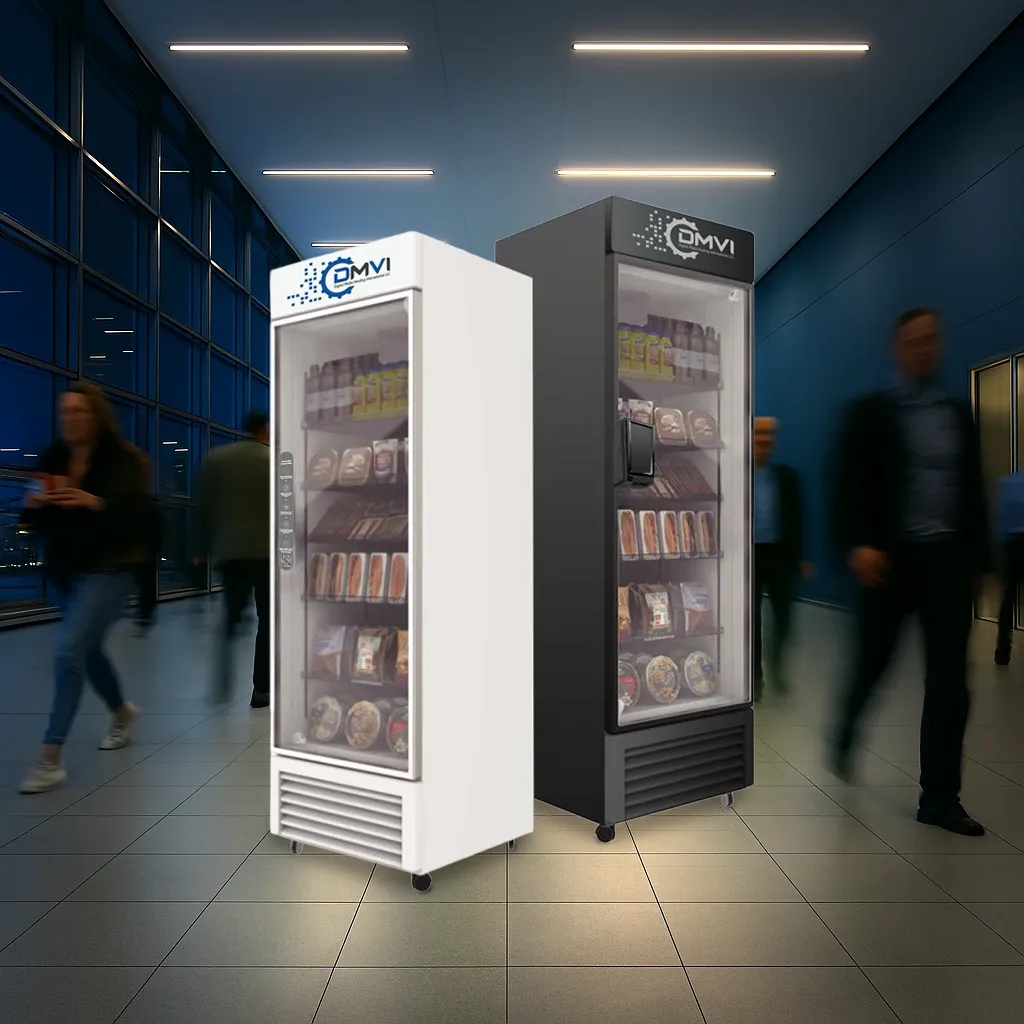
DMVI's financing program for the AI Smart Fridge works differently. It requires no credit check, starts at $1,898.50 for the 360 model, and uses the machine's own daily revenue to help cover the monthly payment. This guide explains exactly how the program works, every number, every step, and what operators are committing to when they choose financing over a full cash purchase.
Why Financing Structure Matters in Micro Markets
A micro market business generates revenue only after the machine is deployed and operational. Every day the machine is not yet running is a day the operator is carrying a capital obligation without any corresponding revenue. The faster the machine is generating transactions, the faster the business reaches the point where the machine's revenue is covering its own costs.
Traditional equipment financing structures do not account for this dynamic. A fixed monthly payment begins immediately and continues regardless of whether the machine has been deployed, whether it is generating strong or weak revenue, or how the business is performing in the first few months of operation.
DMVI's revenue-assisted repayment model is built around the operating reality of a micro market. Daily deductions are made from the machine's sales revenue, up to the scheduled monthly amount. The machine's own transactions are contributing to the repayment obligation as they occur. If a given month produces strong sales, those deductions accumulate toward the monthly target. If revenue falls short of the monthly target by month end, the remaining amount is collected by ACH from the operator's authorized bank account.
This structure does not make the obligation contingent on sales, the operator is still responsible for the full monthly amount. But it means the machine's revenue is actively working toward that obligation, not sitting separately while the operator manually covers the payment.
The Numbers: 360 Model
Every number on DMVI's financing program is confirmed on the product page. For the AI Smart Fridge 360:
Cash price: $4,995
To start financing:
-
30% down payment: $1,498.50
-
One-time financing fee (non-refundable): $400.00
-
Total due at Shopify checkout: $1,898.50
After checkout:
-
Financed balance: $3,496.50
-
Term: 12 months
-
Monthly target payment: $291.38
-
Daily equivalent: $9.71
The $400 financing fee is non-refundable and is charged at checkout regardless of whether the operator later chooses to pay off the balance early.
For the AI Smart Fridge 450, the cash price is $5,995 and the starting amount for financing is $2,198.50 (30% down plus the same $400 fee). Contact DMVI for the specific monthly payment schedule on the 450 model.
What "No Credit Check" Means in Practice
The financing program does not involve a credit inquiry. There is no pull on the applicant's credit report, no underwriting process that evaluates credit score, credit history, or existing debt.
What is required is identity validation. The operator completes basic identity verification through the EZVend onboarding process. This confirms who the financing agreement is with but does not involve evaluating creditworthiness.
The distinction matters for operators who have been declined for traditional equipment financing due to limited credit history, business age, or personal credit profile. None of those factors affect eligibility for DMVI's program. The validation requirement confirms identity; the financing decision is not credit-based.
The Financing Process: Step by Step
The process from selecting a machine to having it shipped involves three stages.
Stage 1: Choose and pay online. The operator selects the 360 or 450 model at the Shopify product page and chooses the financing option. The checkout collects the 30% down payment plus the $400 financing fee. Warranty upgrades and magnetic side panel add-ons are also available at this stage. All add-on costs are collected at checkout.
Stage 2: Complete EZVend onboarding. This typically happens the same day as checkout. The operator completes identity validation, signs the financing agreement electronically, and authorizes the ACH account that will be used for month-end shortfall payments if needed. There is no credit check at this stage.
Stage 3: Finalize delivery and ship. After onboarding is complete, DMVI confirms freight to the delivery address and invoices for the applicable sales tax based on the full machine value. Sales tax is collected by post-onboarding invoice, not at Shopify checkout for financing orders. Once this is settled, the machine ships. The 12-month financing term begins when the machine ships.
How the Revenue-Assisted Repayment Works
The repayment structure is the most important thing to understand clearly before choosing financing.
EZVend monitors the machine's daily sales. Deductions are applied from the machine's revenue each day, up to the monthly scheduled amount. On a day when the machine generates sales, a portion of that revenue contributes toward the monthly payment target. On a day when the machine generates no sales, no deduction occurs.
These daily deductions accumulate across the month. If the accumulated deductions reach the monthly target ($291.38 for the 360) before the end of the month, deductions pause, the system does not collect more than the scheduled monthly amount even if sales continue to be strong. Strong sales do not accelerate payoff unless the operator specifically requests to pay the remaining balance early.
If the monthly accumulated deductions fall short of the $291.38 target when the month ends, the remaining amount is collected by ACH from the authorized bank account. The operator is responsible for ensuring the ACH account has sufficient funds at month end to cover any potential shortfall.
The practical result of this structure: a machine that generates consistent daily sales will have much of its monthly payment covered by revenue deductions before the ACH collection date. A machine at a slow location in a weak month may rely more heavily on the ACH collection to make up the shortfall.
No Early Payoff Penalty
Operators who want to pay off the remaining financed balance ahead of the 12-month schedule can do so at any time with no penalty. The outstanding balance at the time of payoff is the amount owed, there is no prepayment fee or additional charge for closing the financing early.
This is relevant for operators who deploy a machine that performs strongly and want to exit the financing obligation before the 12-month term concludes. The option is available and costs nothing beyond the remaining principal.
Ongoing Costs Beyond the Machine Payment
The financing payment covers the machine's purchase price over 12 months. It does not cover the ongoing operational costs of running the AI Smart Fridge. These are confirmed on the product page and are transparent before purchase:
AI software: $49 per month. This covers the computer vision processing, EZVend access, and remote management capabilities. The first month of AI software after activation is included with every machine. Billing begins in month two.
Card processing: 5.5% plus $0.05 per transaction. Every payment made by a customer, credit card, debit card, Apple Pay, or Google Pay, carries this processing rate. This applies to all transactions regardless of payment method.
Freight: $200 to $350 for curbside delivery in the contiguous US (liftgate included). White-glove delivery, which includes local uncrating and final-mile inside placement, is approximately $500 to $900 depending on the destination. Freight is quoted by address.
These three costs. AI software, card processing, and freight, are the complete picture of ongoing operational costs as stated on the product page. There are no undisclosed monthly platform tiers on this offer.
Cash vs Financing: The Comparison
The cash price for the 360 is $4,995. The financing route costs $4,995 in principal (same machine price) plus the $400 non-refundable financing fee. Over 12 months of financing, the operator pays the machine's full value plus $400.
The financing option costs more than a cash purchase by exactly the $400 fee. The value it provides is access to the machine for $1,898.50 upfront rather than $4,995, with the balance spread over 12 months in a structure where the machine's own revenue contributes to payment.
For operators who have $4,995 available to deploy immediately and do not need to preserve capital, a cash purchase avoids the fee and the 12-month repayment obligation. For operators who want to enter the micro market with a lower upfront commitment, the financing structure provides that entry at the cost of the $400 fee and the 12-month repayment schedule.
The buying vs leasing a vending machine guide covers the general framework for evaluating purchase versus financing decisions for automated retail equipment.
What Happens After the 12-Month Term
After the 12 monthly payments are complete and the financed balance is paid in full, the operator owns the machine outright. The financing obligation ends. Ongoing costs at that point are the AI software subscription ($49/month) and the transaction processing rate. The machine continues operating under EZVend management with no change to the customer experience or operator interface.
The operator can continue running the machine, add additional units on the same financing structure, or explore location expansion using the revenue the first machine has generated.
The Financing Program in the Broader Micro Market Context
Micro market equipment financing has historically followed the same model as other commercial equipment: credit-based approval, multi-year lease terms, significant upfront capital, and a repayment schedule that begins before the machine has generated a single dollar of revenue. This model works for operators with established business credit and sufficient capital reserves. It creates a genuine barrier for operators who are newer to the business, who have limited credit history, or who are deploying their first unit.
DMVI's AI Smart Fridge financing is built around the operating reality of a micro market rather than the standard commercial lending model. No credit check means the program does not evaluate the operator's credit history. Revenue-assisted repayment means the machine's own daily transactions contribute toward the monthly obligation rather than requiring the operator to fund the payment independently from external cash flow.
This is the structural difference that makes the program relevant to a broader range of operators than traditional equipment financing reaches. An entrepreneur who has the location, the product vision, and the operational commitment to run an AI smart fridge, but who does not have an established business credit profile, can access the equipment at $1,898.50 down and pay the remaining balance over 12 months from the machine's own revenue.
What Operators Should Know Before Committing
The financing program is straightforward, and every term is published on the product page. Before committing, operators should be clear on three things.
The $400 financing fee is non-refundable. If the machine is returned within the 15-day return window, the $400 fee is not returned. The down payment refund and return process are governed by the terms on the product page, but the fee is always gone once paid.
The ACH authorization is a real commitment. If the machine underperforms in a given month and daily revenue deductions fall short of the $291.38 monthly target, the ACH account is debited for the difference. The operator needs to have funds available in the authorized account to cover potential shortfalls, particularly in the early months of a new deployment.
The monthly target does not adjust downward if sales are weak. The $291.38 is the scheduled monthly amount. The revenue-assisted deductions help cover it; they do not reduce it. The obligation is fixed.
Understood clearly, these terms are manageable. They are also important to understand before signing rather than discovering afterward.
The 12-Month Term in Context
Twelve months is a shorter financing term than most commercial equipment financing arrangements. A 60-month equipment lease is common in the vending industry. A 12-month term means the operator pays the machine off faster, carries the financing obligation for a shorter period, and reaches outright ownership more quickly.
The tradeoff is that the monthly payment is higher on a 12-month term than it would be if the same balance were spread over 60 months. The $291.38 monthly target for the 360 reflects a 12-month schedule on the $3,496.50 financed balance. On a 60-month schedule, the same balance would produce a lower monthly number.
DMVI's choice of a 12-month term for the AI Smart Fridge reflects the revenue-assisted model: the machine's own daily revenue is expected to contribute significantly toward the monthly obligation. A micro market at a well-selected location generates daily transactions. Those deductions accumulate through the month. The 12-month structure is designed around a machine that is generating revenue, not a machine that is sitting idle.
Operators who are confident in the location's revenue potential benefit from the 12-month structure's faster path to ownership. Operators who are uncertain about first-year revenue need to ensure the ACH account can cover potential month-end shortfalls until the machine establishes its sales pattern.
Who Should Use Financing vs Cash
The financing option is the right choice for operators who want to deploy a machine with a lower upfront capital commitment and are willing to pay the $400 financing fee for that structure. It is also the right choice for operators who want to preserve cash for product inventory, initial venue costs, and operational buffer rather than putting the full $4,995 into the machine itself.
Cash purchase is the right choice for operators who have the full amount available, want to avoid the $400 financing fee, and prefer the simplicity of owning the machine outright from the first day rather than carrying a 12-month repayment obligation.
Neither choice is universally better. The right choice depends on the operator's capital position, their confidence in the first location's revenue potential, and their preference for the financing structure's revenue-assisted dynamic versus the cleaner economics of outright ownership. The full details for both purchase paths are at digitalmediavending.com/micro-markets.
Financing as a Starting Point, Not a Ceiling
The financing structure gives operators access to the machine at a lower entry point. What they do with that access determines the value of the financing decision. An operator who uses the 12-month financing period to build a strong location, optimize their product mix using EZVend data, and generate consistent daily revenue is using the financing structure as a foundation for a viable business. An operator who finances a machine without a confirmed location or a product strategy is using it as a purchase mechanism without the business model to support it.
The financing is well-designed for the former. It is not a substitute for the latter. DMVI's team at 1-800-490-1108 and the information at digitalmediavending.com/micro-markets are available to help operators evaluate whether the financing and the product make sense for their specific situation before committing.
Conclusion
DMVI's micro market financing program makes AI Smart Fridge deployment accessible at $1,898.50 down, with no credit check, over 12 months of revenue-assisted repayment. The machine's own daily sales contribute toward the monthly payment. The $400 financing fee is the cost of that structure above the machine's cash price. Ongoing costs are $49/month for AI software and 5.5% plus $0.05 per transaction for card processing.
All terms are transparent before purchase. The full financing snapshot is available at digitalmediavending.com/micro-markets.
Sources
Interested in micro market financing?
DMVI can explain AI smart fridge financing options, expected payments, and what operators need before launch.