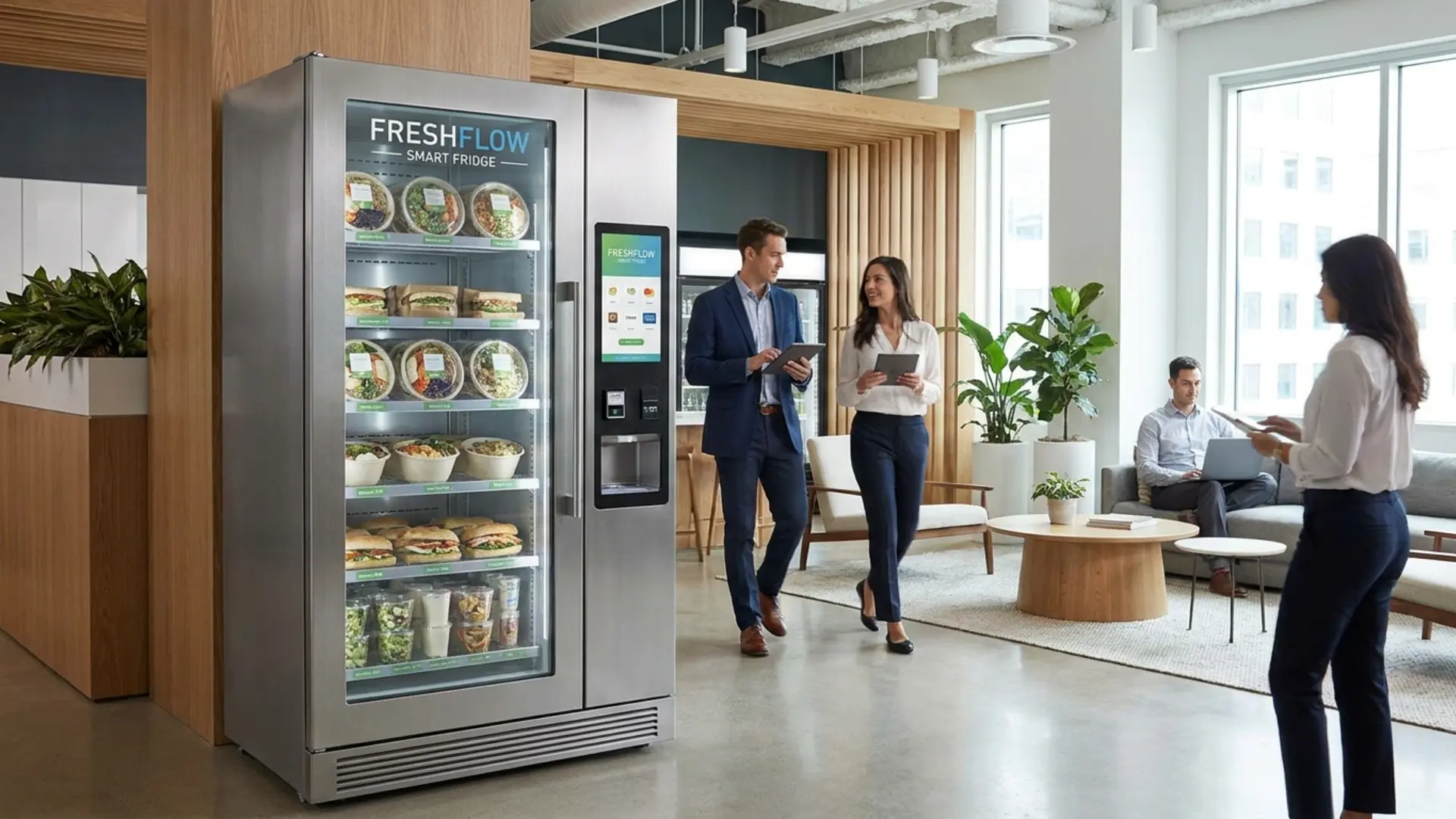
What Does It Cost to Run an AI Smart Fridge?
One of the first questions any operator asks before committing to a piece of automated retail equipment is: what does it actually cost? Not just the purchase price, the full picture. What do I pay upfront, what do I pay every month, and what do I pay per transaction?
For the DMVI AI Smart Fridge, every number is published on the product page. This guide compiles them into a single complete cost picture, the machine, the freight, the ongoing software subscription, the transaction processing rate, and the optional add-ons, so operators can evaluate the economics before making a decision.
The Machine: Two Options, Two Price Points
DMVI offers two AI Smart Fridge models. The price difference between them reflects capacity and size.
AI Smart Fridge 360 Cash price: $4,995 To start financing: $1,898.50 (30% down plus $400 financing fee, no credit check) Capacity: approximately 360 bottles Storage: 18.4 cubic feet Dimensions: 26 inches wide, 27.2 inches deep, 74.4 inches tall
AI Smart Fridge 450 Cash price: $5,995 To start financing: $2,198.50 (30% down plus $400 financing fee, no credit check) Capacity: approximately 450 bottles Storage: 21.7 cubic feet Dimensions: 31.5 inches wide, 27.6 inches deep, 80.7 inches tall
The 450 is the higher-capacity model, suited for higher-traffic locations, hotels, campuses, hospitals, where greater product variety and inventory depth are needed. The 360 is appropriate for offices, gyms, and apartment communities where a focused product assortment at moderate traffic is the operating model.
Both models include computer vision checkout, EZVend operator management, Nayax-compatible payment processing, and the same warranty and support package.
Freight: Getting the Machine to Your Location
The machine price does not include freight. Delivery cost depends on the destination and the level of service selected.
Curbside freight (standard): $200 to $350 for most contiguous US destinations. A liftgate is included, which is necessary for a machine weighing 220 to 270 pounds. The machine is delivered to the curb; the operator is responsible for moving it inside.
White-glove delivery: Approximately $500 to $900 depending on the destination. This includes local uncrating and final-mile inside placement, the machine arrives at its designated location inside the building. For operators without the means to move a 220-pound unit from curbside to the intended installation location, white-glove delivery is worth evaluating.
Freight is quoted by destination. The estimates above are typical ranges for the contiguous US as stated on the product page.
Provisioning and transit time: DMVI provisions from five US warehouses. Provisioning typically takes about two business days. Transit to most contiguous US destinations is one to three business days from the closest warehouse.
Sales Tax
For financing orders, applicable sales tax is based on the full machine value ($4,995 or $5,995) and is collected by post-onboarding invoice rather than at Shopify checkout. DMVI collects tax in states where they are registered: California, Nevada, New Jersey, Pennsylvania, Texas, and Washington. Tax treatment in other states follows applicable law.
For cash purchases, sales tax handling is confirmed on each Shopify product page.
Ongoing Costs: The Monthly Picture
After the machine is deployed and operational, two ongoing costs apply to every AI Smart Fridge regardless of which model is purchased.
AI software: $49 per month. This covers the computer vision processing, EZVend access, and the full remote management platform including live inventory data, low-stock alerts, temperature monitoring, remote pricing, and multi-machine reporting. The first month of AI software after activation is included with every machine. Billing at $49 per month begins in month two.
Card processing: 5.5% plus $0.05 per transaction. Every customer payment, credit card, debit card, Apple Pay, Google Pay, carries this rate. On a $5.00 transaction, the processing cost is $0.33. On a $12.00 transaction, it is $0.71. Operators should factor this rate into their product pricing when evaluating margin on the items they plan to sell.
These two costs are the complete ongoing cost structure as published on the product page. There are no additional platform tiers, monthly service fees, or hidden subscription costs on top of these two line items.
The Financing Cost: What It Adds
Operators who choose the no-credit-check financing option pay the same machine price ($4,995 or $5,995) plus a $400 non-refundable financing fee. The financing fee is the only additional cost of choosing the financing route over a cash purchase.
For the 360 model:
-
Upfront: $1,898.50 (30% down plus $400 fee)
-
Financed balance: $3,496.50 over 12 months
-
Monthly target: $291.38
-
Daily equivalent: $9.71
-
Total cost of machine over 12 months: $4,995 plus $400 fee = $5,395
For operators who have the full $4,995 available and prefer to avoid the fee, cash purchase makes the economics simpler. For operators who want to deploy for $1,898.50 upfront and spread the remaining balance over 12 months, the $400 fee is the cost of that structure.
The revenue-assisted repayment model means EZVend applies daily sales deductions toward the monthly payment target. Strong sales days contribute toward the $291.38 monthly obligation. Month-end shortfalls are collected by ACH from the operator's authorized account.
Optional Add-Ons: What They Cost
Several add-ons are available at purchase. None are required to operate the machine; all are available on the Shopify product page at the time of purchase.
Magnetic side panels: Reusable printed magnetic graphics that install without adhesive residue and can be swapped for seasonal or promotional changes.
-
One side: $250
-
Both sides: $400
Extended warranty: Coverage begins after the included one-year parts and labor warranty expires.
-
Two additional years: $350
-
Four additional years: $650
White-glove delivery: Local uncrating and final-mile inside placement.
- Typically $500 to $900 depending on destination
Location assistance: Available for operators deploying ten or more machines who want support finding locations in their region. Pricing is scope-based. Call DMVI for details.
Building the Full Cost Picture
For an operator purchasing one AI Smart Fridge 360 on the financing plan with standard curbside delivery and no add-ons, the total cost breakdown looks like this:
At checkout: $1,898.50 (30% down plus $400 fee) Post-onboarding invoice: Sales tax on full machine value (varies by state) plus freight ($200 to $350 estimated) Month two onward: $49/month AI software Per transaction: 5.5% plus $0.05 Over 12 months: $3,496.50 remaining balance covered through revenue deductions and ACH shortfall collection
After the 12-month financing term, the operator owns the machine outright. Ongoing costs from that point are the $49 monthly AI software and the per-transaction processing rate. The machine payment obligation ends.
What the $49/Month AI Software Covers
The AI software subscription is worth understanding in detail because it is the ongoing cost that is most specific to this product format and has no equivalent in standard vending machine operations.
The $49/month covers the computer vision processing that identifies products taken during each customer session, this is the technology that makes no-scan checkout possible. It also covers EZVend access and the full remote management platform: live inventory monitoring, low-stock alerts, temperature alerts, remote pricing and product management, and multi-machine reporting.
For a refrigerated micro market unit, the temperature alert capability specifically is a meaningful operational safeguard. Knowing whether the fridge is maintaining its target temperature without a physical visit protects the product inside and the customer experience.
At $49 per month, the AI software is a fixed cost that does not scale with transaction volume. An operator who processes $2,000 in monthly sales and one who processes $500 pay the same $49. That fixed structure favors high-volume locations where the cost is a smaller proportion of revenue.
Evaluating the Economics Before Deployment
The cost picture above is complete based on published information. What the product page does not provide, and what this guide will not invent, is a specific revenue projection for any deployment. Revenue depends on product pricing, location traffic, product mix, and how well the AI smart fridge format fits the customer population at the specific location.
The costs that are knowable before purchase are all confirmed: machine price, freight, AI software, processing rate, and any add-ons selected. These are the inputs an operator needs to model the economics of a specific deployment before committing.
For context on how to think about automated retail economics more broadly, the vending machine business profitability guide covers the cost and revenue framework that applies across automated retail formats. The micro market vs vending machine guide covers how the micro market format differs from standard vending in terms of economics and operations.
How the Cost Structure Compares to Traditional Micro Market Setup
Traditional micro market installations typically require more infrastructure than a single AI smart fridge: open shelving, a kiosk for self-checkout, a cooler or refrigerated display separate from the checkout system, and inventory across all three components. The upfront cost for this kind of installation is generally higher than the $4,995 to $5,995 price point of a DMVI AI Smart Fridge.
More significantly, the traditional model requires a kiosk and scanning equipment that the AI smart fridge replaces with computer vision. A customer at a traditional micro market kiosk scans each item before paying. A customer at an AI smart fridge taps, takes, and closes. The hardware cost savings are real, and the absence of a per-item scanning step changes the customer experience.
The AI software subscription at $49 per month is the ongoing cost of the computer vision capability that replaces the kiosk. It is not an additional overhead on top of the traditional model's cost structure, it replaces part of that structure. The net cost comparison between a full traditional micro market installation and a single DMVI AI Smart Fridge favors the AI smart fridge for operators who are entering the category for the first time or deploying at a single location.
Using the Cost Numbers to Evaluate a Location
The purpose of knowing the cost structure clearly before purchase is to evaluate whether a specific location can support the machine economically. The key input that the cost structure cannot provide is revenue, that depends on the location's traffic, the product mix, and the pricing the operator sets.
What the cost structure does provide is the denominator: the total monthly cost the machine needs to cover. For a financed 360 model, that total in the first 12 months includes the $291.38 monthly payment, $49 for AI software (from month two), and the card processing fee on every transaction. After the 12-month term, the monthly cost drops to $49 plus card processing.
An operator who can estimate daily transaction volume and average transaction value for a specific location can build a basic model of whether the revenue is sufficient to cover these costs and generate a return. The vending machine business profitability guide covers this modeling framework in the context of automated retail generally.
The Return Policy and Its Cost Implications
Operators who purchase an AI Smart Fridge and decide to return it have a 15-day window from delivery for unused, unopened machines. The return involves the buyer paying return freight and a $200 restocking fee. The $400 financing fee, for those who chose financing, is non-refundable.
This means the effective cost of an unsuccessful purchase that results in a return, for a financed 360, is the $200 restocking fee plus return freight plus the $400 financing fee, on top of the original down payment. The down payment itself is returned minus these charges based on the terms published on the product page.
The practical implication for operators is that the cost picture before purchase should be evaluated thoroughly enough that a return is not the expected scenario. A location confirmed before purchase, a product mix evaluated for the specific customer population, and an honest assessment of the location's daily traffic all reduce the likelihood of discovering after delivery that the machine is not the right fit.
The transparency of the cost structure on the product page, and the availability of DMVI's team at 1-800-490-1108 for pre-purchase questions, means operators have the information they need to make a confident decision before the machine ships.
Costs Not Covered by This Guide
This guide covers the costs confirmed on DMVI's product page. A complete deployment picture for any specific operator also includes costs that vary by deployment and are not fixed: the product inventory loaded into the machine, the venue commission or placement fee negotiated with the location manager, and any incidental costs related to installation at the specific location.
These variable costs are real and should be part of any pre-purchase evaluation. They are not DMVI costs and are not published on the product page because they depend entirely on the operator's sourcing, negotiation, and location context. The how to start a micro market business guide covers the full operational picture including these variable elements.
For all questions about the DMVI-specific costs covered in this guide, the product page at digitalmediavending.com/micro-markets is the primary source. Call 1-800-490-1108 to speak with DMVI's team directly.
The First Month of AI Software: What It Covers
Every DMVI AI Smart Fridge includes the first month of AI software after activation at no charge. This month covers the computer vision processing for all customer transactions, EZVend access for the operator, and the full remote management platform including inventory data, temperature monitoring, and sales reporting.
The included first month gives operators a complete operational picture before billing begins. By the end of the first month, the machine has established its sales pattern, the operator has used EZVend's monitoring tools, and the $49/month subscription cost is evaluated against a real revenue baseline rather than a projected one. Billing then begins in month two as a known quantity relative to the machine's demonstrated performance.
This structure is consistent with DMVI's overall approach to cost transparency on this product. The numbers are knowable before purchase, the first month provides a real operational foundation, and ongoing costs are fixed and disclosed upfront.
Connecting the Cost Structure to Pricing Decisions
Understanding the cost structure is only useful if it informs how the operator prices their products. The two variable costs, card processing at 5.5% plus $0.05 per transaction, and the AI software at $49 per month, both need to be factored into the product pricing model.
Card processing is a per-transaction cost. On a $10 product, the processing cost is approximately $0.60. On a $6 product, it is approximately $0.38. These numbers are small individually but compound across every transaction the machine processes. An operator who prices without accounting for the processing rate discovers the gap in their margin calculations after the fact.
AI software at $49 per month is a fixed overhead cost. It does not vary with transaction volume. At higher transaction volumes, $49 is a proportionally smaller share of monthly revenue. At lower transaction volumes, it is a proportionally larger share. Operators who are evaluating whether a specific location can support the machine economically need to factor $49 into their monthly cost baseline alongside the financing payment during the 12-month term.
The product page at digitalmediavending.com/micro-markets provides all the confirmed numbers needed to build this analysis before purchase.
Conclusion
The complete cost of running a DMVI AI Smart Fridge is: the machine ($4,995 or $5,995, or the financed equivalent with a $400 fee), freight ($200 to $350 curbside or $500 to $900 white-glove), sales tax by state, $49 per month AI software (first month included), and 5.5% plus $0.05 per transaction. Optional add-ons are available at purchase. No additional platform fees apply.
All numbers are published at digitalmediavending.com/micro-markets. Call DMVI at 1-800-490-1108 to discuss costs for a specific deployment.
Sources
Need a clear AI smart fridge cost model?
DMVI can walk through equipment price, software fees, processing, freight, and operating assumptions.