
Pokémon Vending Machine for Sale: What You Need to Know Before You Buy
The Business Nobody Saw Coming
Current DMVI vending machine financing: DMVI financing is subject to approval, with a 25%–50% machine deposit depending on stock status and the remaining machine balance paid in 12 monthly payments at 8% simple interest. The quote confirms the deposit percentage. All applicable upfront costs are due at signing, including the wrap, optional topper, payment terminal, first-year software subscription, shipping, and sales tax. Financing is not guaranteed; DMVI reserves the right to deny financing. A UCC filing applies, and a personal guarantee may be required. See the vending machine financing terms for details.
A few years ago, Pokémon vending machines did not exist as a recognized retail category. There were no industry case studies, no manufacturer spec sheets designed for trading card packs, and no established playbook for placing one in a high-traffic venue. The category appeared quickly, grew faster than anyone expected, and produced some of the more striking revenue numbers in the autonomous retail space.
The numbers are not abstract. Digital Media Vending International, a California-based custom vending machine manufacturer founded in 2009, has operators in the Pokémon category generating between $80,000 and $100,000 per machine per month at strong placements. A separate operator generated $300,000 in their first month of operation. These are not projections or estimates — they are outcomes from real deployments, and they explain why the search for "Pokémon vending machine for sale" has grown sharply over the past two years.
This guide is for anyone seriously evaluating the Pokémon vending machine business. It covers what the machines actually need to do, why standard vending machines consistently fail at this product category, how much a purpose-built machine costs, where to place one, and what separates operators who build a recurring revenue stream from those who struggle.
Key Finding: Pokémon vending machines are not a retail product you can buy off a shelf and plug in. They are custom-engineered machines built specifically around trading card dispensing — and the hardware specification determines whether the machine generates $5,000 per month or $100,000.
Why the Pokémon Vending Machine Category Works
Trading card collecting has been growing for over a decade. The global trading card market has expanded significantly across North America, Europe, and Asia, with Pokémon holding its position as the world's best-selling trading card game — a title recognized by Guinness World Records and tracked across global licensing and retail data. Booster packs, mystery boxes, and themed bundles have become an established retail category with specific consumer behaviors that benefit directly from autonomous retail deployment.
The vending machine model suits Pokémon better than many product categories for a few structural reasons.
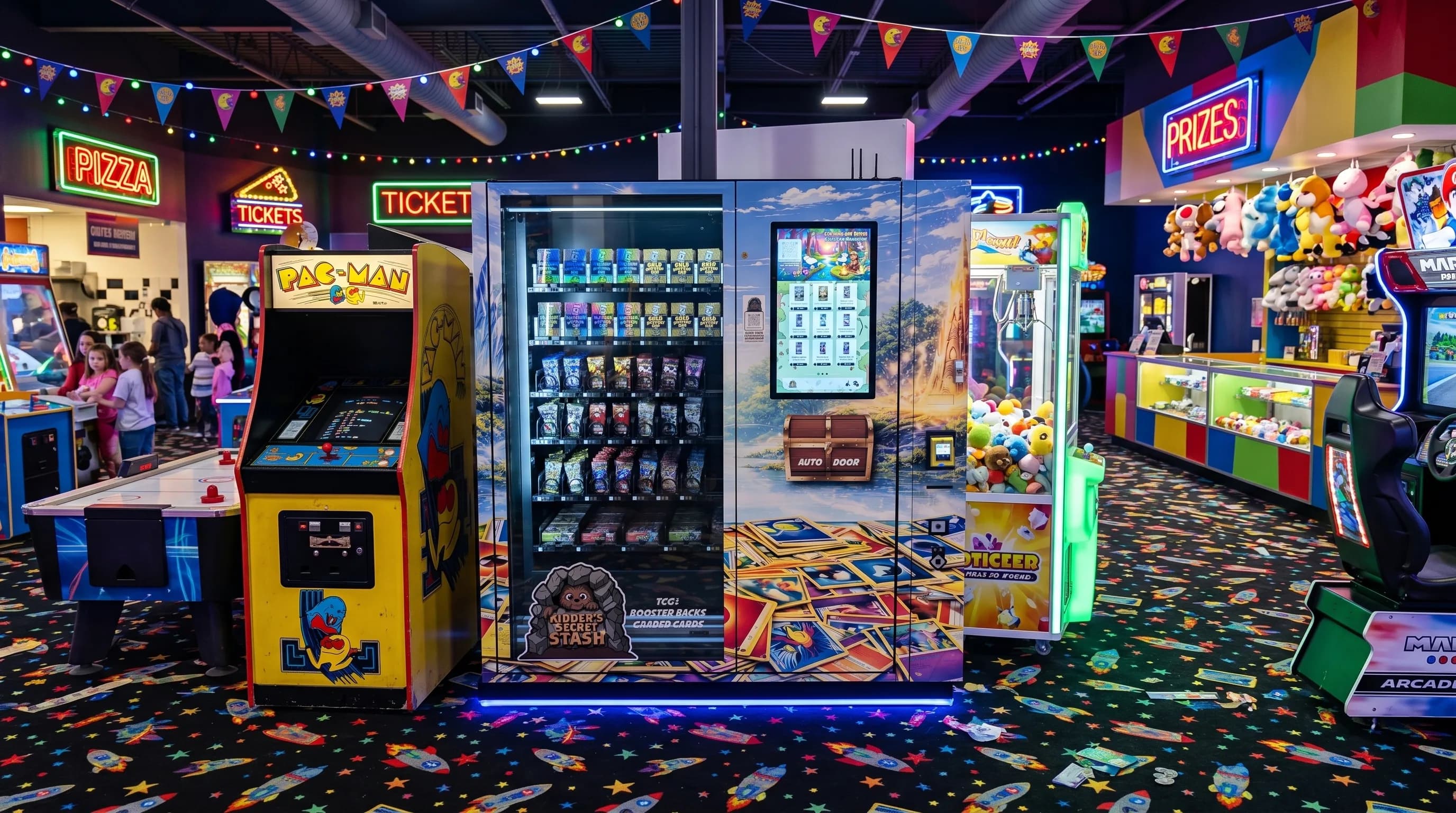
Always-on availability. A brick-and-mortar hobby shop runs during store hours, requires staff, and competes with every other TCG retailer within driving range. A well-placed Pokémon vending machine operates 24 hours a day, seven days a week, staffless, and can hold locations a permanent retail store never could — the floor of an entertainment venue, a mall corridor between anchor stores, the lobby of a hotel adjacent to a gaming event.
Impulse purchase dynamics. Trading card packs and mystery bundles are high-impulse products. The purchase decision happens quickly, driven by proximity, visual appeal, and excitement rather than considered research. This is precisely the consumer behavior that vending machines are optimized to capture. A machine with a large screen displaying animated Pokémon content, positioned in a high-foot-traffic corridor, generates the same impulse response as an endcap display in a retailer — without the overhead of the retailer.
Repeat customer behavior. Pokémon collectors return. Unlike a one-time purchase, trading card collecting creates repeat buyers who return to a machine regularly to check for new inventory, try for specific pulls, and buy additional packs. A machine in a venue those customers visit regularly becomes a recurring revenue asset, not a one-time sale.
Bottom Line: Digital Media Vending International has deployed Pokémon vending machines for operators generating between $80,000 and $100,000 per machine per month — driven by high foot traffic, impulse purchase behavior, and repeat customer visits.
Why Standard Vending Machines Fail at Pokémon
This needs to be stated clearly before going any further: the standard coil-based vending machine is not designed for Pokémon products, and retrofitting one for trading cards produces inconsistent results at best.
Standard vending machines — the type that dispenses chips and candy bars in office break rooms — use a coil dispensing system. A motor rotates a coil, the product at the front pushes forward and drops to a retrieval bin below. This works for uniformly shaped items with enough structural integrity to survive the drop: a can of soda, a bag of chips. It does not work reliably for Pokémon products.
Trading card packs are thin, lightweight, and flexible. Mystery boxes and collector bundles vary in dimensions and weight distribution. Coil dispensing systems jam with these products regularly. They fail to push flexible or lightweight items forward consistently. They can damage packs on the drop. A jammed machine sitting in a premium mall location is losing revenue for every hour it stays stuck, and a machine that dispenses damaged product will develop a reputation that kills repeat business.
Contrary to common belief, modifying a standard snack machine to handle trading cards is not a cost-effective shortcut. The mechanical limitations of coil-based systems are structural, not cosmetic, and operators who have tried this approach consistently report higher jam rates, more service calls, and lower customer satisfaction than those who start with purpose-built hardware.
Digital Media Vending International builds its machines with conveyor belt shelves instead of coils. Products move forward on a belt rather than being pushed by a rotating mechanism. The dispensing system uses an elevator or automatic door delivery mechanism that carries items out of the machine without dropping them, maintaining product integrity and significantly reducing mechanical failures.
This is not a luxury upgrade. For Pokémon vending, it is the baseline mechanical requirement.
What a Pokémon Vending Machine Actually Needs
When evaluating a Pokémon vending machine for sale, these are the specifications that matter:
Touchscreen display, sized for visibility from a distance. The screen is what stops foot traffic. Pokémon is a visually driven brand — the characters, the pack artwork, the animated content. A machine with a small or dim display does not create the stop-and-look moment that converts foot traffic into sales. Digital Media Vending International builds machines with touchscreen interfaces ranging from 21 to 50 inches. At premium placements, operators increasingly specify the larger formats because the screen visibility from 30 to 50 feet away directly affects how many people approach the machine.
Conveyor belt shelving. As covered above, this is a mechanical necessity for trading card products, not an optional feature. Any machine being evaluated for Pokémon dispensing should specify conveyor belt shelves rather than coil dispensing.
Elevator or door-based product delivery. The product should exit the machine without dropping. DMVI's elevator delivery lifts the product to a retrieval point; door systems swing open at the machine base. Both protect pack integrity significantly better than a drop-and-retrieve design.
Cashless payment with NFC and mobile wallet support. The Pokémon buying demographic — from younger collectors to adult nostalgia buyers — increasingly does not carry cash. According to Kande VendTech's vending machine statistics, 71% of all US vending transactions were cashless in 2024, and cashless customers spend an average of 37% more per transaction. For Pokémon products typically priced between $15 and $80+ per pack or bundle, that per-transaction difference is material.
Remote inventory management software. Knowing that a machine is low on a specific SKU before driving to the location is an operational requirement, not a nice-to-have. Digital Media Vending International includes VendingTracker with every machine — a browser-based dashboard that shows live inventory levels, sales data by product, pricing controls, planogram configuration, and machine health alerts in real time.
Large viewing window. Part of the Pokémon vending appeal is seeing the product inside the machine before purchasing. A clear, large cabinet window lets customers browse the inventory, see what's sold out, and builds anticipation that increases conversion.
Key Finding: The combination of conveyor belt shelving, elevator dispensing, large-format touchscreen, NFC cashless payments, and real-time inventory software via VendingTracker is what separates a Pokémon vending machine that performs reliably from one that jams, loses inventory accuracy, and frustrates customers.
Where Pokémon Vending Machines Generate the Most Revenue
Location is the single biggest variable in Pokémon vending machine revenue — more than machine quality, product assortment, or pricing. The same hardware in a low-traffic location and a high-traffic premium venue produces results that are not in the same order of magnitude.
What makes a high-performing Pokémon vending location:
The category runs on impulse purchasing, which means exposure volume drives everything. Locations with 1,000+ daily verified foot traffic are the baseline for strong performance. The demographic composition also matters — the best Pokémon vending locations attract adults with disposable income who have a connection to the brand, not just children.
Locations that have performed well for Pokémon vending operators:
- Premium mall corridors between anchor stores
- Entertainment venue lobbies (gaming centers, cinemas, bowling alleys)
- Hotel lobbies at gaming conventions and hobby events
- Convention centers and hobby expo venues
- Gaming cafes and esports venues
Locations to avoid:
- Corporate offices and campuses (wrong demographic composition, limited evening and weekend traffic)
- Low-traffic strip malls and neighborhood retail
- Locations where management restricts or prohibits trading card products
The location agreement matters as much as the location. Most high-traffic venues charge a percentage of gross revenue as a placement fee, typically 10 to 25% depending on venue type and exclusivity. Building this into the unit economics before committing to a location is essential — a placement that looks attractive at 15% commission looks different at 30%.
One critical point: verify foot traffic data independently. A venue management team's estimate of daily visitors and independently audited foot traffic data are often significantly different. The difference has a direct impact on the revenue projections that justify the machine investment.
How Much Does a Pokémon Vending Machine Cost?
Key Finding: Digital Media Vending International builds custom Pokémon vending machines starting at approximately $4,995 for entry-level wall-mounted formats. Larger M-Series machines suited to premium high-traffic placements range higher depending on specifications.
This pricing compares favorably against the alternatives. A physical Pokémon hobby shop requires commercial lease deposits, buildout, signage, inventory investment, and staff — often $50,000 to $150,000 before opening day. A DMVI vending machine at $4,995 and above, placed in a high-traffic venue on a revenue-sharing arrangement, can reach breakeven quickly at the revenue levels documented from strong placements.
Financing changes the timing of cash outlays, not the need for sound unit economics. Compare realistic sales and operating costs with the deposit, signing costs, and actual monthly payment in the approved agreement. Revenue alone does not establish positive cash flow or guarantee that the machine will fund itself.
Contrary to common belief, a custom Pokémon vending machine is not a capital-intensive enterprise that requires significant upfront wealth. At the $4,995 starting price, it is within range of a serious individual entrepreneur willing to do the work of finding a strong location.
Digital Media Vending International and the Pokémon Vending Category
Digital Media Vending International (DMVI) is a Made in California certified custom vending machine manufacturer that has been building machines since 2009. They have completed more than 2,000 deployments across 22 countries, with US-based manufacturing, US-based support, and in-country technical staff across their global deployment footprint.
DMVI does not sell generic vending machines that customers adapt to their product. Every machine is engineered around the product being dispensed and the environment where it will operate. For Pokémon vending operators, this means conveyor belt shelves configured for trading card pack dimensions, elevator delivery systems that handle product without dropping, and touchscreen displays between 21 and 50 inches displaying product artwork and promotional content configured before the machine ships.
Every DMVI machine ships with VendingTracker software included. Operators can monitor live inventory, review sales data by SKU, adjust pricing, manage planograms, and receive machine health alerts from any browser, from anywhere. A machine placed in a mall in Phoenix can be monitored from a laptop in Chicago in real time.
DMVI handles installation, operator training, and ongoing support as part of every engagement. For someone buying their first vending machine, this means arriving at a working, configured unit rather than navigating a setup process independently.
Visit digitalmediavending.com to request a build consultation.
Building Your Pokémon Vending Machine Business: What Operators Get Wrong Early
The Pokémon vending machine business has produced some of the strongest per-machine revenue numbers in autonomous retail — but there are predictable mistakes that new operators make, most of which are avoidable with planning.
Underestimating the importance of location verification. The most common early mistake is accepting a location based on verbal foot traffic estimates from venue management rather than verified data. Venue operators have an incentive to describe their foot traffic generously. A location that claims 1,000 daily visitors and one with independently verified data showing 1,000 daily entries are different business propositions. Before signing any placement agreement, request raw foot traffic data — turnstile counts, parking data, transactional data from other vendors in the space — and build your revenue projections from that, not from estimates.
Choosing machine format based on price rather than placement. The wall-mounted format is the most accessible price point in DMVI's lineup, and it is the right choice for some placements. It is not the right choice for a high-traffic mall corridor where a larger machine with a 40 or 50-inch display would stop significantly more foot traffic and produce significantly higher revenue. The machine purchase decision and the location decision should be made together, not independently. Choosing the cheapest machine for a premium location is leaving revenue on the table.
Stocking product that doesn't sell in that specific location. Pokémon products vary enormously in purchase behavior. Mystery packs priced at $20 sell differently than collector bundles priced at $60 sell differently than booster boxes priced at $100+. The product mix that works at a gaming venue with a collector demographic may not work at a family entertainment center with a casual buyer demographic. Start with a limited SKU range, monitor VendingTracker sales data by product, and adjust the assortment based on actual purchase behavior rather than assumption.
Not building a restocking schedule from day one. VendingTracker's live inventory monitoring tells you when products are running low — but you still need to physically restock the machine. Building a clear restocking schedule, with defined thresholds that trigger a restocking trip, prevents the machine from running empty during peak hours, which is when most revenue is generated.
Pricing product below the market rate for the location. Operators in premium venues sometimes price conservatively out of uncertainty about what customers will accept. Premium mall locations, casino floors, and entertainment venue lobbies consistently support higher prices than operators initially expect. A Pokémon mystery pack priced at $35 at a premium location is not expensive relative to the customer's expectations in that context. Price testing in the early months of operation is a legitimate use of VendingTracker's dynamic pricing capability.
The operators who generate $80,000 to $100,000 per machine per month are not doing something fundamentally different — they have good machines in excellent locations with well-managed inventory. The path there is validation, iteration, and taking the location decision seriously from the start.
The Pokémon vending machine opportunity is real, the revenue numbers are documented, and the hardware to support it — specifically engineered for trading card dispensing — exists. The question is whether you do the location work seriously enough to put the machine where it belongs. The path to $80,000–$100,000 per machine per month starts with the right machine in the right location — and Digital Media Vending International has been building the machines since 2009.
Conclusion
The Pokémon vending machine business is a genuine autonomous retail opportunity — backed by a product with built-in demand, strong repeat-purchase behavior, and impulse-buy dynamics that vending is specifically designed to capture. The machines that work in this category are purpose-built for trading card dispensing: conveyor belt shelves, elevator delivery, large-format touchscreens, cashless payment, and real-time inventory management.
Digital Media Vending International has been building custom vending machines since 2009 and has operators in the Pokémon category producing documented results. If you're seriously evaluating a Pokémon vending machine for sale, the conversation starts at digitalmediavending.com.
Sources
Planning a Pokémon or trading-card vending deployment?
DMVI builds trading-card vending machines with conveyor shelving, touchscreen displays, VendingTracker software, installation, and operator training.