The Vending Machine Features That Most Improve Customer Experience (And Why Operators Care)
Not all vending machine features improve the customer experience equally. Some are genuinely transformative, the difference between a customer completing a purchase and walking away frustrated. Others are valuable for the operator without directly affecting the customer at all. And a few features that get marketed aggressively turn out to have minimal impact on how the actual transaction feels.
Current DMVI vending machine financing: DMVI financing is subject to approval, with a 25%–50% machine deposit depending on stock status and the remaining machine balance paid in 12 monthly payments at 8% simple interest. The quote confirms the deposit percentage. All applicable upfront costs are due at signing, including the wrap, optional topper, payment terminal, first-year software subscription, shipping, and sales tax. Financing is not guaranteed; DMVI reserves the right to deny financing. A UCC filing applies, and a personal guarantee may be required. See the vending machine financing terms for details.
This ranked breakdown covers the eight features that most significantly improve vending machine customer experience, ordered by their impact at the moment of purchase. Each one is evaluated from the customer's perspective first, what does it change about how the machine feels to use, and then from the operator's perspective, because the features that benefit customers usually benefit operators too, in ways that compound over time.
1. Contactless and Cashless Payment
Nothing creates more customer friction in a vending machine interaction than being unable to pay the way you want to pay. A customer who approaches a machine, finds the product they want, and then discovers the machine only accepts cash, and they have none, does not complete the transaction. They leave frustrated, and the operator loses a sale that was seconds from closing.
Cashless and contactless payment removes this friction entirely. NFC contactless (Apple Pay, Google Pay, tap-to-pay cards), mobile wallets, and standard chip-and-tap card support mean the customer completes the transaction with whatever payment method is already in their hand or on their wrist. No cash required, no change returned, no declined card because the machine only reads magnetic stripe.
According to Kande VendTech's 2024 vending industry data, 71% of all US vending transactions were cashless in 2024. That figure represents both the share of customers who prefer cashless and, by implication, the transactions that cash-only machines are leaving uncaptured. Cashless customers also spend 37% more per transaction on average than cash customers, a figure that matters significantly when the product being sold is priced at $15 to $50 per unit rather than $2.
Every Digital Media Vending International machine ships with NFC contactless, mobile wallet, and card tap payment hardware as standard. The payment tap itself authorizes in under two seconds. The customer does not break stride.
2. Large Touchscreen Display
The touchscreen is the entire customer interface. It is where the customer browses products, reads descriptions, sees pricing, makes a selection, and confirms payment. When the screen is small, dim, or unresponsive, the experience degrades at every step of that sequence.
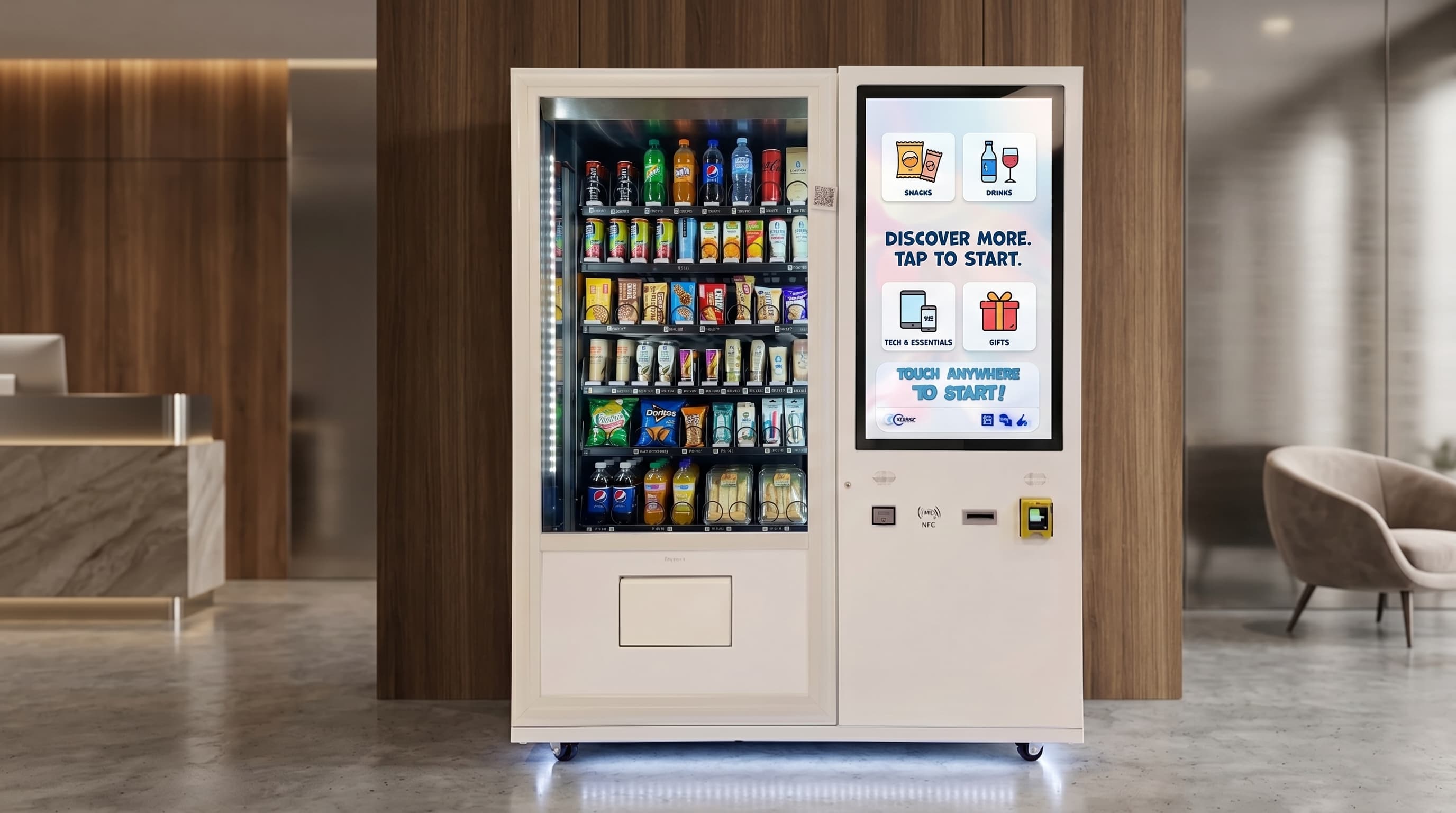
When the screen is large, bright, and fast, the customer experience improves measurably. A 32 or 50-inch touchscreen showing high-resolution product photography, clear pricing, and responsive touch targets is a different interaction from a keypad with a paper price list taped to the glass.
The improvement is not just aesthetic. A larger screen shows more products simultaneously, allowing the customer to browse the full assortment without cycling through multiple screens or memorizing product codes. Product photography at screen size allows the customer to see what they are buying in detail, important for specialty products like trading card packs, beauty items, or premium food where the visual of the product is part of the purchase decision.
For operators, the large touchscreen also functions as ambient content display when no customer is standing in front of the machine. Animated brand content running on a 50-inch screen in a mall corridor is visible to foot traffic from 50 feet away. That visibility generates approach behavior that a machine with a small screen or no screen simply cannot produce.
Digital Media Vending International builds machines with touchscreen displays from 21 to 50 inches, configured to the deployment context and product category.
3. Product Viewing Window
Before the customer touches the touchscreen, they look at the window. Experienced operators consistently report that customers inspect the window before engaging with the screen in a meaningful share of purchase interactions.
A large, clear viewing window that allows customers to see the full product inventory inside the machine performs two functions. First, it confirms that the machine has what the customer wants before they commit to interacting with it, reducing approach abandonment. Second, for impulse purchases, the visual of the product itself creates desire before the customer has made any conscious decision to buy.
The quality of the viewing window experience depends on two things: the size of the window and the interior lighting. A large window with poor interior lighting is effectively a small window. A small window with excellent lighting has limited viewing range. The optimal configuration is a large, clear window with well-distributed interior lighting that makes the entire product inventory visible and visually appealing from the customer's approach distance.
For specialty product categories, collectibles with premium packaging, specialty food with visual appeal, beauty products with distinctive design, the viewing window is part of the sales mechanism. The machine is selling the product visually before the customer has decided to buy.
4. Elevator and Door-Based Product Delivery
The moment of product delivery is the most emotionally salient point in a vending machine transaction. The customer has paid. They are waiting for the product. What happens next either confirms that the purchase was a good decision or immediately undermines it.
A product that arrives intact, in the same condition it was in the machine, handled correctly by the delivery mechanism, that is a confirming experience. A product that drops from a shelf height and lands in a retrieval bin, potentially damaged, is not.
For most standard snack products, the coil-drop delivery mechanism produces acceptable results most of the time. For specialty products, a cupcake with frosting, a boxed collectible figure, a beauty product in glass packaging, a packaged jewelry item, acceptable-most-of-the-time is not sufficient. A damaged delivery produces refund requests, negative reviews, and customers who do not return.
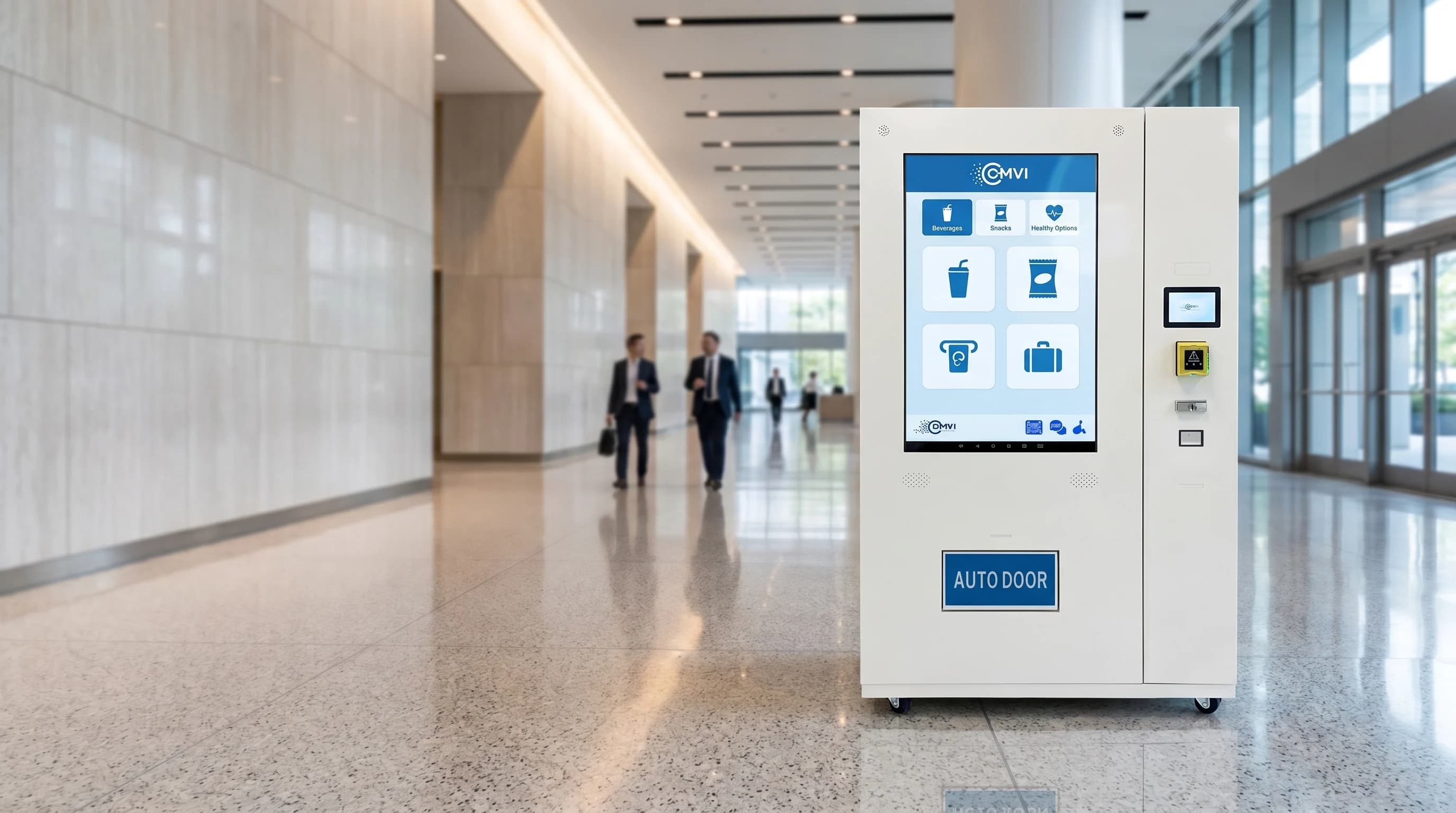
Elevator dispensing carries the product from the shelf to a delivery point at the customer's hand level without any drop. Automatic door delivery opens a panel to allow the customer to retrieve the product directly from the shelf position, again without a drop. Both mechanisms preserve product integrity for the categories where it matters.
Digital Media Vending International uses conveyor belt shelving and elevator or door delivery as standard dispensing technology. The dispensing mechanism is engineered to the specific product during the machine build process, not selected from a generic catalog.
5. Clear, Accurate Inventory Display
Few things frustrate vending machine customers more than selecting a product, completing payment, and discovering the slot is empty. The machine accepted money for a product it could not deliver. The refund process follows. The customer does not come back.
An inventory display that accurately reflects what is actually in the machine, showing sold-out slots as unavailable rather than presenting them as purchasable options, eliminates this failure mode from the customer's perspective. They can only select and pay for products that the machine will actually deliver.
This sounds like a minimal bar, but it requires the machine's software to maintain accurate real-time inventory data that the touchscreen interface reads before presenting options to the customer. VendingTracker, included with every DMVI machine, tracks inventory levels by slot and communicates that data to the display interface. Sold-out products are presented as unavailable rather than as selectable options that will fail on delivery.
From the customer's perspective, this feature is invisible when it works. It becomes very visible when it doesn't.
6. Conveyor Belt Shelving
Conveyor belt shelving is a mechanical feature that most customers will never notice, because when it works correctly, the machine simply dispenses the product they selected without incident.
The customer experience implication of conveyor belt shelving versus coil dispensing is jam rate and dispensing reliability. A coil system that jams with a specialty product produces a machine that appears to have accepted the selection and then fails to deliver. The customer waits, the machine does not dispense, and they have to seek a refund or leave without a product they paid for.
Conveyor belt shelving, which advances product forward on a belt rather than pushing it with a rotating coil, has lower jam rates with specialty products: flexible packages, lightweight items, irregular shapes, products in non-standard packaging. The customer experience benefit is silent and entirely negative when absent, customers do not notice when the machine works correctly, but they remember vividly when it does not.
For product categories where coil-based dispensing would fail, trading cards, cupcakes, beauty products, collectibles, supplements in cylindrical containers, conveyor belt shelving is the feature that allows the machine to serve those categories at all.
7. Machine Availability and Uptime
A machine that is out of service when a customer needs it is not a neutral experience, it is an actively negative one. The customer arrived with purchase intent, found a broken machine, and left without completing the transaction. At a hotel at midnight, there is no alternative option. At a gym at 6am, there is nowhere else to buy a protein bar before the workout. The machine's failure converts a high-intent buyer into a frustrated non-buyer.
Uptime is a function of machine health monitoring and responsive maintenance. VendingTracker's machine health monitoring tracks mechanical, payment, and connectivity status and generates alerts when issues arise, before they produce extended downtime. A motor issue that is flagged and addressed in hours is categorically different from one discovered during a physical site visit days later.
For operators managing machines at locations where the customer has no alternative, the machine is the only retail access point available at that hour and location, uptime is a direct proxy for customer experience. A machine that is always working is a machine that always delivers on the implicit promise of the placement.
8. Speed and Interface Responsiveness
Vending machine transactions should be fast. A customer approaching a machine in a busy corridor, at an airport gate, or at a hotel lobby has a limited dwell time. If the machine's interface is slow to respond, the touchscreen lags on selection, the payment reader takes multiple attempts, or the dispensing cycle takes longer than expected, each delay increases the probability that the customer abandons the transaction.
Responsiveness is a function of the machine's processing hardware, the software optimization, and the payment hardware quality. Modern smart vending machines with properly specified processing hardware complete a full transaction, product selection, payment confirmation, dispensing, and receipt, in under 30 seconds for most product categories.
The customer experience of a fast, responsive machine feels frictionless. The customer interaction feels like a natural extension of wanting something and getting it. A slow machine creates a different experience: one of effort, uncertainty about whether the interaction is working, and frustration.
Transaction speed is not a feature that operators typically see advertised on specification sheets, but it is one of the first things customers notice and remember.
How These Features Work Together in DMVI Machines
Digital Media Vending International builds machines that integrate all eight features as a designed system. The cashless payment hardware ships standard. The touchscreen display, 21 to 50 inches depending on configuration, is sized to the deployment context. The product viewing window and interior lighting are specified to the product and cabinet design. Conveyor belt shelving and elevator or door delivery handle dispensing. VendingTracker manages inventory accuracy and machine health monitoring. The processing hardware is selected for transaction speed appropriate to the machine format and deployment environment.
DMVI is a Made in California certified custom vending machine manufacturer, founded in 2009, with more than 2,000 deployments across 22 countries. Machines start at approximately $4,995. DMVI financing is subject to approval, with a 25%–50% machine deposit depending on stock status and the remaining machine balance paid in 12 monthly payments at 8% simple interest.
The customer experience of a well-designed vending machine is one where the customer gets what they wanted, quickly, without friction. The features that produce that experience are the ones covered above, not because they are the most impressive on a spec sheet, but because they address the actual points where the transaction can fail.
Visit digitalmediavending.com to discuss machine specification for your deployment.
Features That Sound Important But Have Less Customer Impact Than Marketed
Not everything marketed as a premium vending machine feature produces a meaningful improvement in customer experience. Some features matter more to the manufacturer's marketing than to the customer standing in front of the machine.
Animated logos and screensaver content on small screens. A screen that displays animated content on a 12-inch display is not delivering the visibility benefit that a large-screen machine delivers. The screen size determines the marketing radius of the display content. An animated logo on a small screen is not a substitute for a large screen.
Biometric payment technology. Palm-scan and facial recognition payment systems are real technologies being applied to retail. They are also significantly more complex to deploy, require specific hardware, and create friction for customers who are not enrolled in the biometric system. For a vending machine where the goal is a transaction under 30 seconds, biometric payment does not currently outperform NFC contactless for most use cases.
Recommendation algorithms. The idea of a vending machine that suggests products based on the customer's purchase history or demographic profile sounds compelling. In practice, for a standalone machine operating without account login, the data available to drive recommendations is minimal. Most "AI-powered recommendations" in current vending hardware are product category cross-sells built on simple rules, not personalized machine learning.
Augmented reality product display. AR overlays on vending machine screens have appeared in concept demonstrations and a small number of deployments. The customer experience value for most product categories has not been demonstrated at scale. For categories where the physical product appearance is the purchase driver, a high-resolution photograph on a large touchscreen serves the customer at least as well and is significantly more reliable to maintain.
This is not an argument against technology investment in vending machines. The eight features covered earlier in this guide are genuinely impactful. The distinction is between features that address real friction points in the customer transaction and features that are primarily marketing narratives. Operators evaluating vending machine hardware should weight features by their impact on the actual customer transaction, payment, selection, delivery, before the features that affect the pre-transaction experience or the operator's marketing positioning.
The customer's question when they approach a vending machine is simple: can I get what I want, easily, right now? The features that answer yes to that question most reliably are the ones worth prioritizing.
The eight features covered in this guide share a common thread: they each address a specific point in the customer transaction where the experience could fail. Cashless payment addresses the payment friction point. The large touchscreen addresses the selection and information point. The viewing window addresses the pre-selection visual engagement point. Elevator delivery addresses the product receipt point. Accurate inventory display addresses the selection failure point. Conveyor belt shelving addresses the dispensing reliability point. Machine uptime addresses the availability point. Interface speed addresses the transaction duration point.
This failure-point framing is a more useful way to think about vending machine technology than feature accumulation. The question is not "does this machine have feature X?" The question is "at which points in my customer's transaction could the experience fail, and does this machine address those failure points reliably?" The machines that answer yes to the second question across all eight points consistently outperform machines that address some of them with high marketing emphasis while leaving others unresolved.
For operators building a vending machine business in a specialty product category where customer experience affects repeat purchase behavior, the investment in a machine that addresses all eight failure points is not a luxury specification. It is the product quality decision that determines whether customers return or do not. A customer who had a smooth, fast, visually satisfying transaction experience at a vending machine is a customer with a reason to seek it out again. A customer who encountered a jam, a slow interface, a payment that took three attempts, or a product that arrived damaged has a reason not to.
Customer experience in vending is ultimately about one thing: the customer got what they wanted without friction. Every feature on this list contributes to that outcome by removing a specific friction point from the transaction. The machine was there and working. The payment accepted on the first tap. The product was visible and available. The selection process was fast and clear. The product arrived intact. None of these are aspirational standards. They are the baseline that smart vending machine technology now makes achievable at every deployment. The gap between operators who consistently deliver this experience and those who do not comes down to machine selection, product-appropriate hardware, and operational discipline around restocking and maintenance.
The vending machine that consistently delivers a good customer experience is not the one with the most features. It is the one where the features that matter are working reliably. Cashless payment that fails half the time is worse than no cashless payment at all, because it creates expectation and then frustration. Elevator dispensing that jams is worse than a well-calibrated coil system for the right product. The features work when they are correctly specified for the product, correctly configured for the location, and supported by a manufacturer who stands behind the hardware. Choosing the machine is the first decision. Choosing the right manufacturer is what makes the machine's features actually deliver.
Sources
- Digital Media Vending International — Official Website
- Kande VendTech — Vending Machine Industry Statistics 2024
- GetBiopak — The Ultimate Guide to the Vending Machine Business in 2026
- Sheridan Tech — Vending Machine Automation Guide 2026
- IBISWorld — Vending Machine Operators in the US
- Statista — US Vending Machine Industry
Want a vending machine customers actually enjoy using?
DMVI builds smart vending machines with touchscreen interfaces, cashless payment, live inventory data, product visibility, and remote management through VendingTracker.