What Technology Is Used in Vending Machines? The 2026 Breakdown
Most people know what a vending machine does. Fewer people know what is actually inside one. The gap between those two things matters more than it used to, because the technology inside a modern smart vending machine is not remotely similar to the coin-op dispenser in an office break room from fifteen years ago.
The question gets asked in different ways, what technology is used in vending machines, how do smart vending machines work, what is IoT in vending, and the honest answer is that modern vending machines run on six distinct technology layers, each solving a different operational problem. Understanding what those layers are and what each one does is essential for any business owner evaluating a machine purchase, any operator upgrading from legacy hardware, or anyone trying to understand why a smart vending machine costs what it costs.
This is not a buyer's guide or a product pitch. It is a technology explanation. Each layer is covered on its own terms, what it is, how it works, and why it matters.
Touchscreen Display Technology
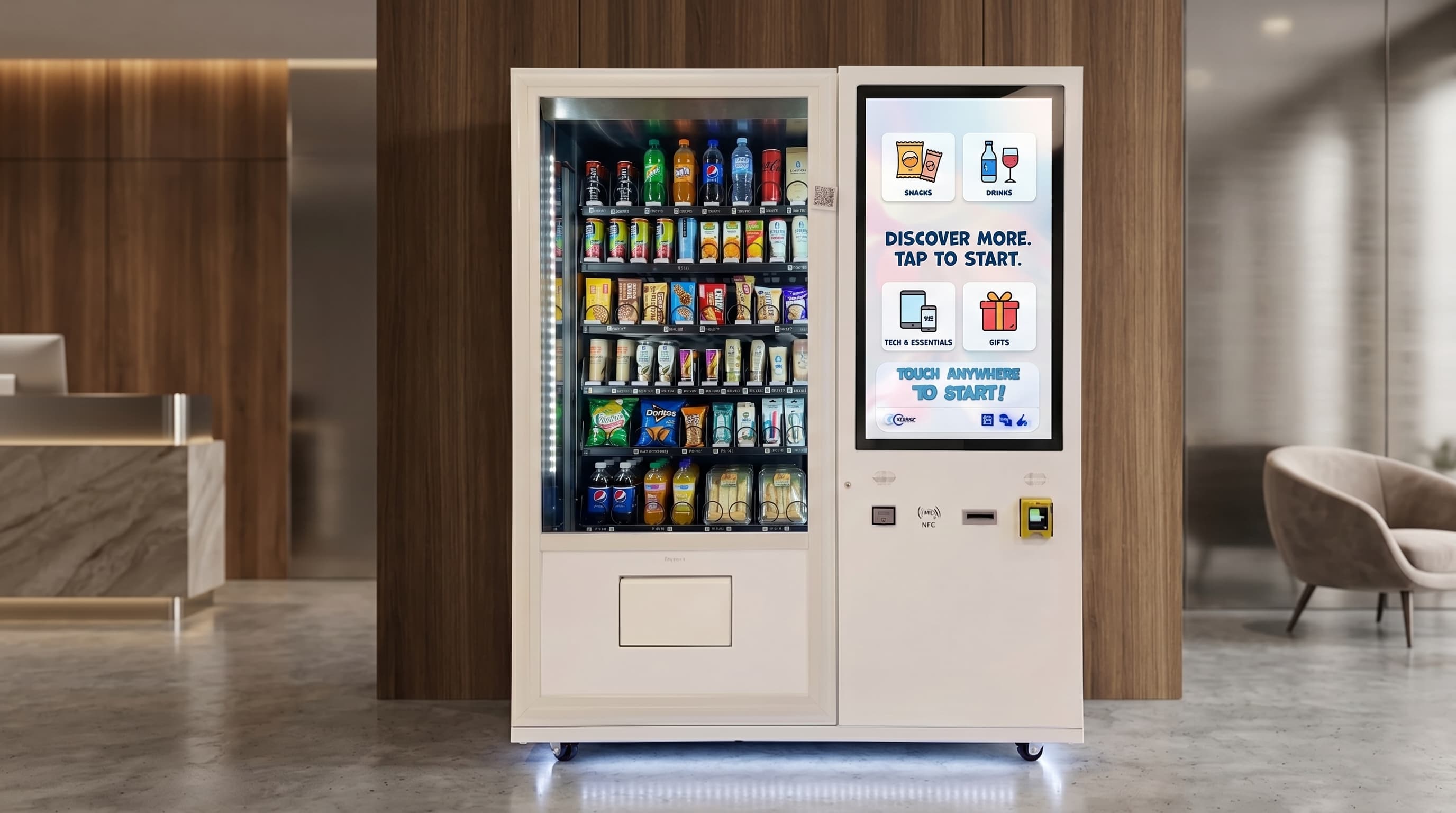
The most visible technology in a modern vending machine is the touchscreen display. In a smart vending machine, the traditional keypad and printed price list are replaced by a capacitive touchscreen, the same fundamental technology used in smartphones, mounted at the front of the machine.
Capacitive touchscreens detect the electrical conductivity of a human finger, registering touch input without requiring mechanical pressure. This makes them faster to respond, more reliable over time (no moving parts), and capable of supporting full graphical interfaces, product photography, descriptions, promotional content, and branded visuals, in a way that keypads cannot.
Screen size varies significantly across machine formats and manufacturers. Digital Media Vending International builds machines with touchscreen displays ranging from 21 to 50 inches. The size distinction matters commercially, not just aesthetically. A 50-inch touchscreen display running branded content is visible and attention-commanding from 50 to 60 feet away in a high-traffic corridor. A 21-inch display has a fraction of that effective visibility radius. At premium high-traffic locations, the larger the screen, the greater the foot traffic conversion.
The content on the touchscreen is configured by the operator through the machine's software platform. Product images, pricing, promotional offers, and seasonal content can all be updated remotely without a technician visit or a physical change to the machine. The touchscreen is simultaneously a transaction interface and a brand communication channel.
For specialty product categories where the customer needs to understand what they are buying, trading card pack contents, beauty product formulations, supplement ingredients, the screen provides enough visual and textual space to present that information before the purchase decision is made. This is a functional difference from a keypad system where the only information available is a product code and a price.
Cashless Payment Technology
The shift from cash to cashless in vending machines is one of the most commercially significant technology changes in the category's recent history. According to Kande VendTech's 2024 vending industry data, 71% of all US vending transactions were cashless in 2024, up 17% from the prior year. Cashless customers also spend an average of 37% more per transaction than cash customers.
Cashless vending payment technology operates through three primary channels:
NFC (Near Field Communication) contactless. NFC enables payment by tapping a card, phone, or smartwatch against the payment reader. The transmission is encrypted and occurs at very short range, typically within a few centimeters of the reader. Apple Pay, Google Pay, Samsung Pay, and contactless-enabled credit and debit cards all use NFC. The transaction completes in under a second for the customer.
EMV chip and tap. EMV (Europay, Mastercard, Visa) is the chip-based card standard that replaced magnetic stripe for card security. Most modern vending machine payment readers support both chip insert and contactless tap, ensuring compatibility with the full range of current card formats.
QR code payment. Some payment systems allow customers to scan a QR code displayed on the vending machine screen to initiate a payment through a mobile banking or payment app. This is a secondary channel in most US deployments but is standard in certain international markets.
Every Digital Media Vending International machine ships with cashless payment hardware included as standard. For specialty product categories where average transaction values run $15 to $80 or more per purchase, the payment technology's reliability and speed directly affects the customer experience at the moment of highest purchase intent.
Dispensing Mechanism Technology
Dispensing technology is the most mechanically diverse area of vending machine hardware, and the one that most directly determines which products a machine can handle reliably.
The traditional dispensing mechanism in a standard snack vending machine is a coil system. A motor turns a coil mounted horizontally on a shelf; the product at the front of the coil is pushed forward by the rotation and drops into a retrieval bin below. This mechanism works well for products engineered to be dispensed by it: uniformly shaped, structurally solid items like chip bags and candy bars. It fails predictably with products that are flexible, lightweight, fragile, or irregularly shaped, items that jam coils, do not advance consistently, or are damaged by the drop.
Modern custom vending machines replace the coil system with mechanisms better matched to a wider product range:
Conveyor belt shelving. Instead of a coil, the shelf is a belt that advances forward when triggered. Products sit on the belt and move forward gently as a unit, rather than being pushed by a rotating mechanism. This eliminates the primary jam mechanism that affects coil systems with specialty products and makes the shelf compatible with a much wider range of product shapes and weights.
Elevator dispensing. Rather than dropping the product from shelf height to a retrieval bin, an elevator mechanism lifts or lowers the product to a delivery point at the customer's hand level. The product arrives without impact, critical for fragile items like cupcakes, boxed collectibles, glass containers, and packaged jewelry.
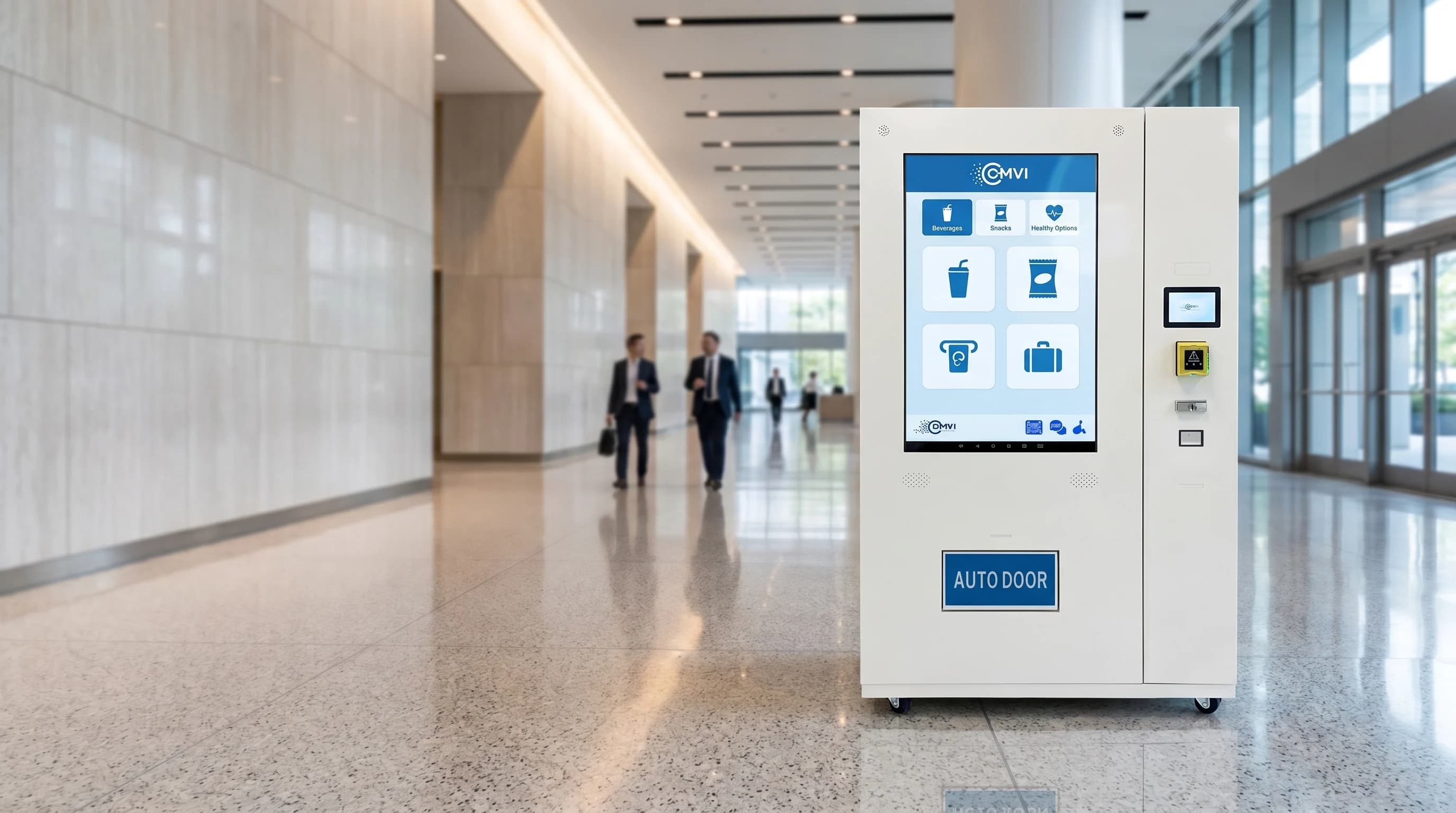
Automatic door delivery. An alternative to the elevator, automatic door systems open a panel at the base of the machine to allow retrieval of the product after it has been advanced to the front of the shelf. The product is never dropped; the customer reaches directly to collect it.
Digital Media Vending International uses conveyor belt shelving and elevator or door-based delivery as standard dispensing technology across their lineup. The dispensing mechanism choice is made during the machine engineering process based on the physical properties of the product being sold.
IoT Connectivity and Telemetry
IoT stands for Internet of Things, a term describing physical devices equipped with sensors and internet connectivity that communicate data to a central platform. In the context of vending machines, IoT technology transforms a machine from a standalone mechanical unit into a connected node in a managed network.
What IoT connectivity enables in a vending machine:
Remote data transmission. The machine sends data, transaction records, inventory levels, motor status, payment system status, temperature readings for refrigerated configurations, to a cloud platform continuously or at defined intervals. This data is accessible to the operator from any internet-connected device without requiring a physical visit to the machine.
Real-time inventory monitoring. Sensors track product levels by slot. When a product slot reaches a defined low threshold, the system generates an alert. The operator learns that a specific product is running low without having to drive to the location to check.
Payment system status. The machine communicates whether payment hardware is functioning correctly. A payment hardware issue that is flagged remotely and addressed proactively is a different outcome from one discovered when a customer tries to make a purchase and cannot.
Motor and mechanical health. Conveyor belt motor status, door mechanism operation, and other mechanical components report operational data that flags anomalies before they become machine-down failures.
Temperature monitoring. For machines with refrigeration requirements, IoT sensors track cabinet temperature and alert operators if the temperature moves outside of acceptable parameters.
The IoT layer is what separates a managed automated retail operation from a machine that requires frequent physical visits to understand its status. For operators running multiple machines at multiple locations, IoT connectivity is the operational foundation that makes the business scalable.
Cloud Management Software
The cloud software layer is where all the data from the IoT sensors, payment systems, and transaction records is organized, presented, and acted on. Every smart vending machine's operational value is partly determined by the quality of the software platform it runs on.
Digital Media Vending International includes VendingTracker with every machine deployed. VendingTracker is a browser-based platform, no dedicated app required, accessible from any internet-connected device, that provides:
Live inventory by SKU. The operator sees current inventory levels for every product slot in every machine, updated in real time based on transaction and sensor data. Low-inventory alerts fire automatically at operator-defined thresholds.
Sales reporting. Daily, weekly, and custom-period sales data broken down by product, by machine, and by location. This reporting replaces manual counting and estimates with precise transaction data that shows exactly what is selling where.
Dynamic pricing controls. Prices can be changed remotely for any product in any machine without a technician visit. Price testing, promotional pricing, and location-specific pricing adjustments are all executable from the browser dashboard.
Planogram management. A planogram is the configured map of which product occupies which shelf slot in the machine. VendingTracker allows operators to update planogram configurations remotely, introducing new products, retiring slow sellers, and reorganizing assortments, without physical intervention.
Machine health monitoring. Operational alerts for mechanical, payment, and connectivity issues surface in the dashboard before they become extended downtime events.
For an operator with machines in multiple locations, the software layer is what makes the operation manageable. Without it, each machine requires a physical visit to understand its status. With it, the entire fleet is visible from a browser in real time.
How DMVI Integrates All Six Technology Layers
Digital Media Vending International is a Sebastopol, California-based custom vending machine manufacturer, Made in California certified, founded in 2009 with more than 2,000 deployments across 22 countries.
Every machine in the DMVI lineup integrates all six technology layers as a designed system rather than as bolt-on additions to a standard cabinet. The touchscreen display is sized and positioned for the specific deployment context. The cashless payment hardware ships included. The dispensing mechanism, conveyor belt shelving and elevator or door delivery, is engineered to the product during the build process. IoT connectivity provides the data stream. VendingTracker organizes that data into actionable operational intelligence.
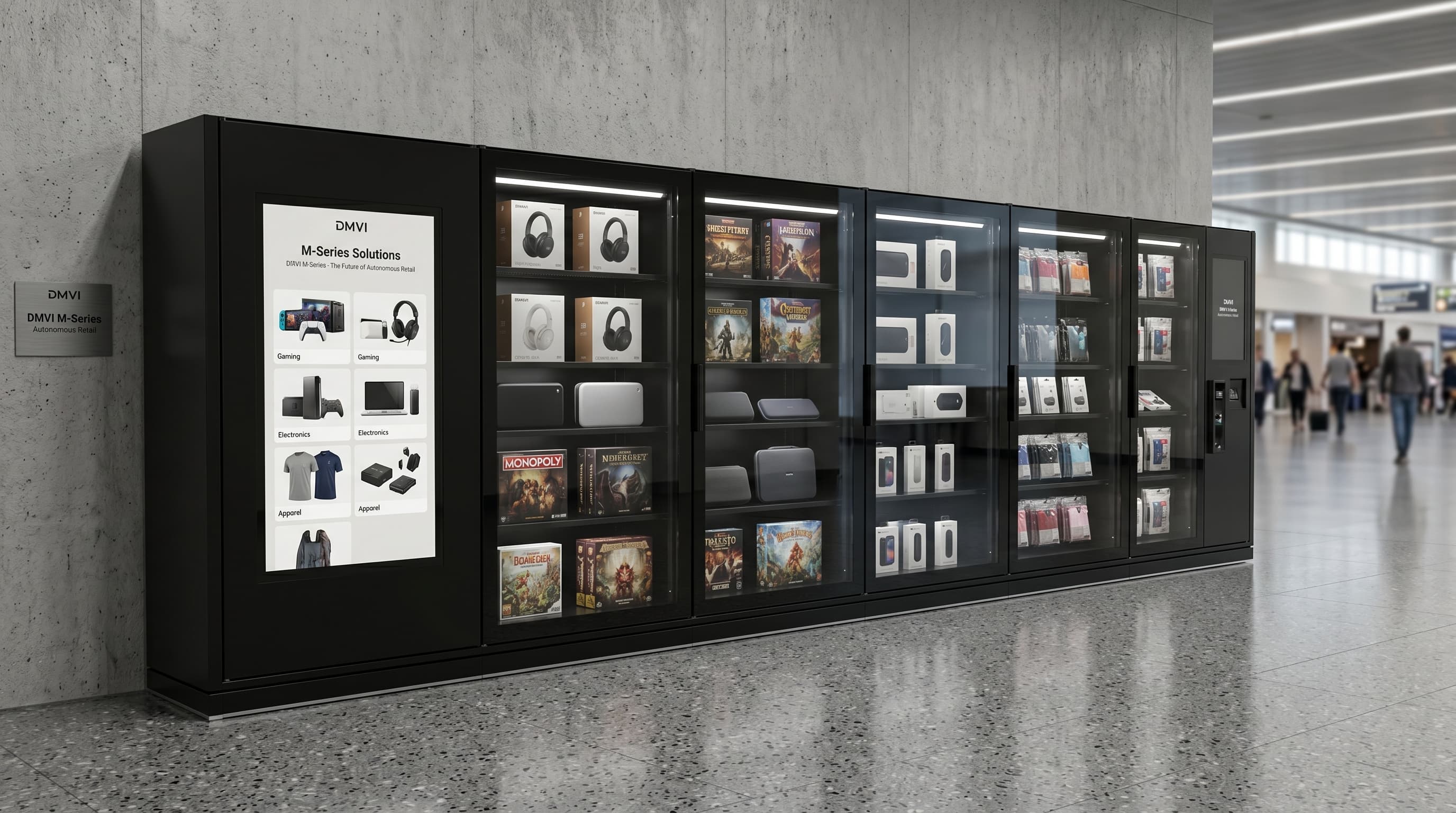
DMVI's wall-mounted units, Smart VM mid-size cabinets, M-Series large format machines, smart lockers, micro markets, and AI smart fridges all run on this integrated technology stack. The format changes based on the deployment context; the underlying technology architecture is consistent.
Installation, operator training, and ongoing US-based technical support are included with every deployment. Operators learning to use VendingTracker are trained during the installation process rather than left to figure it out from a manual.
Machines start at approximately $4,995.
Visit digitalmediavending.com for machine specifications.
How to Evaluate a Smart Vending Machine's Technology Stack
Knowing what the six technology layers are is useful. Knowing how to verify that a specific machine actually delivers them, rather than just claims to, is more useful when you are about to spend several thousand dollars on hardware.
Here is what to ask and what to look for when evaluating any smart vending machine's technology stack.
On the touchscreen: Ask for the screen size in inches and verify it matches the marketing claims. Ask what content management system controls what is displayed on the screen and whether it can be updated remotely without a technician visit. A machine whose screen content requires a technician to update is not a smart vending machine, it is a machine with a screen.
On cashless payment: Confirm which payment types are supported as hardware standard on the machine, not as optional add-ons. NFC contactless, mobile wallet, and chip-and-tap should all be included. Ask whether the payment hardware has a specific certification for unattended retail transactions, the payment hardware standard for vending machines is different from point-of-sale retail terminals.
On dispensing mechanism: Ask directly: does this machine use coil dispensing, conveyor belt shelving, or both? Then ask: for my specific product, which mechanism will you configure and why? A manufacturer who cannot explain the dispensing mechanism selection relative to your product's physical properties is not engineering the machine to your product, they are selling you a generic cabinet.
On IoT connectivity: Ask what data the machine transmits, at what frequency, and to what platform. Ask whether the machine can operate in both WiFi and cellular connectivity environments. Ask what happens to data transmission if the machine loses internet connectivity, does it buffer and transmit when reconnected, or does data get lost?
On cloud software: Ask for a demo of the management platform. A dashboard that shows live inventory, sales data by SKU, machine health status, and pricing controls in a single browser view is what you should see. A platform that requires manual data entry or shows only aggregate transaction counts is not delivering the operational value of true cloud management.
On machine health monitoring: Ask specifically what triggers a health alert. Does the system alert on motor status changes? Payment hardware anomalies? Connectivity drops? Temperature deviations for refrigerated units? The more specific the monitoring triggers, the earlier the operator is notified of issues before they become downtime events.
The integration test: Ask whether all six layers, screen, payment, dispensing, IoT, software, and health monitoring, are integrated from the manufacturer as a designed system, or whether some components come from third-party vendors with separate support relationships. Integrated systems from a single manufacturer have clearer accountability when something goes wrong. Systems assembled from multiple third-party components have multiple potential failure points and multiple potential support contacts.
Digital Media Vending International builds all six technology layers as an integrated system. The VendingTracker software platform, the IoT connectivity, the cashless payment hardware, the touchscreen, and the dispensing mechanism are all designed to work together and supported through DMVI's US-based technical team. When something needs attention, there is one contact, not six.
The technology inside a smart vending machine is not visible from the outside. Asking the right questions before purchase is how you verify that what is claimed is actually present and functioning as described.
Legacy machines ran on mechanical timers, coin acceptors, and manual inventory checks. A route operator visited each machine on a schedule, opened the cabinet, counted what was left, restocked from a van, and moved on. There was no way to know remotely whether the machine had dispensed correctly, whether the payment system had a fault, or whether a product slot had been empty since Tuesday. The information gap between the operator and the machine was large, and managing around it required labor.
Smart vending machine technology eliminates that information gap. VendingTracker receives transaction data, inventory data, payment hardware status, and motor health data continuously. The operator's knowledge of every machine in their portfolio is current to the moment they open the browser, not to the last time they visited each location. This operational difference is what makes it economically viable to run a vending machine business with machines spread across multiple cities, multiple states, or multiple countries from a single management point. The technology is not primarily about making the customer experience better, though it does that too. It is about making the operator's business manageable at a scale that legacy machines never supported.
For buyers evaluating smart vending machine technology, the most important question is not whether a machine has any given feature, most smart vending machine manufacturers will claim all of them. It is whether those features work as an integrated system, who supports them when something goes wrong, and what the software platform actually shows you when you log in.
The vending machine technology category is moving faster than most operators realize. Machines that were considered advanced two years ago, touchscreen with cashless payment, are now baseline expectations. Across the smart vending industry, the features moving to the leading edge include predictive restocking based on sales velocity data, dynamic pricing that operators can update remotely based on time of day, inventory levels, or competitive conditions, and machine health monitoring precise enough to flag a mechanical issue before the first failed dispensing attempt. Operators who choose hardware with software architectures built for configurability and remote update are better positioned to access these capabilities as they mature than those locked into closed systems with limited update pathways.
Conclusion
Modern vending machine technology is not a single feature, it is a stack of six interdependent layers that together create a managed automated retail system. The touchscreen handles customer interaction. Cashless payment handles transactions. The dispensing mechanism handles product delivery. IoT connectivity handles data collection. Cloud software handles management. Machine health monitoring keeps the system operational. Each layer does something the others cannot, and the value of a smart vending machine comes from all six working together.
The gap between a legacy snack machine and a modern smart vending machine is not cosmetic. It is the gap between a mechanical appliance and a connected retail platform.
Sources
- Digital Media Vending International — Official Website
- Kande VendTech — Vending Machine Industry Statistics 2024
- Sheridan Tech — Vending Machine Automation Guide 2026
- GetBiopak — The Ultimate Guide to the Vending Machine Business in 2026
- IBISWorld — Vending Machine Operators in the US
- Statista — US Vending Machine Industry
Need smart vending technology built into the machine?
DMVI builds touchscreen vending machines with VendingTracker, cashless payment, telemetry, planogram management, and remote operations support.