
Pokémon Vending Machine vs. Snack & Drink Vending: Margin, Capital & Risk Compared
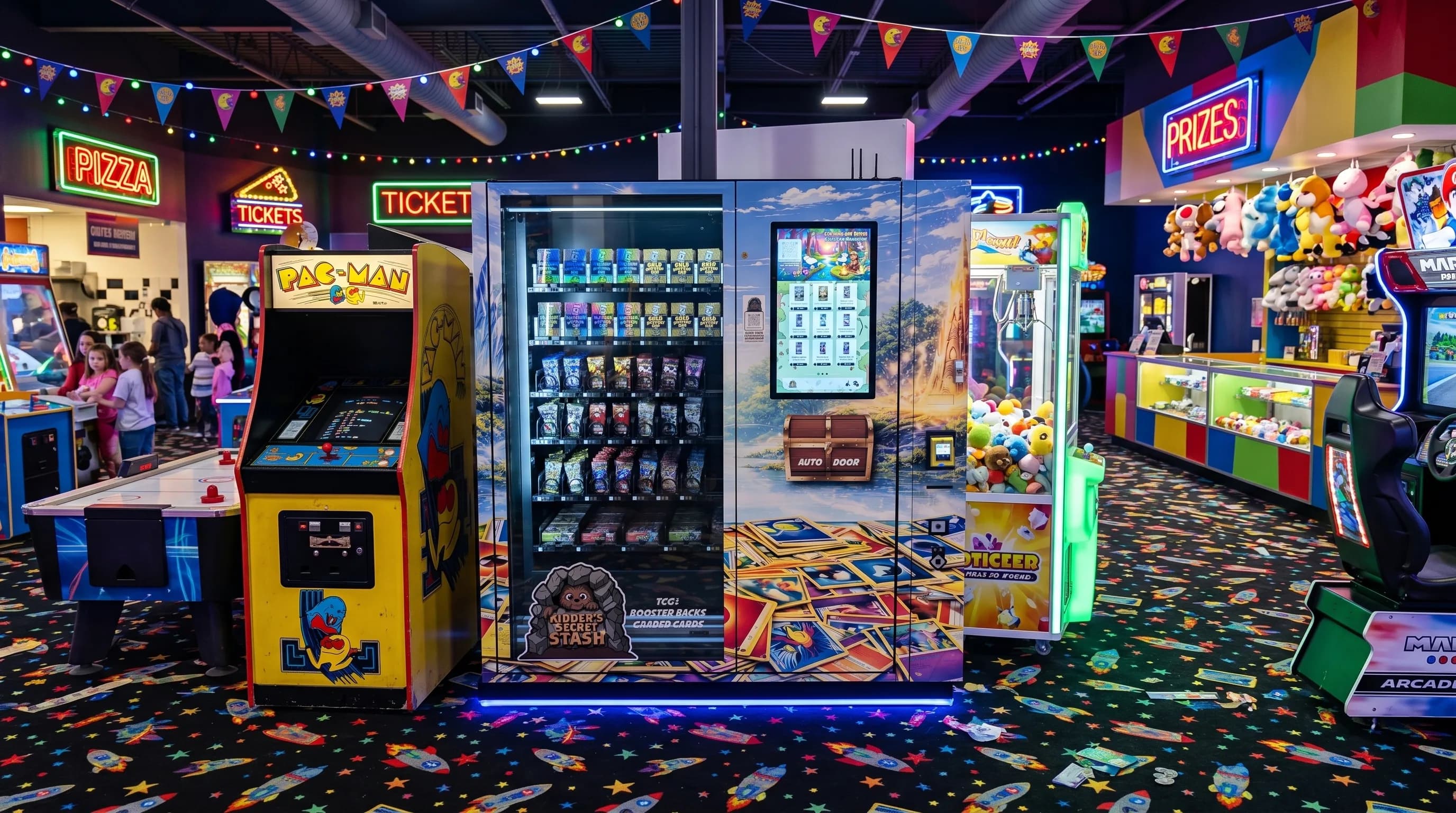
DMVI purchase financing: Subject to approval and not guaranteed; DMVI reserves the right to deny financing. A 25%–50% machine deposit is required depending on whether the machine is in stock, with the percentage specified in your quote. The remaining machine balance is paid in 12 monthly payments with 8% simple interest. All upfront costs are due at signing, including the wrap, optional topper, payment terminal, first-year software subscription, shipping, sales tax, and other quoted upfront charges. A UCC filing applies, and a personal guarantee may be required. See vending machine financing and your approved agreement for details.
TL;DR: Pokémon vending machines offer 4–5× higher gross margins than snack vending (59–76% vs. 15–25%), higher revenue per machine, and lower spoilage/expiry risk. The tradeoff: higher upfront cost and more active inventory management tied to TCG release cycles. For entrepreneurs starting fresh in 2026, the numbers strongly favor the TCG category.
Introduction
Most people comparing vending machine business models eventually ask: why Pokémon cards instead of snacks? It is a fair question. Snack vending is familiar, low-maintenance, and widely understood. You have seen those machines in every office break room, hospital corridor, and gym lobby for decades. The business model seems proven.
But the numbers tell a different story.
When you put both models side by side on a spreadsheet — margin per item, revenue per machine, restock frequency, spoilage risk, and five-year revenue ceiling — the gap is not incremental. It is transformational. A snack machine in a busy office might generate $1,500 in a strong month. A single DMVI M1 Pokémon vending machine in the San Francisco Bay Area generated $87,000 in one month. That is the same category of asset — a vending machine — producing roughly 58× more revenue.
This post puts both business models side by side across every dimension that matters to an operator: gross margin, capital requirements, restocking operations, location difficulty, and risk profile. Whether you are already running a snack route or evaluating vending as a new business in 2026, this comparison will give you the data to make an informed decision.
Section 1: The Margin Comparison
This is where the story starts. Before you think about locations, operations, or scaling, you need to understand what each sale is actually worth.
A typical snack vending machine sells chips, candy bars, and drinks at retail prices of $1.50–$3.00 per item. Wholesale costs and distributor margins compress gross profit to roughly 15–25% per transaction. A $2.00 bag of chips might carry $0.40 of gross margin. You need volume — hundreds of transactions per week — to generate meaningful income. And that volume depends entirely on footfall at your location.
Pokémon TCG vending works on fundamentally different economics. A standard booster pack retails in a DMVI machine for $8–$12. The wholesale cost from an authorized distributor such as GTS Distribution or Southern Hobby Supply is approximately $2.20–$2.50 — around 50% off MSRP. That produces a gross margin of 59–61% on a booster pack. When you vend higher-ticket items — Elite Trainer Boxes at $49.99, booster boxes at $100+, or sealed cases — margins stretch further, because the consumer is paying a convenience premium on top of retail.
Stat Callout: A single booster pack vended at $10 generates approximately $7.50–$7.80 in gross profit. You would need to sell 19 bags of chips at $0.40 margin each to match one booster pack transaction.
Here is the full comparison:
| Metric | Snack/Drink Vending | Pokémon TCG Vending |
|---|---|---|
| Gross margin per item | 15–25% | 59–76% on booster packs |
| Average transaction value | $1.50–$3.00 | $8–$150+ |
| Product shelf life | Days to weeks (perishable) | Indefinite (sealed packs) |
| Shrinkage/expiry loss | 3–8% | Near zero (sealed product) |
| Restock frequency | 1–3× per week | 1–2× per month |
| Monthly revenue per machine | $500–$1,500 | $6,000–$87,000 |
| Machine cost | $2,000–$6,000 | $4,995–$39,995 |
The monthly revenue range for Pokémon TCG vending is not a typo. The conservative floor of $6,000–$7,000/month reflects a steady mall or arcade location with moderate foot traffic. The $87,000 peak is field data from a verified DMVI operator — not a projection, not a best-case estimate. It is a real result from a real machine. No snack vending machine, at any location, under any circumstances, produces revenue at that level.
The margin advantage is structural, not situational. As long as sealed TCG product is sourced from authorized distributors at wholesale pricing, the 59–76% gross margin holds regardless of which Pokémon set is in market. In May 2026, with Scarlet & Violet era releases including Prismatic Evolutions, Journey Together, Destined Rivals, and Mega Evolution all generating collector demand, that margin compounds across a wide SKU range.
Section 2: Capital Comparison
Understanding what it costs to get into each business is essential for evaluating return on capital. Both models have a range depending on machine format and whether you buy new or used.
Snack/drink vending entry cost:
- Used machine (refurbished): $800–$2,000
- New machine: $2,000–$6,000
- Initial inventory load: $200–$500
- Total entry cost (new): approximately $2,200–$6,500
Pokémon TCG vending entry cost:
- Wall-Mounted unit (DMVI): $4,995
- Wall-Mounted XL: $5,995
- Standard (base): $8,500
- M1 flagship cabinet: $21,995; a separate lease option is discussed below
- M3 flagship: $39,995
- Initial inventory: $800–$8,000 depending on machine format and SKU depth
TCG machines can require more initial capital than used snack machines. Compare purchase prices, all signing costs, inventory, operating reserves, and any approved payment schedule. Financing spreads the remaining machine balance over 12 months; it does not make one format inherently cheaper or more profitable.
The lease option on the M1 at $625/month all-inclusive deserves special attention. That lease includes the custom full-body graphic vinyl wrap, cloud management via VendingTracker.com, custom shelves, branded touchscreen UI, California-based technical support, remote diagnostics, and on-screen digital advertising. An operator running the M1 in a strong mall location at $25,000/month in revenue is paying 2.5% of gross revenue in lease costs. The equivalent snack machine generating $1,500/month against a $400/month machine cost would be paying 26.7% in machine overhead.
Financing approval is discretionary. Request a quote and review the required deposit, signing costs, and payment obligations before selecting a format.
To explore the full machine line-up and financing options, visit DMVI's Pokémon vending machines for sale.
Section 3: Restock & Operations
Operational complexity is one of the most underrated factors in vending profitability. Every route stop costs time, fuel, and labour. The fewer stops you need to make, the more machines you can run with the same operator hours.
Snack vending operations:
A typical snack machine requires restocking 1–3 times per week depending on volume. Drinks and refrigerated items may need even more frequent attention. Products have expiry dates — unsold stock is a write-off. Temperature sensitivity creates additional failure points: a refrigeration issue overnight can spoil an entire inventory load. Operators running busy snack routes effectively have a part-time job just managing the restocking schedule.
Pokémon TCG vending operations:
Sealed trading card packs have no expiry date. A booster pack sitting in a machine for six weeks is worth exactly the same as the day it was loaded. This eliminates the entire category of spoilage waste that erodes snack margins. Restock frequency for a steady-state TCG machine is typically every 2–4 weeks, and for lower-volume wall-mounted units, monthly restocking is often sufficient.
DMVI's VendingTracker dashboard — included with every machine — provides real-time low-stock alerts accessible from any device. Operators manage their routes remotely, receiving notifications when specific SKUs approach depletion rather than running a physical check on a fixed schedule. This means you schedule a route stop only when inventory data tells you it is necessary — not because you are guessing or following a calendar.
Practical implication: An operator managing ten DMVI machines may need to make 10–15 route stops per month. An operator managing ten snack machines needs to make 40–120 route stops per month. At scale, that difference represents thousands of hours of labour annually — labour that in the snack model either costs money or constrains how large you can grow.
For a deeper look at the operational systems DMVI operators use, read how to start a Pokémon vending machine business.
Section 4: Location Difficulty
Getting a machine placed is one of the real friction points in any vending business, and the two models have very different dynamics here.
Snack vending placement:
Virtually every office building, factory, gym, school, and hospital will accept a snack machine. The category is ubiquitous and expected. This makes initial placement relatively easy — particularly for operators with existing relationships or a cold-calling operation.
The problem is saturation. Popular locations already have machines. Property managers receive multiple approaches per month from vending operators. To compete, operators often accept unfavorable revenue-share arrangements of 10–15% of revenue paid to the location. On a machine producing $1,500/month, that is $150–$225 back to the venue — a meaningful cut of an already thin margin.
Pokémon TCG vending placement:
The demographic requirement is more specific: you need locations with collector-friendly foot traffic — malls, gaming stores, entertainment venues, hobby centers, and arcades. Not every building qualifies. This is a genuine constraint that operators need to plan around.
However, DMVI actively supports placement for its operators. The company provides direct mall introductions and placement strategy support — a meaningful advantage when approaching mall management for the first time. Malls in particular are actively seeking this category: it drives foot traffic, appeals to the 16–35 demographic that mall operators most want, and fills the collectibles retail gap left by declining traditional retail.
The revenue-share economics are also far more favorable in absolute terms. Paying a 10–15% location commission on a machine doing $20,000/month leaves the operator $17,000–$18,000 before other costs. That is more than 10× the net from a typical snack location after the same commission rate.
Critically: in most venues, a Pokémon or TCG vending machine faces zero direct competition from other vending machines. There is no adjacent machine selling the same product. In snack vending, operators compete not just with each other but with convenience stores, coffee shops, and cafeterias. In TCG vending, you are often the only automated retail point for that category in the entire venue.
For a full breakdown of location strategies, see Pokémon vending machine best locations.
Section 5: Risk Profile
Every business carries risk. Understanding the specific risk profile of each model allows operators to make informed decisions and mitigate exposure.
Snack vending risk:
The primary financial risk in snack vending is expired and unsold inventory. Shrinkage from expiry typically runs 3–8% of stock value, and operators in slower locations can face higher write-off rates. Machine vandalism does occur, though the low per-item value reduces incentive for targeted theft. Temperature-sensitive product (refrigerated drinks, dairy) introduces equipment failure risk — a broken compressor at the wrong time is both an inventory loss and a maintenance cost.
Market risk is low but the ceiling is also low. Snack demand is stable and flat. Growth requires adding machines and route stops rather than extracting more from existing locations.
Pokémon TCG vending risk:
Higher per-item product value increases the incentive for theft — a booster box is worth $80–$120. DMVI addresses this directly in its machine design: every unit features an automatic locking door that eliminates open-shelf vulnerability. The machines include remote monitoring, cloud-based alerts, and full transaction logging. There is no smash-and-grab exposure. Every sale is recorded, and the operator is notified of anomalies in real time.
Market risk for TCG vending is different in character from snack vending. Pokémon card spending grew approximately 350% between 2020 and 2026, driven by a passionate, repeat-buying collector base that returns weekly rather than once per year. The $15 billion+ global trading card market is structurally growing, not flat.
Seasonal risk exists and is worth acknowledging. Pokémon release weeks — when a new set like Destined Rivals or Mega Evolution drops — can 2–4× normal monthly revenue as collectors rush to pull new cards. Q4 holiday season also drives outsized performance. Operators who understand the TCG release calendar and plan inventory accordingly can capture these spikes. For operators who prefer flat, predictable income, this seasonality requires management.
For a detailed ROI model across both scenarios, visit the Pokémon vending machine ROI and profit calculator.
Section 6: When Snack Vending Still Makes Sense
This comparison is not intended to dismiss snack vending entirely. There are specific scenarios where it remains the better choice.
Snack vending wins when:
- You already operate an established route in offices, factories, or healthcare facilities where TCG demand does not exist, and your machines are paid off
- You are entering with very limited capital and cannot qualify for financing
- Your target locations operate under permit restrictions that prohibit luxury goods or non-food vending
- You are supplementing a snack route with TCG machines and want to keep the infrastructure consistent
For an entrepreneur starting fresh in 2026, this is a capital-allocation decision. Compare TCG and snack vending using realistic site-level net cash flow and the full acquisition budget. Any financed purchase must accommodate the deposit, all signing costs, and approved monthly obligations; the format alone does not establish the better financial choice.
The market timing also matters. Snack vending is a mature category with compressed margins and high operator saturation. TCG vending via automated retail is a growth category with low competition, rising consumer demand, and significant headroom for new operators to establish strong locations before the market matures.
Section 7: The Verdict
| Decision Factor | Pokémon / TCG Vending | Snack & Drink Vending | Practical Edge |
|---|---|---|---|
| Gross margin profile | Higher per item, especially on booster packs and premium SKUs | Lower margin, higher unit velocity | TCG wins on margin density |
| Startup capital | Higher cabinet and inventory cost | Lower machine and opening inventory cost | Snack wins on entry price |
| Product complexity | More merchandising and release-cycle strategy | Simpler replenishment and familiar SKUs | Snack wins on simplicity |
| Spoilage risk | No expiry issue on sealed product | Real expiration and waste management | TCG wins on shelf life |
| Customer behavior | Collector-driven, repeat visits, event spikes | Convenience-driven, steadier baseline demand | Depends on venue and audience |
| Best-fit operator | Wants a branded specialty route with stronger upside | Wants a broader, simpler route model | Choose based on business style |
| Factor | Winner |
|---|---|
| Gross margin | Pokémon TCG |
| Revenue ceiling | Pokémon TCG |
| Location difficulty | Snack (easier) |
| Restock complexity | Pokémon TCG (less frequent) |
| Spoilage risk | Pokémon TCG (none) |
| Startup cost | Snack (lower) |
| 5-year revenue potential | Pokémon TCG |
The verdict is clear for the right operator profile. If you have $5,000–$25,000 to invest and access to collector-friendly locations — or are willing to work with DMVI's placement support to secure them — Pokémon vending outperforms traditional snack vending on every financial metric that matters: gross margin, revenue per machine, operational efficiency, and long-term growth trajectory.
The only category where snack vending has a genuine advantage is ease of initial placement and lower startup cost. Both are real considerations, particularly for first-time operators. But neither changes the fundamental revenue gap between a $1,500/month snack machine and a $6,000–$87,000/month TCG machine.
For entrepreneurs who want to build a vending business that scales — where adding one more machine means materially more income, not just marginally more revenue at thin margin — the Pokémon TCG vending model is the clear choice in 2026.
Explore DMVI's Pokémon card vending machines by DMVI to review machine formats, pricing, and financing options.
Start Comparing Your Options
The data in this post is drawn from real DMVI operator results and standard industry benchmarks for snack vending. The margin gap between snack vending and Pokémon TCG vending is not marginal — it is structural, and it compounds with every machine you add to your operation.
If you are evaluating vending as a business in 2026, start with a quote for your specific situation. The DMVI team can discuss machine formats, the financing review process, and placement options. Assess revenue expectations against your own location research and operating budget.
Visit DMVI's Pokémon vending machines for sale to explore the lineup, or call +1-800-490-1108. Request current purchase, lease, or financing terms as applicable.
Want pricing, format guidance, or a launch plan?
DMVI can help you compare Pokemon vending machine formats, rollout strategy, financing, and location fit based on your route goals.