Luxury Vending Machines: Build a Pilot Scorecard Before You Scale
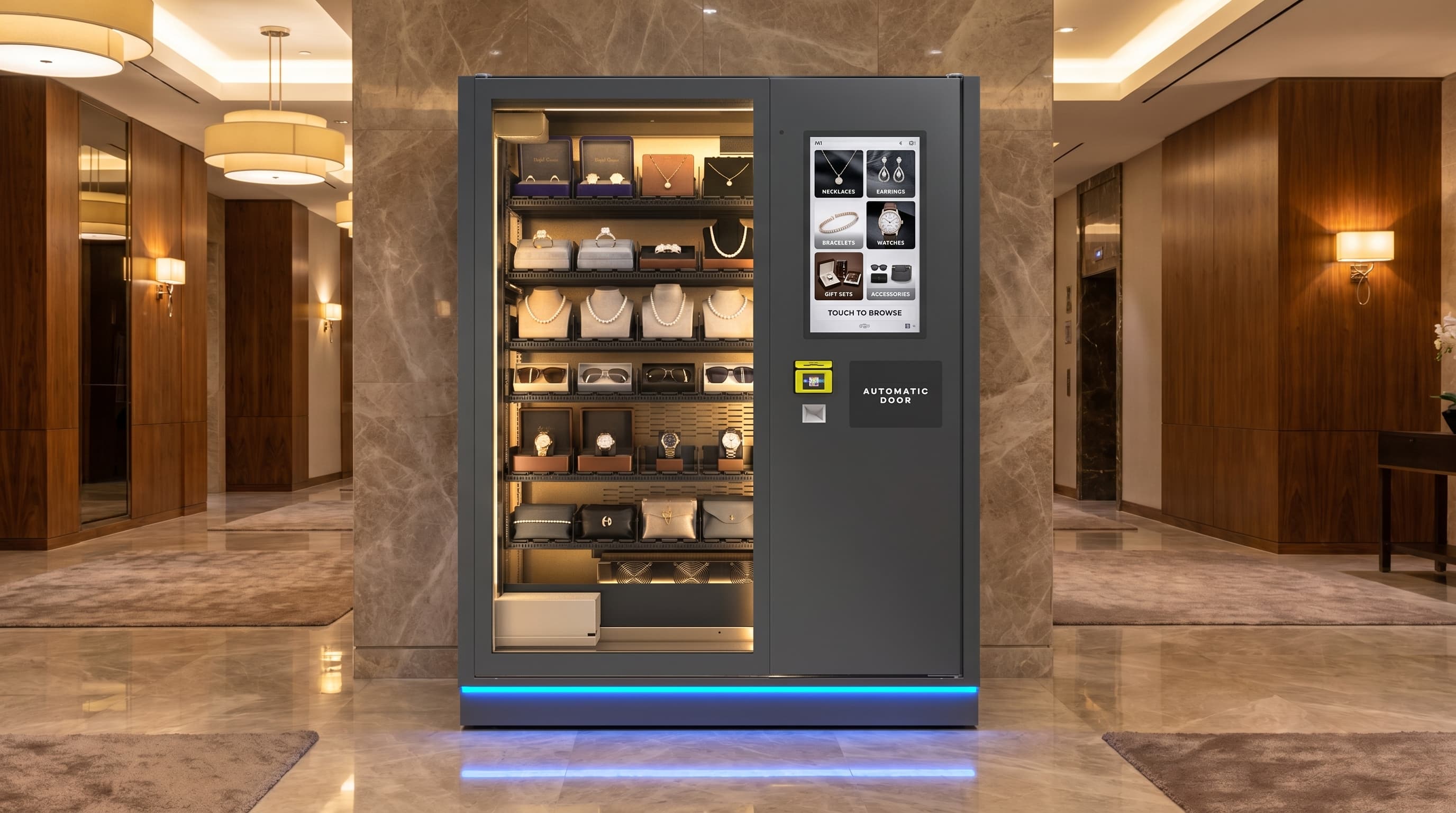
A premium cabinet can look right in a hotel, airport, or retail property and still leave the operator with unanswered business questions. Will customers buy the proposed products at the proposed prices? Can the team keep the machine stocked and presentable? What remains after product costs and the work required to operate it?
A luxury vending pilot should answer those questions before a larger rollout. Start with a written scorecard that connects the brand experience to measurable operating results. Our luxury vending machines guide covers the broader category; this article focuses on deciding whether a particular concept deserves expansion.
Define the purchase occasion, not just the venue
“A premium hotel” is a location description, not a demand forecast. Describe the purchase you expect: a guest replacing a forgotten accessory, buying a gift, or choosing a familiar beauty product after nearby stores close. Then identify what must be true for that purchase to happen.
Record the customer access hours, nearby alternatives, product familiarity, expected need for advice, and proposed price. A product that usually requires a fitting or demonstration may need a different assortment or a supported customer-service option. A larger touchscreen does not resolve every barrier to buying unattended.
Separate observations from assumptions. A busy lobby establishes traffic, not how many people want your products. Premium pricing also does not establish premium profit: acquisition costs, returns, venue charges, and service effort can absorb the difference.
Write the pilot agreement around decisions
Agree with the property on the operating period, placement, access, responsibilities, commercial terms, and what happens when the pilot ends. Include delivery and removal arrangements, support contacts, utilities, replenishment access, and any restrictions on signs or branding.
Set a review date and decide in advance which outcomes would justify expanding, changing the offer, or stopping. Choose targets from your budget and operating requirements; there is no universal sales threshold that makes every luxury vending placement worthwhile.
Do not assume a machine purchase includes venue introductions or a secured placement. Any location assistance needs a separately confirmed scope, and permission to install must come from the appropriate property representative.
Establish a customer-experience acceptance check
Before collecting sales results, confirm that the proposed buying journey works. Otherwise, a weak result may reflect a broken selection or payment flow rather than lack of demand.
Walk through the transaction with the actual products and packaging:
- Check that photographs, descriptions, sizes, quantities, and prices match what the buyer receives.
- Confirm permission to use third-party branding and product imagery.
- Test the supported payment methods and the process for declined or interrupted transactions.
- Inspect the package after the complete dispensing and retrieval sequence.
- Verify that a customer can find the operator's support contact and applicable refund or return policy.
Select the delivery mechanism through testing, not a blanket rule that coils always damage premium products or that a conveyor guarantees a drop-free handoff. Confirm the exact cabinet, display, payment equipment, and software scope in the quote. Features shown on another configuration are not automatically included.
Track a small, useful scorecard
Use records you can actually obtain and reconcile. Do not promise a particular analytics feature until its availability has been demonstrated for the proposed system.
| Measure | What to record | What it helps you decide |
|---|---|---|
| Availability | Open hours, downtime, and product stockouts | Whether customers had a genuine opportunity to buy |
| Paid sales | Completed purchases, refunds, and product mix | Which items generate retained sales |
| Delivery quality | Failed deliveries and package-condition complaints | Whether the tested setup remains acceptable in service |
| Service effort | Replenishment, cleaning, support, and travel time | Whether the route and staffing plan are workable |
| Inventory control | Units received, loaded, sold, removed, and missing | Whether stock records match physical inventory |
| Customer support | Issue type, response time, and resolution | Whether the unattended experience meets your standard |
If you measure conversion, define the denominator. Sales divided by everyone entering a property is not the same measure as purchases divided by people who interacted with the machine. Do not compare the two as if they were interchangeable. Use an appropriate, privacy-conscious counting method and acknowledge any gaps in the data.
Separate margin, operating results, and cash
Consider one deliberately simple hypothetical transaction: a product sells for $120 and costs the operator $45. Product gross profit is $75, and product gross margin is $75 divided by $120, or 62.5%. That arithmetic says nothing about how often the product will sell.
The $75 is not take-home income. Deduct or otherwise account for applicable processing charges, venue fees, packaging costs not already included, refunds, losses, labor, travel, software, connectivity, insurance, maintenance, and other operating expenses. Use consistent definitions so costs are neither omitted nor counted twice.
Prepare a separate cash schedule for the equipment, inventory purchases, upfront charges, taxes, and financing payments. Inventory buying and product costs recognized on sales are related but not identical cash events. Do not treat a product-margin calculation as a full-investment payback or ROI model.
DMVI's standard machine financing requires a 25%–50% machine-value deposit. Shipping, the payment terminal, annual software license, wrap, and selected topper are separately priced and paid upfront as applicable, along with applicable taxes and quoted extras. The quoted interest rate is 8%–15%, depending on repayment ability and other approval conditions. The remaining machine balance is paid in 12 monthly payments beginning 30 days after shipment.
The written quote and agreement specify the interest calculation, total charge, and payment amounts. Financing is discretionary; a UCC filing applies and a personal guarantee may be required. DMVI no longer offers all-inclusive leases. The AI fridge program is separate and does not inherit these standard terms.
Expand only when the evidence supports the next site
Review the scorecard alongside the budget. Good sales with frequent failures may call for an operational fix, not more machines. Strong presentation with weak demand may call for a different assortment or placement. A successful seasonal event does not establish year-round demand.
Document changes to pricing, assortment, access hours, and promotion during the pilot. When practical, change one major variable at a time so the result remains interpretable. If important evidence is missing, extend the evaluation only through an agreed plan rather than labeling the concept proven.
The final decision should identify what worked, what needs correction, and which conditions a second site must reproduce. A profitable first placement is useful evidence, not a promise that every premium venue will perform the same way.
Turn the scorecard into an equipment brief
Bring your product samples, purchase occasion, venue constraints, service plan, and measurement requirements to the equipment discussion. Contact DMVI™ to discuss a configuration and testing scope. The objective is a pilot that produces a defensible operating decision—not simply a machine that looks convincing on opening day.
Discuss your project with DMVI
Bring your product samples, site requirements, and intended customer experience to the conversation.