
Coil vs. Elevator Dispensing in Pokémon Vending Machines: Which Protects Cards Better?
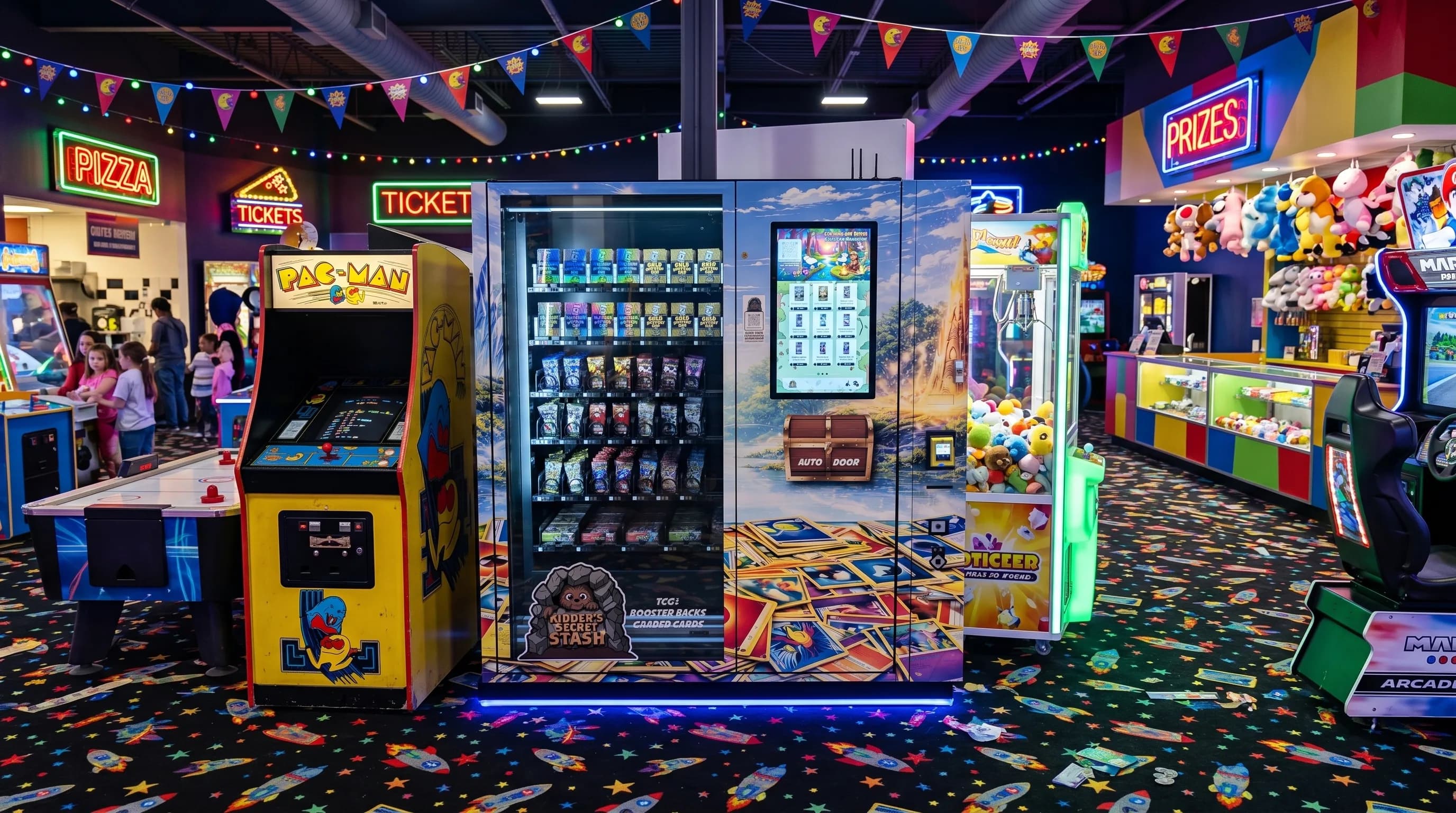
DMVI purchase financing: Subject to approval and not guaranteed; DMVI reserves the right to deny financing. A 25%–50% machine deposit is required depending on whether the machine is in stock, with the percentage specified in your quote. The remaining machine balance is paid in 12 monthly payments with 8% simple interest. All upfront costs are due at signing, including the wrap, optional topper, payment terminal, first-year software subscription, shipping, sales tax, and other quoted upfront charges. A UCC filing applies, and a personal guarantee may be required. See vending machine financing and your approved agreement for details.
TL;DR
For Pokémon TCG vending machines, elevator-style or hybrid dispensing mechanisms are strongly preferred over standard coil dispensing. Standard coils can crush or bend booster packs, cause corner damage on Elite Trainer Boxes (ETBs), and result in double-vends. Elevator mechanisms lift and lower items gently — essential for heavier products (ETBs, booster boxes, cases). DMVI machines use precision-engineered dispensing calibrated specifically for collectibles, not snacks.
Introduction
Most operators don't think about dispensing mechanisms until their first customer tweets a photo of a bent booster pack. By then, you've already absorbed a chargeback, a one-star review, and — worst of all — a lost repeat customer in a category where repeat buyers are everything.
The delivery system inside your vending machine is the single most important engineering decision for a TCG operation. It is the main reason you should not retrofit a snack machine for Pokémon cards, no matter how attractive that $1,200 used unit looks on Facebook Marketplace. Snack machines were engineered to dispense chips and candy bars — objects that can survive a six-inch drop onto hard plastic without consequence. A sealed Prismatic Evolutions booster pack, a Scarlet & Violet ETB, or a PSA-slabbed card cannot.
This guide breaks down how each dispensing mechanism works, where each fails, what a hybrid approach looks like in practice, and exactly what questions to ask when evaluating any machine for TCG use. Whether you are buying your first unit or scaling to multiple locations, understanding dispensing engineering will save you from the most common — and most expensive — mistake in this business.
Section 1: How Standard Coil Dispensing Works
Standard coil dispensing is the mechanism you see in nearly every snack and beverage machine manufactured over the past four decades. A motorized helical spring (the "coil") is mounted horizontally on a shelf. Products are loaded behind the coil, which rotates forward when a sale is triggered, pushing the frontmost item off the shelf edge. The item then falls freely into a collection bin at the bottom of the machine.
It is an elegantly simple design for its intended purpose. Fewer moving parts mean fewer service calls. Coils are cheap to replace and easy to calibrate for uniform products with predictable dimensions. For a bag of pretzels or a Kit Kat, the mechanism is essentially perfect.
For collectibles, it is a series of compounding failure points.
Drop impact. Product falls freely from shelf height — typically between six and eighteen inches depending on shelf position. A snack wrapper absorbs that impact. A booster pack does not. The cardboard printing plate inside a foil booster pack can shift, crease, or dimple on impact. An ETB dropped corner-first onto a hard plastic bin will show damage on the cardboard lid — exactly the kind of cosmetic flaw that triggers collector complaints.
Coil pitch mismatch. Standard coils are sized for snack products: typically 38–54mm pitch. A standard Pokémon booster pack measures approximately 22mm thick. Load a booster pack into a coil calibrated for a wider product and one of two things happens: the pack slides through without being properly gripped (causing double-vends, where two packs dispense for a single payment) or the coil clamps too tightly against the product during rotation (causing bend and crease damage along the pack's spine or corners).
Corner crushing on boxes and ETBs. The rotational force of a coil grips product at the corners and edges. Elite Trainer Boxes are particularly vulnerable — they are large enough to be significantly gripped by the coil but not rigid enough to resist the localized pressure. Corner denting on an ETB is not a minor cosmetic issue in the collector market. It directly affects perceived product value and triggers refund requests.
Verdict on coil dispensing for TCG: Marginally acceptable for individual booster packs in low-price-point machines where customers have been explicitly informed they are accepting potential cosmetic wear. Not acceptable for ETBs, booster boxes, cases, tins, graded slabs, or any product where condition is tied to resale value.
Section 2: How Elevator and Platform Dispensing Works
Elevator dispensing operates on an entirely different mechanical principle. Rather than pushing a product off a ledge, the elevator mechanism places the product on a platform or tray and then actively controls its descent to the retrieval area. The item is never in free fall. It is guided throughout the entire vend cycle.
This class of mechanism goes by several names depending on the manufacturer: platform vending, tray dispensing, robotic arm delivery, or carousel-and-lift systems in premium configurations. The core principle is the same: the machine does work to lower the product gently, rather than relying on gravity and a hard plastic landing zone.
Zero drop impact. Because the product is placed rather than dropped, there is no impact event. A PSA-graded slab, a sealed booster box, or a full case can be vended without any risk of impact damage. This is not a marginal improvement over coil — it is a categorical difference in product handling.
Accommodates irregular shapes and large dimensions. Coil machines have a rigid physical limit: the coil pitch and shelf height constrain both the width and height of anything that can be vended. Elevator mechanisms are not limited the same way. DMVI's M1, for example, is engineered to handle items up to 9"×9"×7" — a form factor that encompasses ETBs, booster boxes, tins, Funko Pops, Labubu plushies, mystery boxes, and even signed memorabilia. A standard coil machine physically cannot stock most of these products.
No coil pressure. Without a helical spring clamping against the product, there is no mechanism by which bending or corner damage is applied during the dispensing cycle. The product rests flat on its platform until delivery.
Handles heavy items reliably. A coil motor sized for 300g snack products will jam or underperform when asked to push a 1.2kg booster box. Elevator mechanisms are sized to carry load vertically, which means heavier products are handled within the mechanism's design envelope rather than at its stress limit.
Preferred product types: ETBs, booster boxes, full cases, tins, graded slabs, mystery boxes, designer plushies, signed memorabilia, collectible coins, Funko Pops — any product where dimensions, weight, or condition sensitivity exceeds what a coil machine was designed for.
Section 3: Hybrid Mechanisms — The Best of Both Worlds
The most practical TCG vending setup does not choose between coil and elevator — it uses both, each calibrated for the product category it handles best.
Modern purpose-built TCG machines like those in DMVI's TCG cabinet line-up combine precision-calibrated coil sections for individual packs with platform or elevator delivery for larger items. This hybrid approach solves a real business problem: booster packs are the highest-volume, highest-margin SKU in any TCG vending operation, and they benefit from the density and slot efficiency of coil dispensing — if that coil is engineered to the correct specifications.
Precision coil for booster packs. A coil calibrated to the exact diameter of a standard booster pack (~22mm) guides the pack through the vend cycle rather than gripping it with oversized spring pressure. When the pitch is correct, the pack exits the coil cleanly without being pinched or creased. This is not what you get from a converted snack machine. It requires coils manufactured specifically for the product.
Soft-floor delivery chute. The retrieval area in a purpose-built TCG machine uses a cushioned or low-drop delivery system to eliminate the final impact that standard machines handle with a hard plastic bin. Even a correctly coiled booster pack benefits from a controlled landing.
Dedicated elevator sections for oversized inventory. ETBs, booster boxes, and cases occupy dedicated shelf sections with elevator or platform delivery. The machine can hold a mix of SKUs — individual packs in coil slots, larger items in platform slots — allowing an operator to merchandise high-velocity packs and high-margin boxes from the same cabinet.
The result is a machine that can stock the full range of Pokémon product, from a single Scarlet & Violet booster pack to a full booster box, without making product condition trade-offs at any price tier.
Section 4: Failure Mode Comparison
| Mechanism | Card Protection | Best Use Case | Primary Risk | Best Fit |
|---|---|---|---|---|
| Standard coil | Simple, familiar dispensing | Low-cost general vending environments | Product catches, bends, or tumbles | Poor fit for premium TCG product |
| Elevator / platform | Controlled drop with better presentation | Packs, ETBs, boxes, and higher-value sealed product | Higher system cost than basic coil | Best fit for dedicated Pokémon vending |
| Hybrid system | Mixes controlled handling with broader slot flexibility | Operators wanting format flexibility across SKUs | Complexity if the implementation is weak | Strong fit when executed by a purpose-built TCG machine |
The table below maps common dispensing failure modes across machine types. This is the framework to use when evaluating any machine for TCG deployment.
| Failure Mode | Coil Machine | Elevator Machine | DMVI Hybrid |
|---|---|---|---|
| Booster pack bend / crease | Common | Rare | Rare |
| ETB corner damage | Very common | Rare | Rare |
| Double-vend (two products for one payment) | Occasional | Very rare | Very rare |
| Jam (product stuck mid-dispense) | Occasional | Occasional | Rare |
| Item too large to vend | Common (rigid limit) | Rare (flexible) | Rare |
| Graded slab damage | Extremely common | Rare | Rare |
Stat callout: A single chargeback on a $12 booster pack wipe out the margin on four to five clean transactions at standard vend pricing. In a high-volume TCG machine generating $8,000–$12,000/month, even a 1% damage-and-dispute rate represents $80–$120 in direct monthly losses — before accounting for the repeat-customer revenue that doesn't happen after a bad experience.
Double-vending deserves special attention because it is both a mechanical failure and a financial one. When a second product dispenses without payment, you lose margin on that unit. In a machine stocking $8–$12 booster packs, a handful of double-vends per week compounds quickly. The root cause in coil machines is almost always coil pitch mismatch — a problem that does not occur in a coil sized for the specific product being vended.
Section 5: Why Dispensing Mechanism Directly Affects Customer Trust
In most vending categories, customers have a low bar for product condition. A slightly warm bottle of water or a bag of chips with a minor crease is acceptable. In the collector market, condition is the product. A cosmetically damaged booster pack triggers the same emotional response as a damaged slab — and in a category built on repeat buyers who visit weekly, that response has long-term revenue consequences.
A bent corner on an ETB generates a chargeback. A creased booster pack becomes a social media post. In the TCG community, word travels fast in Discord servers, Reddit threads, and local card shop networks. One bad dispense experience — documented and shared — can follow a machine's location for months and suppress new customer acquisition.
The operators running the highest-revenue DMVI machines understand this dynamic intuitively. They know that a $21,995 purpose-built machine with precision dispensing is not just a capital expenditure — it is a customer retention investment. The machine's job is not just to process transactions; it is to deliver product in the same condition it arrived from the distributor.
DMVI machines are engineered specifically for collectibles. Every dispensing component — coil pitch, platform design, delivery chute — is calibrated for sealed TCG product, not food. This is why a purpose-built TCG machine commands a premium over a retrofitted snack machine, and why that premium pays back in lower dispute rates, higher repeat visit frequency, and the ability to stock and sell the higher-margin, larger-format products that generate the most revenue.
Section 6: What to Look For When Evaluating a Machine
Use this checklist when assessing any vending machine for Pokémon or TCG deployment. Ask every vendor these questions before you commit capital.
Dispensing mechanism questions:
- Does the machine have a drop-free or soft-floor delivery mechanism for large items (ETBs, booster boxes, cases)? If the answer is "the product falls into a bin," that machine was not designed for collectibles.
- Are the coil pitches calibrated specifically for booster pack dimensions (~22mm)? Ask for the spec sheet. A vendor selling a converted snack machine will not have this documentation.
- Is the retrieval chute padded or cushioned? Ask to see it physically or on video before purchasing.
- Can the machine handle items of varying dimensions — from a single booster pack to a full booster box — without hardware reconfiguration between restocks?
- Does the manufacturer have documented field experience with TCG product specifically? Case studies, operator testimonials, and real-world footage of TCG product dispensing are reasonable asks.
- Is technical support available for mechanism adjustments and calibration post-installation? Dispensing precision can drift over time and needs to be re-calibrated; know who does this and at what cost.
- What is the warranty coverage on the dispensing mechanism specifically? This is separate from the general machine warranty and is where most TCG-related mechanical failures occur.
For additional guidance on choosing the right machine format for your location and inventory mix, see the Pokémon vending machine format guide and the full breakdown at how to start a Pokémon vending machine business.
Section 7: New vs. Retrofitted Machines — The Real Cost Comparison
The retrofitted snack machine pitch is common in TCG vending communities: find a used machine for $1,000–$2,000, swap in new coils, and you have a card vending machine for a fraction of the cost of a purpose-built unit. The math sounds compelling until you run the actual numbers.
The hidden cost structure of a retrofit:
- Used snack machine: $1,000–$2,000
- Refurbishment and coil replacement: $500–$1,000
- Coils will still be the wrong pitch for booster packs (standard snack coil pitch is 38–54mm; booster pack requires ~22mm)
- Hard plastic retrieval bin — no soft-floor delivery, no drop mitigation
- No elevator or platform mechanism for ETBs and larger items
- Product damage and customer disputes: ongoing, unquantifiable at purchase
Compare a retrofit's purchase price, modifications, product damage, chargebacks, and downtime with a purpose-built DMVI wall-mounted unit at $4,995. Financing, if approved, requires a deposit and all signing costs; use the full quote and operating budget rather than a headline monthly figure.
A purpose-built DMVI machine also comes with cloud management via VendingTracker.com, a branded touchscreen UI, cashless payment processing (tap, swipe, chip), California-based technical support, and remote diagnostics. A retrofitted used machine comes with none of these, and the operator absorbs every service call, every jam, and every damaged-product dispute personally.
The decision looks different when you price the full operational cost of each option rather than just the hardware purchase price. For a deeper look at this comparison, see the full analysis at new vs. used Pokémon vending machine.
Ready to See TCG-Purpose Dispensing in Action?
The dispensing mechanism is not a feature footnote. It is the operational foundation of your TCG vending business — determining which products you can sell, what condition they arrive in, and whether customers come back.
DMVI builds the only vending machines purpose-engineered for the collectibles and TCG category from the ground up. Every dispensing component is calibrated for sealed TCG product. Every machine ships with cloud management, cashless payment, and California-based technical support.
If you are serious about running a TCG vending operation that holds up to daily volume, explore DMVI's Pokémon vending machines for sale and request a quote for the format that fits your location.
Call DMVI: +1-800-490-1108
Want pricing, format guidance, or a launch plan?
DMVI can help you compare Pokemon vending machine formats, rollout strategy, financing, and location fit based on your route goals.