Vending Machine Permits, Regulations, and Compliance: An Operator Checklist
Vending machine compliance is the operating discipline of meeting licensing, health-department, accessibility, age-restriction, food-safety, and payment-security obligations everywhere an operator places equipment. Requirements vary by jurisdiction, product type, and venue. This page is an operational checklist, not legal advice, and operators should confirm binding requirements with qualified counsel and the relevant local, state, and federal authorities before deploying.
The useful mindset is to treat compliance as portfolio infrastructure rather than as a last-minute admin chore. A machine can be commercially attractive and still be non-viable if the permit stack, accessibility requirements, payment scope, or age-restriction controls were treated as somebody else’s problem.
Business licensing and vendor permits
Most U.S. jurisdictions require a general business license plus a vendor permit, vending registration, or similar authorization tied to the places where machines are actually operated. Some states also require sales-tax registration and, in certain cases, per-machine decals or location-specific filings. The practical headache is not usually any single filing; it is managing multiple renewal dates across multiple jurisdictions without letting something lapse quietly.
Operators scaling across counties or states should keep a portfolio-level register covering entity license status, local vending permits, tax registrations, renewal dates, and placement-specific obligations. That is dull paperwork, yes, but dull paperwork is often what separates a stable route from an avoidable enforcement letter.
Health-department requirements for food and beverage cabinets
Machines dispensing food, drinks, or perishable products usually sit under local health-department oversight. Shelf-stable snacks tend to face lighter scrutiny than refrigerated food, fresh meals, or other higher-risk categories. Once the machine crosses into cold-chain, prepared food, or temperature-sensitive dispensing, the operator may face plan review, temperature logging, expiry controls, sanitation procedures, and local inspection requirements.
Fresh-food operators should request written guidance from the local health department before placement rather than assuming the previous operator’s approval, the venue’s confidence, or a sales rep’s optimism will somehow count as compliance documentation. It will not.
ADA and accessibility requirements
Vending machines placed in public-accommodation environments need to be evaluated for ADA accessibility. That includes clear floor space in front of the cabinet, reachable operable parts such as controls and payment hardware, and increasingly the accessibility of touchscreen interfaces themselves. Placement matters as much as cabinet specification because a theoretically compliant machine can become non-compliant once it is boxed in by bad site planning.
Operators should address cabinet height, mounting position, payment-terminal reach, and approach clearance during procurement and site design rather than after the machine is live. Accessibility retrofits are usually more expensive and more awkward than simply getting it right first time.
Age-restricted products need explicit compliance architecture
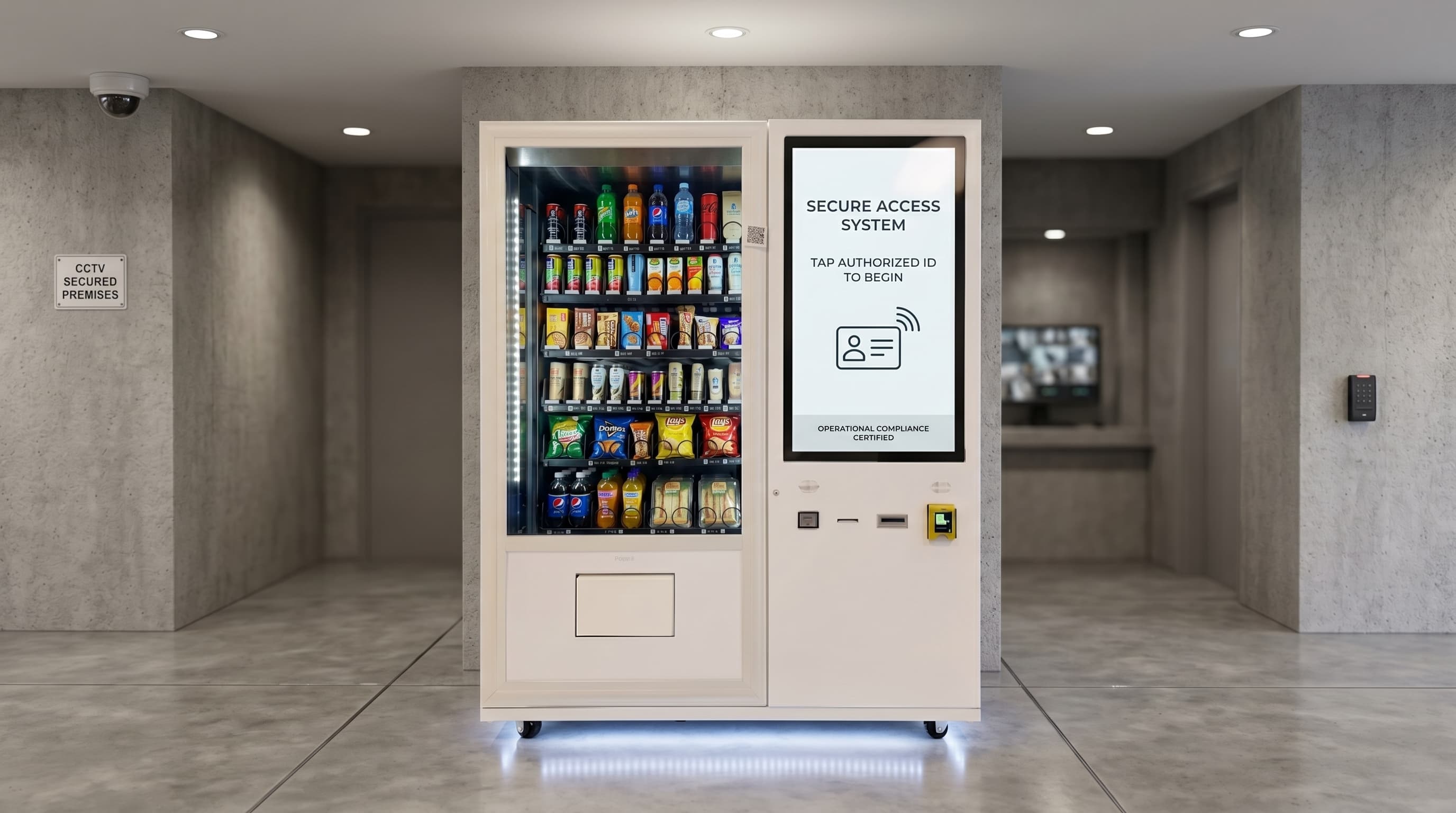
Alcohol, tobacco, vape, CBD, and certain pharmacy-adjacent products create a stricter compliance envelope. Federal age rules, state licensing, local restrictions, venue permissions, and operational controls all stack together. If the cabinet dispenses age-gated products, the age-verification workflow cannot be treated as a decorative add-on.
That means documented licensing review before deployment, a verified ID-check process at the dispense path where required, event logging for passes and failures, and a clear exception-handling process for disputes, overrides, and service scenarios. The hardware can be elegant and the interface can be lovely, but if the licensing path is wrong, the cabinet is still dead on arrival.
Payment, data, and network security
Cashless vending places the operator inside a payment-security and privacy framework whether they like it or not. Machines using EMV, NFC, and mobile-wallet payments typically rely on certified processors that reduce the operator’s direct PCI burden, but they do not remove the need to confirm inherited scope, secure the cabinet’s network path, and document the handling of any customer data collected through the interface.
If the machine also captures loyalty enrollments, surveys, age-verification data, or other identifiable information, privacy obligations may extend beyond payment compliance into state consumer-data rules. Operators should know exactly what data is collected, where it flows, who stores it, and how long it is retained.
FDA menu labeling and food disclosure rules
Operators with 20 or more covered vending machines may be subject to FDA calorie-disclosure requirements for food items sold through those machines. The rule focuses on the operator rather than a single cabinet and allows disclosures on packaging, adjacent signage, or electronic displays visible during the buying process. Operators below the threshold may still face state-level or venue-level disclosure expectations depending on the deployment.
The right move is to confirm current rule scope and format requirements before rollout rather than discovering after launch that the cabinet experience does not present information in a compliant way.
Compliance is a portfolio discipline
The common failure mode is treating each machine as an isolated project. In reality, compliance needs a portfolio view: licensing register, renewal calendar, health-department contacts, ADA placement review, payment-scope confirmation, age-verification process documentation, and food-labeling status where relevant. Every time the product mix, jurisdiction, or venue changes, the compliance envelope may change with it.
Operators who build that discipline early are far less likely to end up firefighting preventable issues later.
Planning a regulated or compliance-sensitive vending deployment?
DMVI helps operators scope machine format, payment flow, age-verification architecture, and deployment fit before compliance surprises become expensive ones.