
Office Supplies AI Cabinet — Badge Access, Computer-Vision Tracking, Real Audit Trail
Enterprise-grade controlled-access cabinet for office supplies, IT consumables, PPE, and internal inventory. Badge or barcode entry, AI item tracking, ERP-ready reporting.
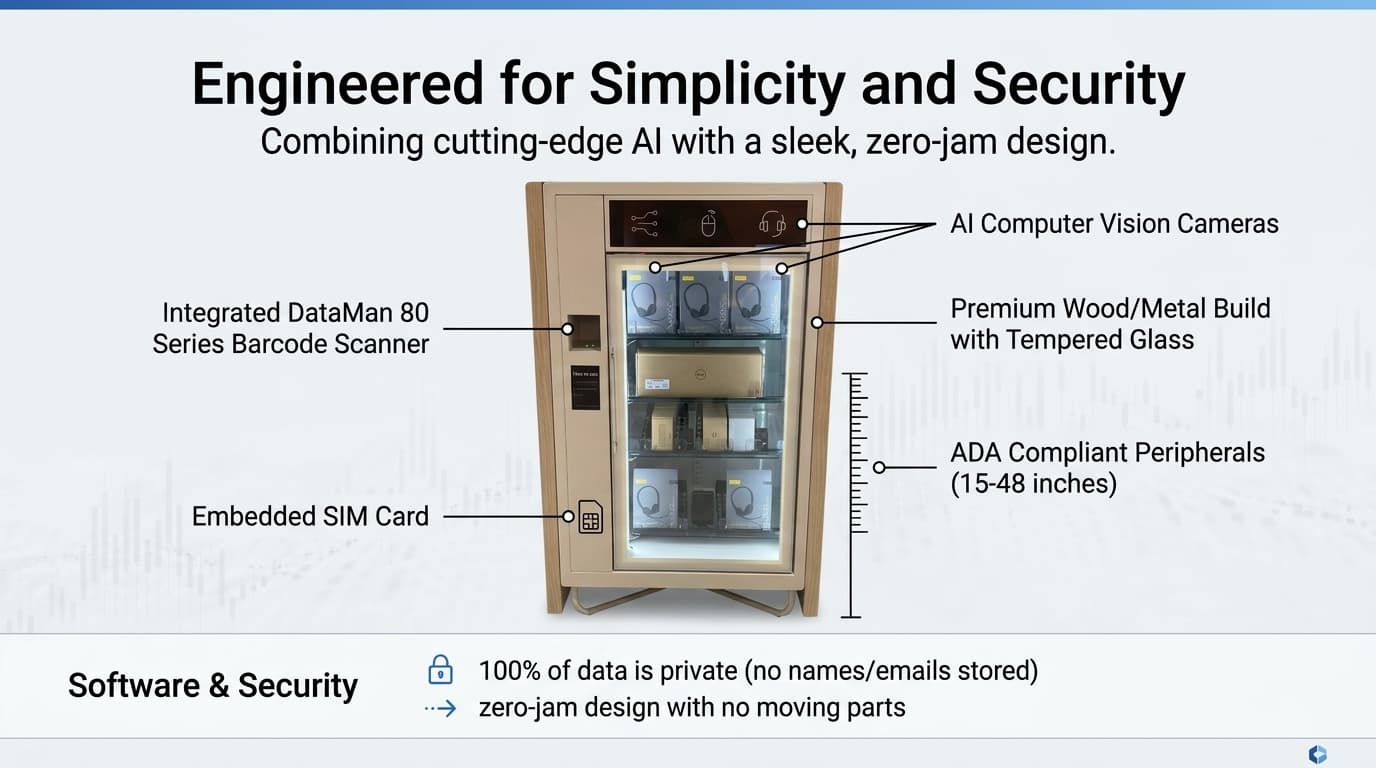
An office supplies AI cabinet is a controlled-access enterprise vending cabinet that uses badge or barcode authentication to unlock, computer-vision and weight-based item tracking to record what was taken, and cloud reporting to feed the result into the company's inventory or ERP system. DMVI's office supplies AI cabinet replaces the open-shelf supply closet with a real audit trail without adding another approval workflow on top of the employee — the cabinet opens, the item leaves, the system reconciles.
The hardware is built on the same controlled-access platform highlighted on NBC Nightly News for retail shrink reduction in 2023, and it is well aligned with the broader enterprise loss-prevention concerns documented in the 2025 NRF retail theft survey.
ENTERPRISE AI INVENTORY CONTROL
What an AI Cabinet Replaces
An office supplies AI cabinet replaces three things at once:
The open-shelf supply closet that nobody actually inventories until the auditor shows up.
The locked supply closet with a single key, a sign-out sheet, and a manager bottleneck.
The shadow inventory of office supplies, IT consumables, PPE, and internal tooling sitting in desk drawers and warehouse corners across the company.
SCOPED AROUND THE REAL WORKFLOW
How the Cabinet Actually Works
Badge or barcode access
Employee taps a badge or scans a barcode. Cabinet unlocks for that user only.
Computer-vision item tracking
Cameras and weight sensors record which item was taken, by whom, and at what time.
Cloud reporting
The cabinet reports the transaction to a dashboard procurement, ops, and IT teams can audit.
ERP and inventory integration
APIs feed the company's existing inventory, ERP, or asset-management system instead of creating a fourth silo.
Cashless and contactless payment optional
For chargeback-to-department or bill-back scenarios, MDB-bus payment hardware is supported alongside modern vending payment and telemetry stacks such as Nayax where the rollout needs them.
Scope an AI Cabinet Around the Real Workflow
Cabinet format, access method, and reporting flow should be set by the actual workflow, not by a generic spec sheet. DMVI scopes the deployment against the SKU list, badge system, IT integration constraints, and rollout footprint before quoting. A 5-cabinet pilot in one campus and a 200-cabinet rollout across a national footprint are different programs with different economics.
Office Supplies AI Cabinet FAQs
An office supplies AI cabinet is a controlled-access enterprise vending cabinet that uses badge or barcode authentication to unlock, computer-vision and weight-based item tracking to record what was taken, and cloud reporting to feed the result into the company's inventory or ERP system. It replaces the open-shelf supply closet with a real audit trail.
A standard office supply vending machine dispenses an item after a coin or card payment. An office supplies AI cabinet authenticates the user with a badge, opens the door, and uses computer vision and weight sensors to record exactly which items were removed, by whom, at what time. The audit trail is the actual product.
Yes. DMVI office supplies AI cabinets expose APIs for ERP, inventory, and asset-management integrations, so transactions flow into the system the company already runs rather than living in a fourth silo. Computer-vision events, badge IDs, item SKUs, and timestamps are available for procurement, ops, IT, and audit teams.
Office consumables (paper, toner, batteries, pens), IT consumables (cables, dongles, peripherals, replacement chargers), PPE (gloves, safety glasses, masks), and internal tooling (test equipment, calibration kits) all fit an office supplies AI cabinet. The cabinet format, tray geometry, and locking are matched to the item set during scoping.
Badge-based access uses the company's existing access-control credential — an RFID badge, mobile credential, or barcode — to authenticate the user. The cabinet unlocks only for that user, the computer-vision system records the items taken, and the transaction is written to the cloud dashboard with the user ID, timestamp, and SKU list.