
Vending Machine Financials: Cost Structure, Revenue Projection, and Break-Even for Operators
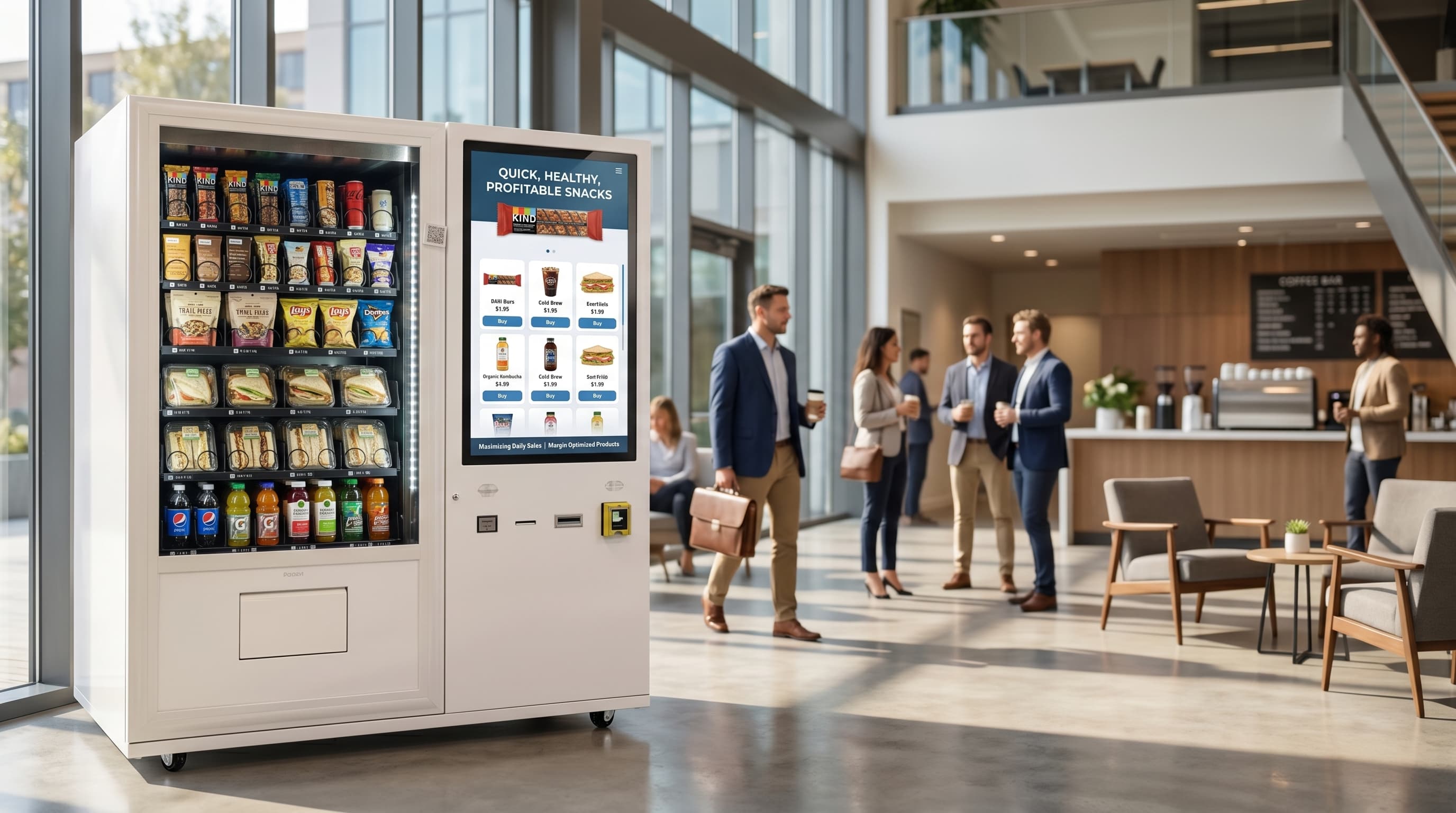
Vending machine financials is the operator discipline of modeling product cost, service cost, equipment cost, venue commission, and revenue together before capital is committed. The maths is not exotic. The trouble is that new operators often overestimate velocity, underestimate route cost, or both. A working model forces the placement to survive contact with reality before the machine is ordered.
This page is informational only and is not financial, accounting, tax, or investment advice. Actual results vary by location quality, product mix, route density, capital structure, and operating discipline. Serious operators should use qualified accounting and tax advice when they are making capital-deployment decisions.
The cost structure of a vending machine business
A vending machine business runs on five recurring cost groups that interact with one another.
- Cost of goods sold. Standard snacks and beverages often land in the 40–50% gross-margin range at retail pricing, while specialty categories can sit higher or lower depending on the product, packaging, and spoilage profile.
- Route service cost. Driver time, vehicle expense, fuel, warehouse handling, and the lost productivity of covering isolated sites are often the most underestimated costs in the model.
- Equipment cost. Depreciation, financing, lease cost, and maintenance reserves all belong in the model rather than being treated as background noise.
- Cashless processing. Card and mobile-wallet acceptance improves conversion, but it also introduces per-transaction fees that matter sharply on low-ticket sales.
- Venue commission. Some placements carry no commission at all. Others run on a percentage of gross revenue or gross profit, especially in higher-leverage hospitality, office, or premium-retail environments.
If the model ignores one of those five groups, it is not really a financial model. It is wishful arithmetic in a blazer.
Revenue projection: build the model from likely behavior, not headline traffic
Gross revenue is daily transactions multiplied by average ticket multiplied by operating days. The weak version of the model starts with foot traffic because it sounds large. The better version starts with the captive audience, the buying occasion, and the realistic purchase rate for that environment.
A workplace with 80 reliably present staff might produce 10 to 20 daily transactions if the offer is aligned and nearby alternatives are weak. A captive industrial site can outperform that. A glamorous site with plenty of passing traffic but no real purchase mission can underperform it badly. The same logic applies to specialty formats: a premium cabinet may produce fewer transactions than a snack machine but still generate stronger gross revenue because the average ticket is far higher.
Break-even is the question that matters
Break-even is more useful than asking what a vending machine can make because it forces the operator to work backwards from the real monthly burden. The question is not whether a machine can sell. It is whether contribution margin can cover service cost, processing, venue economics, equipment cost, and allocated overhead soon enough to justify the placement.
If a machine costs $8,000 and the operator wants that capital recovered within 24 months, the machine needs to produce roughly $333 per month in net contribution after operating costs. That target then tells you how much velocity the location must support. If the site cannot plausibly support the volume, the right answer is not motivational thinking. It is a different site, a different format, or a different commercial model.
For projects involving higher-spec cabinets or bespoke retail concepts, the custom vending machine design costs page is the right companion read because format and configuration change the full economic picture.
Route economics decide whether the portfolio works at scale
Once a business grows beyond a handful of cabinets, route economics become the difference between a nice-looking topline and a commercial operation. Geographic density is the key lever. A driver covering five scattered cabinets across a large radius costs dramatically more per cabinet than a driver servicing twenty cabinets in a tight cluster.
That is why every new placement should be evaluated against the live route footprint rather than in isolation. A decent site that fits an existing route can be more valuable than a stronger site that forces a new service pattern. Connected telemetry from smart vending machines also changes the model, because the operator can restock and troubleshoot based on real machine data instead of blanket service visits.
Cash flow and working capital are where growth gets ambushed
Vending is often cash-flow-positive once the route is established, but it is still capital-intensive to build. Inventory is paid for before it is sold. Hardware is paid for before the route is proven. Repairs and service events never ask whether the spreadsheet feels emotionally prepared.
Operators who expand too quickly often discover that a growing route can outrun working capital faster than it grows profit. The practical model should account for inventory on hand, stock sitting in cabinets, processing-settlement timing, maintenance reserves, and the fact that not every new machine becomes a star immediately.
The KPIs that actually matter
A useful vending dashboard tracks more than gross revenue. Five measures matter most:
- SKU velocity: units sold per SKU per week per machine.
- Planogram turn rate: how quickly the cabinet works through its full assortment.
- Cashless adoption: the share of sales moving through card and mobile-wallet acceptance.
- Average ticket: gross revenue divided by transaction count.
- Service cost per machine: route labour, fuel, and overhead divided across the live cabinet base.
Operators who manage those five numbers make better decisions about pricing, assortment, site retention, and route expansion than operators who stare only at topline sales.
Pressure-testing the economics of a vending deployment?
DMVI can help evaluate cabinet format, product mix, route logic, and the commercial assumptions that decide whether a vending project actually works in the real world.